Three pages, three answers. One tells you to copy Alpari traders through ZuluTrade, one talks about PAMM, and one names something called CopyTrade — and the ZuluTrade page was accurate when it was written, more than a decade ago. If you would rather put your capital behind someone with a live record than build your own setups, you need the route that exists now, not the archived one.
Here is what Alpari copy trading actually looks like today: what the product is, where your money sits while it runs, what it costs, how to judge the person you are about to follow, and a direct answer on Brazil.
Key Takeaways
Alpari's current copy-trading product is Alpari CopyTrade, built on MetaTrader's signal-subscription system — the ZuluTrade partnership ended over a decade ago and those accounts were converted to standard MT4.
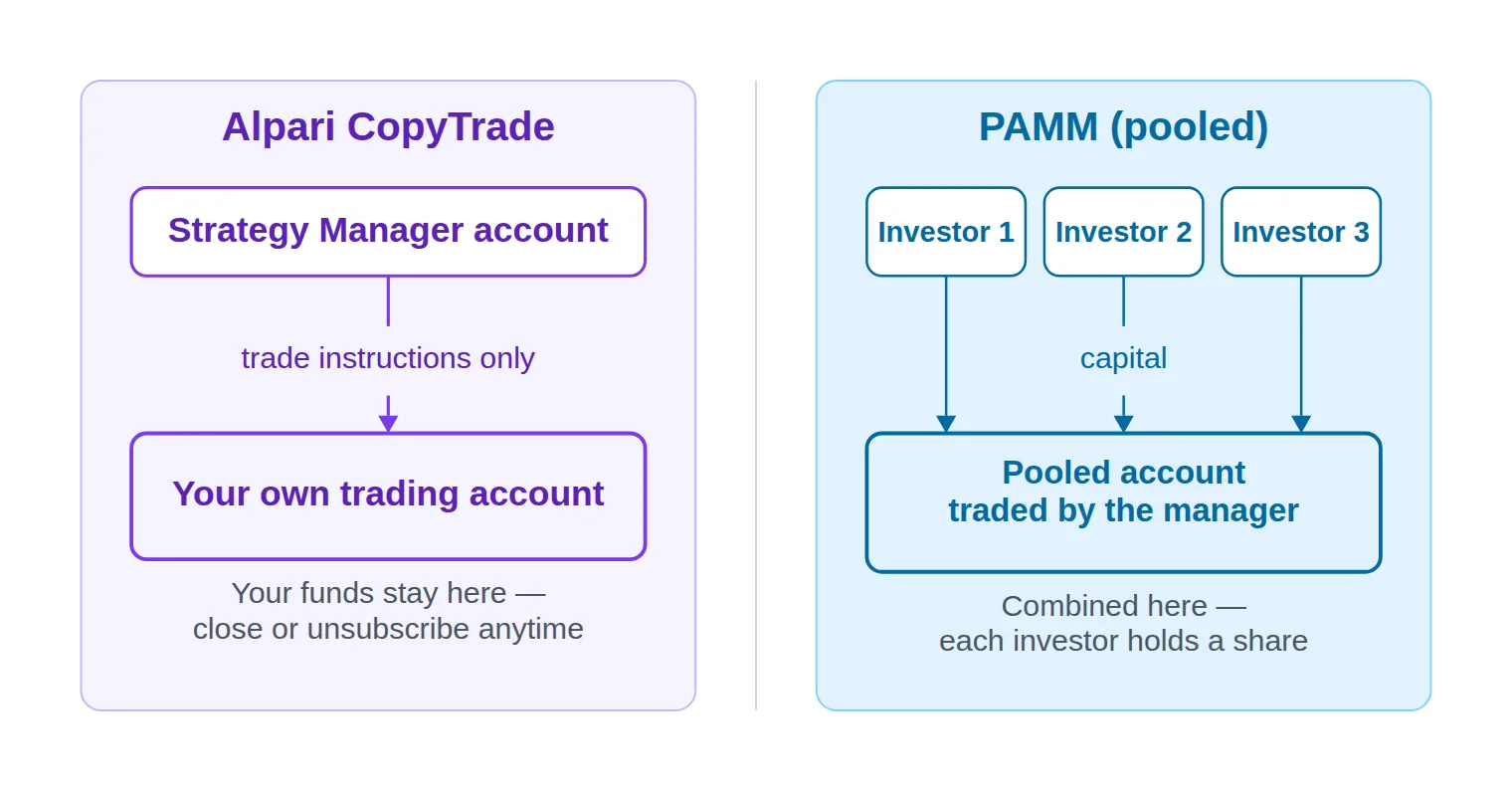
Your capital never leaves your own trading account: only trade instructions cross from the Strategy Manager, scaled to your equity — which is what separates CopyTrade from a pooled PAMM account.
Copying costs three layers, not one: the manager's subscription and/or profit share, ordinary spread and swap on every copied trade, and slippage between their fill and yours.
Brazil is not on Alpari's published restricted-country list, so Brazilian residents can ordinarily subscribe — but they onboard to an international entity rather than a locally regulated broker, and that list can change.
Table of Contents (17 min read)Contents
What Alpari Copy Trading Actually Is
Alpari's copy-trading service is called Alpari CopyTrade, and it is not a separate website you log into. It runs on MetaTrader's built-in signal-subscription system: an experienced trader — Alpari calls them a Strategy Manager — publishes their live account as a subscribable signal, and every trade that account takes is replicated onto the accounts of the people subscribed to it.
That makes it copy trading in the strict sense. Positions are mirrored automatically, without you approving anything, which is different from social trading, where you watch other traders' ideas in a feed and still decide for yourself. There is no feed here, no comment thread, no "like" button. A position opens on the manager's account, and moments later an equivalent position opens on yours.
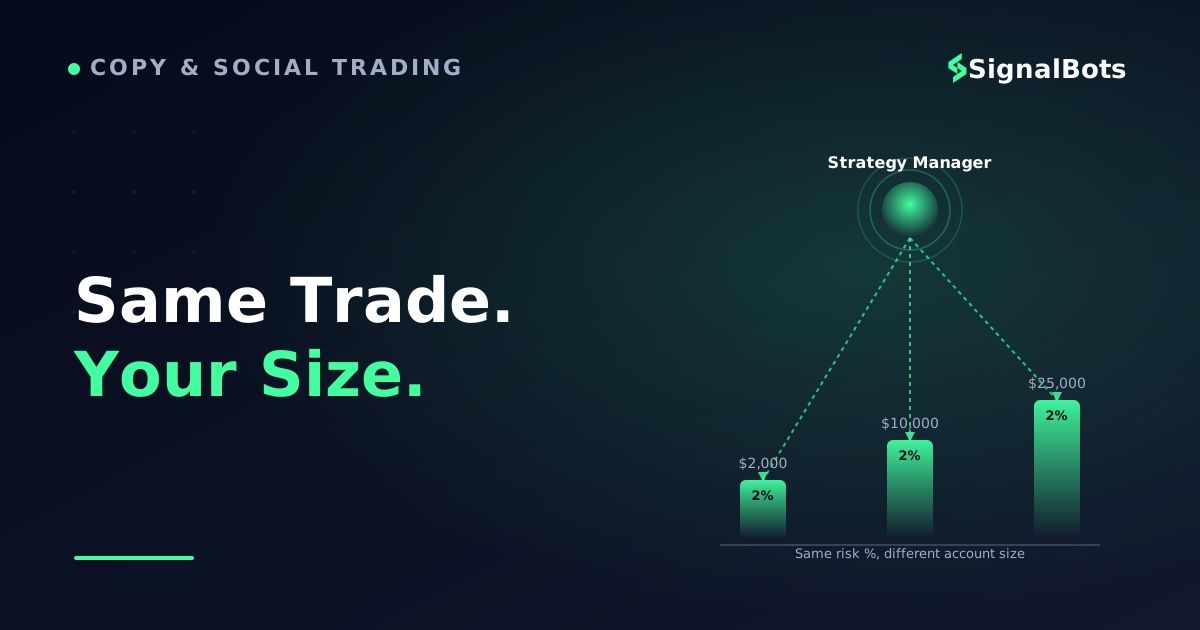
"Equivalent" is doing real work in that sentence. Your balance is not the manager's balance, so the trade is not copied at the same size — it is scaled. That mechanism is called proportional copying, and it is the single thing most new subscribers misunderstand: the manager risks a share of their own equity, and the copy engine translates that into the same share of yours.
The core mechanism
One manager's trade, scaled onto three different accounts
Strategy Manager accountBUY EUR/USD — 2% of equity — 1.00 lot on $50,000
Mirrored to each subscriber's account
Subscriber A — $2,0000.04 lot — same 2% of equity
Subscriber B — $10,0000.20 lot — same 2% of equity
Subscriber C — $25,0000.50 lot — same 2% of equity
Illustrative example: the copied trade keeps the manager's risk percentage, not their lot size.
You inherit the manager's risk proportions, not their position size — which is why a small account and a large one can follow the same trader.
Does Alpari Still Use ZuluTrade?
No, and it has not for over a decade.
The two were genuinely partnered once, which is why the pairing still shows up in older reviews and forum threads. Alpari announced the end of ZuluTrade support in 2013: accounts carrying the zulutrade suffix were converted to standard MT4 accounts, the authorisation that let ZuluTrade send trading instructions to those accounts was withdrawn, and clients were told to close any open ZuluTrade positions before the cutoff rather than expect them to be closed for them.
So if you searched zulutrade alpari and landed on a step-by-step guide to linking the two, you found a page that was correct in its day and has simply aged out. ZuluTrade still exists and still works with other brokers — it is just no longer a door into Alpari. Everything current runs through MetaTrader's own signal system instead.
How Alpari CopyTrade Actually Works
A Strategy Manager applies through their myAlpari area to publish their live trading account. Once it is approved, that account appears in the signals directory with its trading history attached, and anyone browsing can subscribe to it. From that moment your terminal listens to their account: when they open, modify or close a position, the same instruction is applied to yours at your scaled size.
Because the plumbing belongs to MetaTrader rather than to a third-party website, two consequences follow that are easy to miss:
Only what the manager trades inside MetaTrader gets copied. Anything they do on a different product or platform is invisible to the copy engine.
Your account keeps its own rules. Your leverage, your account currency, your margin and your stop-out level all still apply — and they may differ from the manager's, which is why the same trade can be comfortable on their account and tight on yours.
Where Your Money Sits — Your Account, Not the Manager's
This is the detail that separates CopyTrade from the product most people confuse it with. Under CopyTrade, your funds never leave your own trading account. The Strategy Manager receives no transfer, no deposit and no custody of your capital; what travels between the two accounts is trade instructions, nothing else. You can close a copied position yourself, or unsubscribe, whenever you want.
That is the opposite of a PAMM account, Alpari's separate pooled-investment product, where investors' capital is combined into one account that the manager trades as a single pot and each investor holds a share of the result. Same broker, same idea of "follow a better trader", completely different place for your money to sit.
CopyTrade sends instructions between accounts; a pooled PAMM structure moves the capital itself.
What Copying Actually Costs You
Three separate layers of cost stack up on a copied trade, and most write-ups only mention the first one.
The manager's compensation. A signal can carry a subscription price for a fixed period, a share of the profit it produces, or both. The profit share — a performance fee — is charged on gains, so a flat month costs you the subscription but not the share.
Ordinary trading costs. Copied trades are real trades on your live account, so every one of them pays the spread, any commission on your account type, and swap if it is held overnight. Ten copied trades a day cost you ten round turns, whatever the manager's own cost structure looks like.
Execution difference. Your order is sent after theirs, so your fill can differ. On fast news candles that gap — slippage — is exactly where a copied result drifts away from the published one.
Fee levels change and vary per manager, so read the price attached to the specific signal before you subscribe rather than trusting any figure quoted in a review, including a recent one.
The Official Route vs. Third-Party Copy Tools
Search copy trade alpari and you will not only find Alpari's own service. Independent cross-broker copiers also rank for it — small tools that connect one MetaTrader account to another and can copy any broker's account, Alpari included. They are a legitimate category, and they solve a problem CopyTrade does not: copying a trader who is not on your broker at all.
They also change who holds the keys. A copier normally needs your account credentials, and the distinction between an investor password and a master password becomes the whole security question — read-only access can watch an account, trading access can move it. Know which one a tool is asking for, and who is behind the tool, before it touches a funded account.
Runs inside MetaTrader's own signal system — no external site holds your login
Managers are vetted and published by the broker, with their trading history attached
Costs are declared up front on each signal's page
Limited to Strategy Managers who publish on Alpari
The default route if the trader you want to follow is already on Alpari.
VS
Third-party cross-broker copier
Can copy an account held at a different broker onto your Alpari account
Usually needs your MetaTrader credentials — check whether it asks for trading access
Adds a second party between the source account and your fills
Quality, uptime and accountability vary widely between providers
Worth it only when the source account cannot be followed any other way.
Same outcome on the chart, very different trust model behind it.
How to Start Copy Trading on Alpari, Step by Step
Setup
From a new account to a live copied position
1
Register and verify myAlpari
Open the client area and complete identity verification — an unverified account cannot fund or subscribe.
2
Open and fund the right account type
Copying happens on a live MetaTrader account. Match the account type the signal you want is published on.
3
Browse the signals directory
Filter the published Strategy Managers by the things you can verify: age of the record, drawdown, and how they trade.
4
Read the history, not the headline
Open the manager's full trade record and check how the curve was actually built before you commit anything.
5
Subscribe and set your copy size
Choose how much of your equity the copy engine may use, then set your own ceiling on risk per copied trade.
6
Monitor and keep an exit ready
Copied trades are yours to close. Review the manager weekly and unsubscribe if their behaviour changes.
The whole flow lives in two places: the myAlpari client area and your MetaTrader terminal.
Two of those steps deserve more than one line. Funding is where account-type mismatches bite: a signal published on one account type cannot be copied onto an incompatible one, and a minimum deposit applies before anything can be subscribed — check the current figure in the client area rather than relying on a number from a review.
Sizing is the step where subscribers most often over-commit. The copy engine will happily scale a manager's aggression onto your balance, so decide the exposure you are willing to carry before you subscribe, not after the first drawdown. If you are unsure what that means in lots on your account, work it out on the forex position-size calculator first.
How Do You Choose a Strategy Manager to Follow?
The directory hands you names and equity curves. Neither tells you whether a trader survives the next bad month. What tells you more:
Length of the live record. A verified track record built over years across different market conditions carries information; a spectacular two-month curve mostly carries luck.
Historical win rate read next to average win and average loss. A high strike rate paired with losses far larger than the wins is a losing system wearing a flattering number.
Maximum drawdown, and how long it lasted. This is the real question — not "how much did they make" but "how deep was the hole, and would I have stayed subscribed through it?"
Trade frequency and holding time. A manager who takes dozens of trades a day multiplies your spread and commission bill; one who holds for weeks hands you swap charges instead.
How the curve was built. Rising lot sizes after losses, no visible stop losses, and a suspiciously smooth equity line together point at martingale-style recovery — a pattern that looks flawless right up to the trade that ends the account.
Every figure in a directory is a historical result on someone else's account under conditions that will not repeat exactly. Read them with that framing, and read the full risk warning before you treat any of them as a forecast.
Pre-subscribe check
Vet a Strategy Manager before you subscribe
0 / 8
The live record spans multiple market conditions, not one good quarter
Average win is at least comparable to average loss, not dwarfed by it
Maximum drawdown is a number I could actually sit through without unsubscribing
Position sizes stay stable after losing trades instead of doubling up
Individual trades show stop losses rather than open-ended recovery holds
Trade frequency matches what my spread and commission costs can absorb
The instruments traded are ones my account type can actually copy
I have set my own risk ceiling in the terminal, independent of the manager's
★
Checklist complete — you’re cleared to proceed.
Tick all eight before you fund the subscription — any unticked line is a question worth answering first.
The Risks You Take On When You Copy Someone
Copy trading removes the work of finding trades. It does not remove the risk of taking them, and it adds a few risks of its own.
The manager owes you nothing. They are not managing your account and are not liable for your losses; they trade their own and are compensated when it goes well. If they change instrument, raise risk or stop trading entirely, no one is obliged to tell you first.
Your account can break before theirs does. Different balance, different leverage, different open positions elsewhere — a drawdown the manager absorbs comfortably can put your account near a margin call, because proportional copying matches their risk percentage, not their cushion.
Costs run even when performance does not. Subscription fees and trading costs keep accruing through a flat period, so a strategy that merely breaks even at the manager's account can end the month slightly negative at yours.
Dependency is the quiet one. Following removes the need to understand why a trade was taken, which is fine until the day you have to judge whether a losing streak is normal variance or a broken strategy — and you have no basis to tell the difference.
The directory shows what already happened, not what will.
Is Alpari Copy Trading Available in Brazil?
Brazilian traders searching for alpari copy trading want a straight yes or no, so here it is: Alpari's own published list of countries it does not serve does not include Brazil. That list names markets such as the United States, Canada, Japan, the United Kingdom and the European Union, among others — Brazil is not on it, so Brazilian residents are ordinarily able to open an account and use CopyTrade.
Two qualifications matter more than the yes.
First, being accepted is not the same as being locally regulated. A Brazilian client onboards to an international Alpari entity, not to a broker authorised by Brazil's own securities regulator, so the local supervisory and compensation routes you would have with a domestically licensed firm do not apply. Check which entity's client agreement you are signing and what it says about dispute resolution before you fund anything.
Second, restricted-country lists change. They are updated as licensing arrangements shift, and a list that excludes Brazil today is not a promise about next year. Read the current version on the broker's own site at the moment you register rather than trusting any third-party page, this one included.
Copying a Manager vs. Trading the Signals Yourself
Alpari also publishes conventional trading signals — analyst-produced trade ideas you read and act on manually. It is worth being clear that this is a different product from CopyTrade, because the two get blurred constantly. A trading signal is information: entry, stop, target, delivered to you to execute or ignore. CopyTrade is execution: someone else's decisions become live positions on your account whether you were watching or not.
The trade-off is control against attention. Copying suits someone who cannot watch the market during their session and accepts a stranger's judgement in exchange. Acting on signals yourself keeps every decision — and every skipped trade — in your hands, at the cost of needing to be there. Neither is the beginner option; they simply fail differently.
See the Full Signal Before You Trust a Track Record
There is a moment in the process above where you are asked to trust a number: the manager's curve looks convincing, and you are about to let it move real money without ever seeing an individual trade broken down. It is worth knowing what a fully specified trade actually looks like before that.
That is what our free forex live signals feed shows — each signal published with its entry, stop-loss and take-profit levels visible in real time, so you can watch how a call is structured, where the risk is defined, and how it resolves. Use it as a reference point for reading anyone's track record: a trade with a defined stop is a different object from a trade held open until it comes back.
To be clear about what it is not: it is a signal feed you act on yourself, not an auto-copy service. It will not place trades on your Alpari account or replace CopyTrade — it is a transparent comparison point for judging how trades are put together.
Before You Subscribe
The confusion this topic generates is almost entirely a dating problem. ZuluTrade was real, PAMM is real, CopyTrade is real, and they belong to different chapters of the same broker's history. The current route is CopyTrade, it runs on MetaTrader's signal subscriptions, your funds stay in your own account, and the whole decision reduces to one thing the directory cannot decide for you: whether the person whose risk you are about to inherit trades in a way you could sit through on your worst week.
FAQ
Does my computer need to stay on for copied trades to arrive?
Yes — MetaTrader signal copying happens in a connected terminal, so trades that fire while your platform is closed are not picked up. This is why subscribers who take it seriously run the terminal on a VPS instead of a laptop that sleeps at night.
Can I close a copied trade myself, or edit its stop loss?
Yes. The positions are on your account, so you can close or modify them like any other trade. Be aware that you are then out of sync with the manager, and their later close instruction may behave unexpectedly against a position you have already changed.
What happens to my open positions if I unsubscribe?
Unsubscribing stops new trades from being copied; it does not automatically flatten what is already open. Check the state of your account after unsubscribing and close anything you no longer want to hold yourself.
Can I copy more than one Strategy Manager at once?
You can subscribe to more than one signal, but the exposure adds up on a single account and the managers do not know about each other. Two of them buying the same pair at the same time doubles a position you may have intended to take once.
How much money do I need to start?
Enough to satisfy the broker's current minimum deposit, plus enough equity for the manager's smallest scaled position to be executable on your account. A balance too small to carry a proportional position simply will not copy the trade at all, which is why very small accounts often see fewer trades than the manager took.
Sources & Further Reading
Want to go deeper? These independent, authoritative sources shaped this guide — each one is worth reading in full:
The Binary Options Desk is the SignalBots editorial team for fixed-time and OTC trading coverage. We research and write the guides that explain expiry timing, payout structure and disciplined entry across the major brokers.



Discussions 0
Leave a comment