$1,000/day is only realistic on a large account (~$100k-$200k) earning a sustainable 0.5-1% daily return.
On a typical $1k-$10k account the target quietly demands 10-50% a day - reachable only by overleveraging until the account breaks.
A bot executes a risk rule precisely but cannot raise your win rate or bypass the account-size math.
Swap the fixed-dollar fantasy for a percentage goal your account can actually sustain, and protect the account first.
Table of Contents (20 min read)Contents
Can You Really Make $1,000 a Day Trading Forex?
You have probably seen the claim: a slick ad for a bot or EA, a forum post, or a friend swearing they pull $1,000 a day trading forex. It sounds within reach — you already know what pips, lots, and leverage are, so why not you?
Here is the straight answer, without the hype: yes, $1,000 a day is technically possible — but only at account sizes and risk levels that almost no retail trader actually runs. For the typical small account, hitting that number every day requires returns so large they are indistinguishable from gambling. The figure is not impossible in the abstract; it is just badly mismatched to the capital most people bring to it.
The rest of this article shows you the actual arithmetic, so you can place your own account size on the map, see why small accounts fall short, and spot the pitfalls that make "$1,000 a day" look far closer than it is.
The Math: What Capital and Return Combination Gets You to $1,000/Day
Every daily-income claim reduces to one line of arithmetic:
Daily profit = account size × daily return %.
To reach $1,000 in a day you can either run a large account at a modest return, or a small account at an extreme return. There is no third door. The table below shows where realistic daily returns — the kind disciplined traders actually target — land you across a range of account sizes, and the daily return each size would need to average $1,000.
The real map
Account Size
Daily $ at 0.5%
Daily $ at 1%
Daily $ at 2%
Daily % needed for $1,000
$1,000
$5
$10
$20
100% / day
$10,000
$50
$100
$200
10% / day
$50,000
$250
$500
$1,000
2% / day
$100,000
$500
$1,000
$2,000
1% / day
$200,000
$1,000
$2,000
$4,000
0.5% / day
The green cells show where $1,000/day actually appears - around a $100k-$200k account earning a sustainable daily return. On smaller accounts, the required daily percentage turns red for a reason.
Read the green cells: $1,000 a day shows up naturally on a $200,000 account at 0.5% a day, or a $100,000 account at 1% a day. On a $50,000 account it takes a strong 2% day. Below that, the required return climbs into territory no repeatable strategy sustains.
Plug in your own numbers to see exactly where you sit:
Try the numbers
What would $1,000/day take on your account?
Enter your account size and a realistic daily return to see your daily profit - and the return you would actually need to average $1,000 a day.
Account size
$
Realistic daily return
Profit per day at this return
—
Daily return needed for $1,000/day
—
The second number is the tell: the smaller your account, the more absurd the daily return the target demands.
If the "return needed" figure comes back above roughly 2–3% a day, the target is not a trading goal — it is a request to overleverage until the account breaks.
Why Most Small Accounts Fall Short of the Target
Most people searching this question are trading a $1,000 to $10,000 account — exactly the range the table punishes hardest. To average $1,000 a day on $10,000 is a 10% daily return; on $2,000, it is 50%. Those are not aggressive targets, they are fantasy numbers, and the only way to chase them is to pile on risk far beyond what the account can absorb.
That is where leverage turns from a tool into a trap. Cranking position sizes up to force a small account toward a fixed dollar figure means a single run of losses produces a deep drawdown you may never climb out of — and past a point, it pushes you into genuine risk of ruin, where a normal losing streak wipes the account entirely. The whole point of managing leverage and risk to avoid account blowup while chasing a daily target is that the account has to survive its bad days to see any good ones.
The recovery math is unforgiving too: a 50% drawdown does not need a 50% gain to get back to even — it needs 100%. If you want to feel how quickly the hole deepens, run a few scenarios through a drawdown-recovery calculator before you ever size a trade to hit a dollar target. And if you want to see how leverage inflates both sides of every position, the forex margin and leverage calculator makes it concrete.
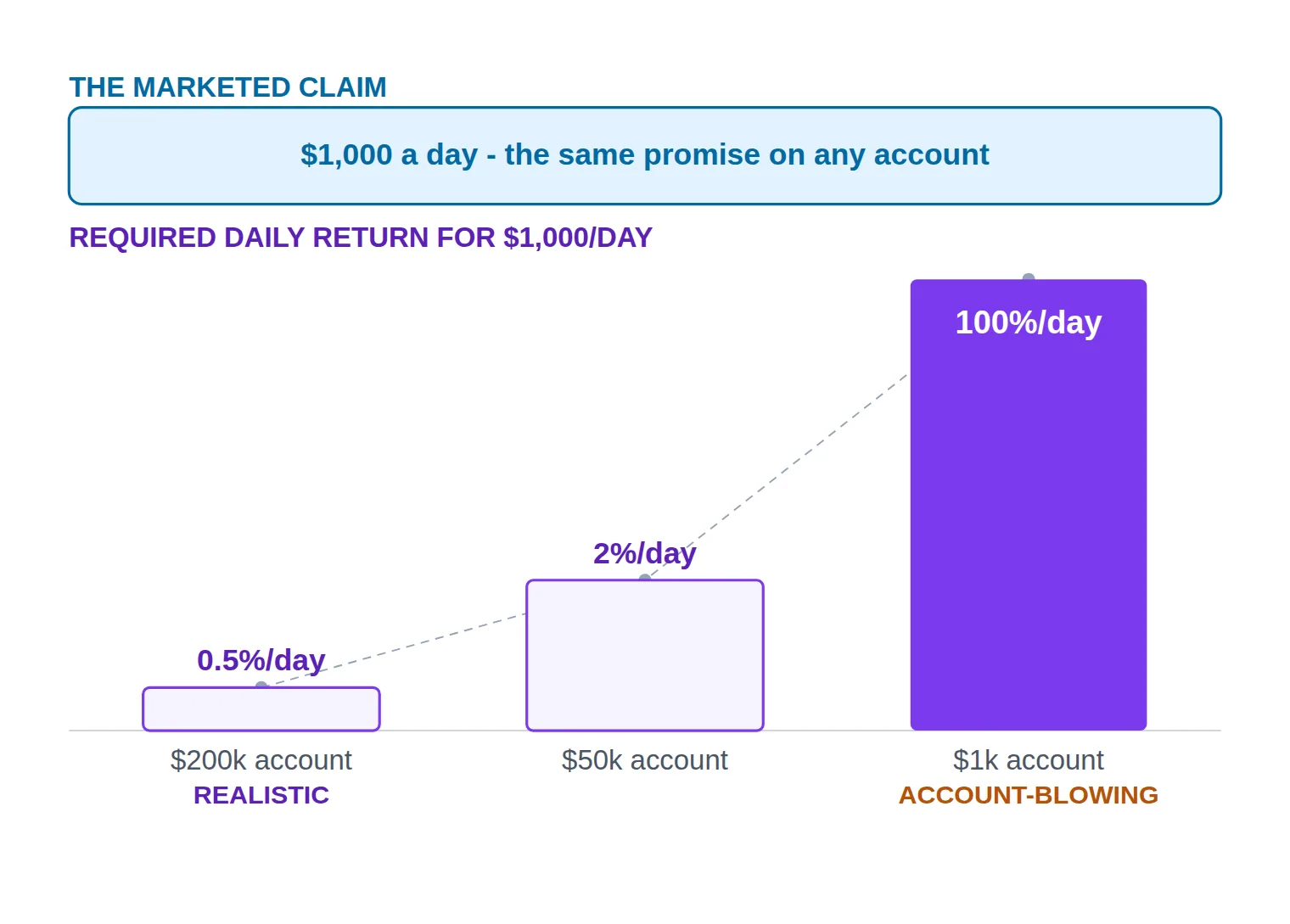
The figure below shows the contrast at a glance — the marketed promise sits flat across every account size, while the return actually required rises steeply as the account shrinks.
The '$1,000/day' pitch stays flat for every account, but the daily return it truly requires climbs from a sustainable 0.5% on a large account to an impossible 100% on a small one.
A Realistic Worked Example
Numbers get real when you walk one through. Take a genuinely well-capitalized account — $50,000 — and a disciplined trader risking 1% per trade ($500) at a 2:1reward-to-risk ratio. Here is what one of those trades looks like on the price ladder; you can drag the levels to see how the asymmetry and the break-even win rate move together, or size your own trade to match your account:
One 2:1 trade on the worked-example account
Long setup
Reward zone+0.0060
Risk zone−0.0030
TP 1.0910
Entry 1.0850
SL 1.0820
Reward-to-risk ratioYou aim for 2.00x what you risk
1 : 2.00
Risk (1R)
0.0030
Reward
0.0060
Break-even win rate
33.3%
Risk $500 to make $1,000: a 2:1 setup only needs to win about a third of the time to break even - but breaking even is not $1,000 a day.
Each winning trade nets $1,000; each loser costs $500. To bank $1,000 on a given day, the trader roughly needs two clean wins with no offsetting losses — and markets do not hand out clean setups on demand. Even a solid historical win rate is an average over many trades, not a promise for today: some days deliver three winners, plenty deliver a loss and a scratch, and a few just bleed.
That is why the honest read on our $50,000 trader is that $1,000 is a good day, not a daily paycheck. Over a month the account might average out to something respectable in percentage terms, but the daily line is lumpy. And the sizing itself matters: risking more than a small, fixed slice per trade — abandoning sound position sizing or ignoring what a framework like the Kelly criterion says about optimal bet size — is exactly how a strong strategy still blows up.
The deeper truth is captured by expectancy: your long-run edge is win rate and average win/loss combined, and no daily dollar goal can override it. Chasing $1,000 on a day the market does not offer it only tempts you to force trades your edge never justified.
One more cost hides inside the "daily" framing: time and pressure. A daily target means you are at the screen every session, under pressure to produce a number on schedule, with no room to simply stand aside when conditions are poor. A monthly or percentage goal lets a bad Tuesday be a bad Tuesday; a daily quota turns it into a reason to overtrade.
Does Automation Change the Odds?
Since many readers arrive here from a bot or EA ad, this is the question that really matters: does automation make $1,000 a day more achievable?
The honest answer is that a bot changes how consistently a rule is followed — not the ceiling on returns. A well-built automated system executes your risk rule precisely, every time, without the fear and greed that make humans oversize after a loss or exit a winner early. That is a real advantage for discipline and profit factor over time. But it is not magic.
A bot cannot manufacture a higher win rate, and it cannot bypass the capital-and-return math above. Automation does not turn a $2,000 account into a $1,000-a-day machine, because the plausibility of any dollar target still comes from account size × return, not from the software. Be especially wary of any system marketed with a flat daily-dollar promise or "risk-free" returns — that language is a red flag, not a feature, and the results screenshots behind it are usually the survivors, never the failures.
Knowledge check
A trader has a $2,000 account and buys a bot advertised as making "$1,000 a day." Assuming the bot performs exactly as promised, what daily return would that actually require?
Why
$1,000 on a $2,000 account is a 50% daily return ($1,000 divided by $2,000). No bot, however well-built, changes that arithmetic - a dollar target's plausibility comes from account size, not the software. A bot can follow a risk rule flawlessly; it cannot conjure a 50%-a-day edge.
The Pitfalls Behind the "$1,000/Day" Claim
If the number keeps looking achievable, it is usually because of one of these traps rather than a real edge:
Overleveraging. Pumping position size to force a small account toward a fixed dollar figure is the fastest route to a blown account, not to $1,000 a day.
A fixed-dollar target instead of a percentage goal. "$1,000 a day" ignores account size entirely; "0.5–1% a day" is the same goal expressed honestly, and it instantly reveals how much capital the dollar figure assumes.
Survivorship-bias marketing. The winning screenshots, testimonials, and "verified" months you see are the handful that worked. The far larger number of accounts that lost following the same pitch are never posted.
"Risk-free" and "guaranteed" language. Any product promising a daily profit with no downside is describing something that does not exist in a leveraged market. Treat the promise as a warning label.
Name these to yourself, and the "$1,000 a day" pitch loses its grip — you can see it is a framing trick, not a hidden shortcut.
See Realistic, Risk-Managed Signals in Action
The worked example above lived on a spreadsheet: an entry, a stop, a 2:1 target on a $50,000 account. It is fair to want to see that same risk-defined framing on real, current trades rather than only an illustration — a setup where the entry, the stop, and the reward-to-risk are stated up front instead of buried under a bare dollar-per-day promise.
That is exactly what our free live forex signal feed shows: each trade published with its entry, its stop, and its reward-to-risk ratio, so you read a risk-defined setup, not a marketing number. You can watch how those setups actually behave on the live forex signals feed.
To be clear about what it is and is not: it is a signal feed, not an income guarantee or an auto-execution system. You still supply your own capital, choose your own position sizing, and execute with your own discipline — it will not turn a small account into $1,000 a day. Think of it as a way to see risk-defined trades in the open, and treat the hands-on process — backtesting a strategy against historical forex data, building your risk rules, and evaluating any bot before you trust it — as the real next step.
The Realistic Takeaway
So, can you make $1,000 a day in forex? On paper, yes — with roughly $100,000 to $200,000 in capital and a sustainable daily return you actually have to earn. For the small account most traders bring, the same target quietly demands 10%, 20%, or 50% a day, and the only way to reach for that is to overleverage until the account breaks.
The fix is not a better bot or a secret strategy. It is to drop the fixed-dollar fantasy and think in percentages your account can realistically produce, then protect the account so it survives long enough to compound. Reframed that way, "$1,000 a day" stops being a goal and becomes what it always was: a marketing hook that the math quietly dismantles.
From here, the useful moves are the boring, durable ones — validating an approach by backtesting it against historical forex data, building risk rules that keep a bad streak from ending your account, and judging any bot or signal by its risk-defined setups rather than its dollar-per-day headline.
FAQ
Is $1,000 a day in forex realistic for a beginner?
For a beginner with a typical small account, no. A $5,000 account would need a 20% daily return to average $1,000 — a figure no sustainable strategy produces. The realistic beginner path is a small percentage goal on a modestly sized account, focused on not losing before you focus on winning big.
How much capital do you actually need to make $1,000 a day trading forex?
Around $100,000 to $200,000, assuming a sustainable daily return of about 0.5–1%. A $200,000 account earning 0.5% a day averages $1,000; a $100,000 account needs 1%. Below roughly $50,000, the required daily return climbs into unrealistic territory.
Can a forex bot or EA make $1,000 a day?
Only within the same capital math a human faces. A bot can execute a risk rule precisely and remove emotional mistakes, but it cannot raise your win rate beyond your edge or make a $2,000 account produce $1,000 a day. The account size drives the dollar figure — not the software.
Why is a percentage goal better than a $1,000-a-day target?
A dollar target ignores account size and pressures you to overtrade to hit a number on schedule. A percentage goal scales to your capital, exposes exactly how much money "$1,000 a day" really assumes, and lets you stand aside on poor days without feeling behind.
Is chasing a fixed daily profit risky?
Yes. Sizing positions to force a fixed dollar amount out of a small account leads to overleveraging, deep drawdowns, and a real risk of ruin. Trading survives on managing risk so the account lives through its losing days — a fixed daily quota works directly against that.
Sources & Further Reading
Want to go deeper? These independent, authoritative sources shaped this guide — each one is worth reading in full:
The Forex Desk is the SignalBots editorial team responsible for our currency-market coverage. We research and write the guides, explainers and reference articles on how the majors, minors and crosses actually trade — sessions, spreads, swaps and the macro releases that move price.



Discussions 0
Leave a comment