You've watched an experienced forex trader post a clean run of winners for months. You believe the edge is real — you just don't have the screen time, the nerve, or the years of pattern recognition to trade it yourself. Copy trading is the answer to a very specific question: can I put that trader's decisions to work in my account, automatically, without becoming them first?
The short answer is yes — and the mechanics are simpler than the marketing makes them sound. This guide walks through what forex copy trading actually is, how the copying happens under the hood, how it differs from mirror trading and plain signal-following, and the exact steps to start — with clear eyes about where the risk really sits.
Answer first
What is forex copy trading?
Auto-mirroring
What you chooseThe trader, not the trades
How it copiesEvery position, in real time
Scaled toYour balance and risk
Who runs itA trade copier, automatically
Concept overview - see the full breakdown below
Copy trading turns one trader's decisions into positions on your own account, sized to what you can afford.
Key Takeaways
Forex copy trading automatically mirrors an experienced trader's positions into your own account, scaled to your balance and risk — you don't pick the trades, you pick the trader.
It's copying trades, not a magic account: when the trader you follow draws down, you draw down with them, so trader selection and position sizing are the whole game.
Copy trading, mirror trading, and following a signal provider are three different levels of automation — knowing which one you're actually using changes how much control you keep.
The safest way to start is small: vet the track record, allocate a slice you can afford to lose, and treat the first weeks as a live audition, not a set-and-forget.
Table of Contents (21 min read)Contents
What forex copy trading actually is
Copy trading is a way to link your trading account to an experienced trader's account so that every position they open, adjust, or close is automatically replicated in yours — in real time and in proportion to the capital you've allocated. You are not receiving a tip and deciding whether to act. The action is the copy itself.
Think of it as hiring a driver rather than buying a map. A forex signal provider hands you the map — an entry, a stop, a target — and you still have to drive. In copy trading, the trader you follow is the driver: their hands are on the wheel, and your car goes wherever theirs goes, at whatever speed matches your fuel.
The person being copied goes by a few names — leader, master, strategy provider — but the role is the same: they trade their own real account, and a piece of software fans their every move out to everyone following them. Crucially, you pick the trader, not the trades. Your one decision is who to trust with the wheel; after that, the copying is hands-off by design.
That single shift is what makes copy trading attractive to a beginner. You don't need to read order flow, size positions in the heat of a news spike, or hold your nerve through a drawdown — you delegate all of it to someone who has already built those reflexes. What you keep responsibility for is narrower but no less important: choosing well, sizing sensibly, and knowing when to pull the plug.
How the copying actually happens
Under the hood, copy trading is a one-to-many broadcast. The leader places a single trade; a trade copier — the software layer that sits between the leader's account and every follower — reads that trade the instant it fires and re-creates it on each follower's account, resized to fit that account.
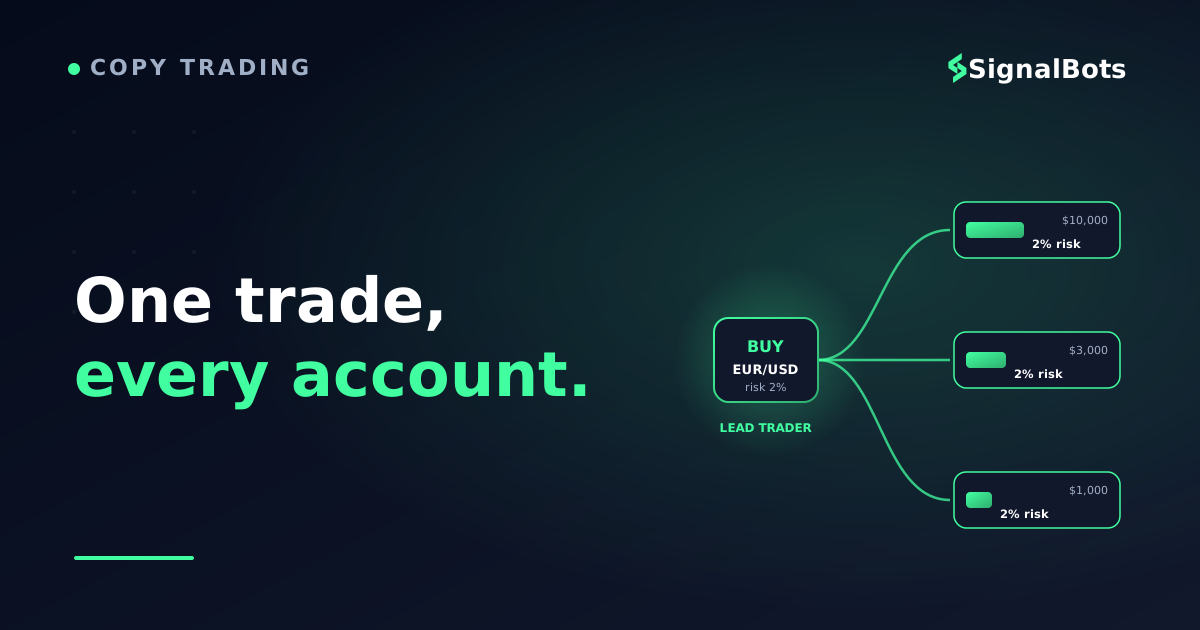
The resizing is the part beginners miss. The copier doesn't clone the leader's dollar amount — it clones the leader's proportion. If the leader risks 2% of their account on a EUR/USD long, the copier opens a position that risks roughly 2% of your account too, even if your balance is a fraction of theirs. That's how a trader running a $50,000 account and a follower with $3,000 can both be in "the same trade" without the follower taking on a wildly oversized position.
One trade, mirrored and scaled to each account
Lead traderBUY EUR/USD - risks 2% on a $50,000 account
Copied to each follower, by balance
Follower - $10,000BUY EUR/USD - same 2% risk, 1/5 the size
Follower - $3,000BUY EUR/USD - same 2% risk, smaller lot
Follower - $1,000BUY EUR/USD - same 2% risk, smallest lot
The copier clones the leader's percentage risk, not their dollar size - so every follower rides the same trade at a scale their account can carry.
Same trade, same direction, same relative risk - three different lot sizes, one for each follower's balance.
Because the copier keys off proportion, most platforms let you tune the relationship instead of accepting a raw 1:1 copy. Common controls include a copy ratio (mirror the leader at half their risk, or double it), a hard maximum drawdown stop that unlinks you if losses hit a ceiling you set, and per-trade or per-symbol filters. These knobs matter: they're the difference between blindly inheriting someone else's risk appetite and shaping the copy to fit your own.
See the trade get scaled to your own numbers below. Plug in the leader's account size and risk, then your balance, and watch the position the copier would open on your account.
Try the numbers
What would this trade look like on your account?
Illustrative only - actual lot sizing also depends on the stop distance your leader uses on each trade.
Leader's account size
$
Risk the leader takes per trade
Your account size
$
Your copy ratio
Dollars the leader risks
—
Your effective risk per trade
—
Dollars you'd risk on the copy
—
Copying scales by percentage, so a smaller account takes a proportionally smaller position - and your copy ratio lets you dial that risk up or down.
Copy trading vs. mirror trading vs. following signals
These three terms get used interchangeably, and that sloppiness costs beginners real money — because each hands you a different amount of control. Getting them straight is the fastest way to know exactly what you're signing up for.
Copy trading follows a person. You're tied to a specific trader's live decisions, quirks and all — including the day they revenge-trade after a loss. Mirror trading follows a strategy or algorithm rather than an individual: you replicate a rules-based system, so there's no human mood in the loop, just the model executing its logic. Following a signal provider is the least automated of the three — you receive the trade idea and you place, size, and manage it yourself.
The practical trade-off is control versus effort. Signals keep you fully in the driver's seat but demand discipline and screen time. Copy and mirror trading take the wheel from you — which is the point — but that means the quality of your outcome is only ever as good as the leader or strategy you chose.
Copy trading
Follows a specific person's live trades
Fully hands-off once linked
Inherits the trader's judgment - and their bad days
Best when you trust one trader's edge
Delegate the whole decision to a human you vet
VS
Following signals
You receive an entry, stop, and target
You place and size every trade yourself
Full control, full responsibility
Best when you want to learn while you trade
Keep the wheel; use the idea as your map
Mirror trading sits between these two - it automates like copy trading, but follows a rules-based strategy instead of a person.
If you're weighing the middle ground more carefully, the difference between copying a human and mirroring a system is worth its own deep dive — start with what mirror trading a rules-based strategy actually removes from the equation. And if you'd rather keep control and just want high-quality ideas to act on, our forex signal feeds are built for exactly that reader.
How to start copying an experienced trader
Getting started is a short, ordered process — but the order matters. Rushing straight to "pick the trader with the biggest number" is how most beginners get burned. Here's the sequence that keeps you out of the common traps.
The setup
From zero to your first copied trade
1
Open and fund an account
Use a broker or platform that supports copy trading, and fund only what you can genuinely afford to put at risk.
2
Shortlist a few traders
Filter by a long, consistent track record - not one lucky month - and read how they handle losing streaks.
3
Check the drawdown, not just the gains
Look at their worst peak-to-trough loss. If you couldn't stomach it live, they're not your trader.
4
Set your copy ratio and limits
Allocate a slice you can lose, set a copy ratio, and a maximum-drawdown stop that unlinks you automatically.
5
Link, then monitor
Start the copy and treat the first weeks as a live audition - copying is hands-off, but not decision-free.
The whole flow takes minutes to set up - the judgment lives in steps two and three, where you choose and vet the trader.
The single most important habit is to vet the trader's track record honestly before you allocate a cent. A flashy return over three months tells you almost nothing; a modest, steady curve over a long period with a shallow worst-case drawdown tells you a great deal. Prioritize survivability over headline gains — the trader who never blew up beats the one who tripled an account and then gave it all back.
Use the checklist below before you link any account. If you can't tick every box, keep looking.
Pre-flight
Vet before you copy
0 / 7
The track record spans many months, not one hot streak
The worst historical drawdown is one you could hold through live
The trader's risk per trade is disclosed and consistent
You understand the strategy well enough to know when it should struggle
You've set a copy ratio and a maximum-drawdown auto-stop
You're allocating only capital you can afford to lose
You've decided in advance what would make you unlink
★
Checklist complete — you’re cleared to proceed.
Copy trading is hands-off on execution, but the decision to copy - and to stop - stays firmly yours.
Sizing the copy correctly is its own skill, and it's the one that separates a manageable strategy from an account-ender. Even inside an automated copy, the percentage you let a leader put at risk is a lever you control — treat it deliberately. Our forex position size calculator lets you sanity-check the exposure a copy ratio actually creates on your balance before you commit.
Where the risk really lives
Here's the uncomfortable truth the glossy platforms soft-pedal: copy trading copies losses just as faithfully as it copies wins. When the trader you follow hits a losing streak — and every trader does — your account walks down the same staircase, proportionally. There is no floor built into the copying itself.
The copier is faithful in both directions - vet the trader and cap your drawdown accordingly.
Two failure modes catch beginners repeatedly. The first is chasing the leaderboard — allocating to whoever posted the biggest recent return, which usually means whoever took the most reckless risk and got lucky. The second is set-and-forget — linking an account and never looking again, so you miss the moment the trader's edge stops working or their behavior changes. Copy trading is hands-off on execution; it is never hands-off on oversight.
Manage those two, and copy trading becomes what it should be: a disciplined way to put a vetted edge to work while you learn from watching a real trader operate. Manage a slice of your capital, cap your worst case, and let the track record — not the hype — decide who earns your allocation.
FAQ
Is forex copy trading profitable?
It can be, but only to the extent the trader you copy is genuinely skilled and you size the copy sensibly — copy trading has no edge of its own, it simply transmits the leader's edge (or lack of one) to your account. A well-vetted trader with a long, shallow-drawdown record copied at a conservative ratio is a reasonable proposition; chasing last month's top performer is not. Frame every outcome in reward-to-risk terms, never as guaranteed gains, because past performance never assures future results.
Do I need trading experience to start copy trading?
No — that's much of the appeal. You don't have to read charts, size positions in real time, or manage the trade, because the trader you follow does all of that. What you do need is the judgment to choose a trustworthy trader, the discipline to allocate only what you can afford to lose, and the attention to monitor the copy rather than forget it. Those are learnable quickly, and copy trading itself is often how beginners build the intuition to eventually trade on their own.
How is copy trading different from mirror trading?
Copy trading follows a specific person and replicates their individual live decisions, human quirks included. Mirror trading follows a strategy or algorithm — a rules-based system with no mood or emotion in the loop. Both automate execution for you; the difference is whether you're trusting a human's judgment or a defined set of rules. Many experienced traders split capital across both.
How much money do I need to start copying a trader?
Because copiers scale by percentage rather than dollar amount, you can start with a modest balance and still be in "the same trade" as a much larger leader — your position is simply proportionally smaller. The right amount is less about a minimum and more about a maximum: only allocate capital you can afford to lose entirely, since the copy inherits the leader's full downside in proportion. Starting small and scaling up once you've watched a trader through a losing streak is the sound approach.
Can I stop copying a trader at any time?
Yes. You can unlink from a trader whenever you choose, and most platforms also let you set an automatic maximum-drawdown stop that unlinks you if losses hit a ceiling you define in advance. Deciding before you start what would make you pull the plug — a drawdown threshold, a behavior change, a strategy that stops working — is one of the most valuable habits in copy trading. It turns "hands-off" from a risk into a plan.
You came in asking
“can I put a good trader's decisions to work in my account, automatically?”
and the answer is
yes - pick the trader well, scale the copy to your balance, and cap your worst case..
Copy the edge, keep the oversight
Forex copy trading turns one experienced trader's live decisions into proportionally-sized positions on your own account. The mechanics are simple; the judgment is not. Your job shrinks to three things done well - choosing a trader with a long, survivable track record, sizing the copy to what you can afford to lose, and deciding in advance what would make you unlink. Do those, and copy trading becomes a disciplined way to put a vetted edge to work while you learn.
The Forex Desk is the SignalBots editorial team responsible for our currency-market coverage. We research and write the guides, explainers and reference articles on how the majors, minors and crosses actually trade — sessions, spreads, swaps and the macro releases that move price.



Discussions 0
Leave a comment