Scalping trades the smallest moves the market makes - and closes them almost immediately.
Scalping is the trading style where you take the market's smallest, fastest moves and get out almost immediately. A scalper is not waiting for a trend to develop over an afternoon. They open a position, watch it move a few pips in their favor, close it, and look for the next one — sometimes within the same minute. Do that dozens or hundreds of times a day and the tiny, repeatable edges are supposed to add up.
That rhythm is exactly what makes scalping so demanding by hand, and exactly why it is the first style most traders ask whether they can hand to software. This guide answers both halves of that question: what scalping actually is as a style, and whether — and how — you can genuinely automate it.
Key Takeaways
Forex scalping is a very-short-timeframe style: dozens to hundreds of trades a day on M1-M5 charts, each aiming for a handful of pips and closed within seconds to minutes, with nothing held overnight.
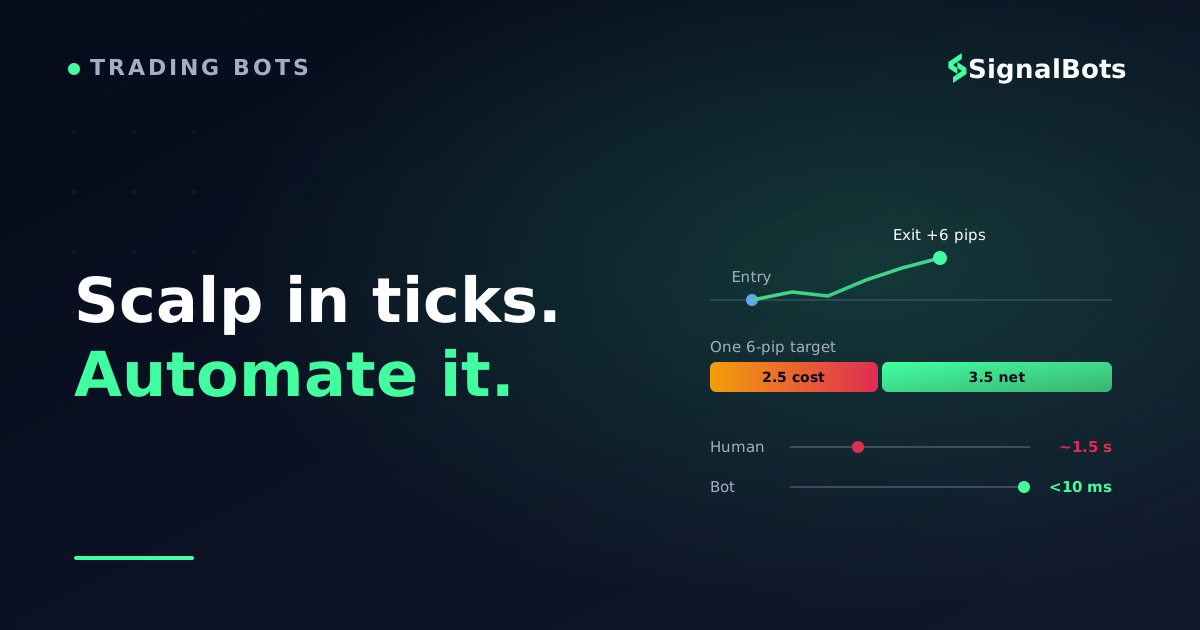
Its two silent killers are spread (a 2-pip spread on a 6-pip target starts you a third underwater) and human reaction time — both make it the hardest style to run by hand.
Scalping is the trading style automation was practically built for: a scalping bot or EA reacts in milliseconds, never blinks, and applies identical rules to trade 1 and trade 400.
Automating it well means solving latency, spread, and broker permission first — a slow feed or a market-maker that requotes will quietly turn a positive-expectancy strategy into a losing one.
Table of Contents (25 min read)Contents
What Forex Scalping Actually Is
Scalping is defined by its timeframe and its target, not by any single indicator or setup. You work on very low timeframes — usually the 1-minute (M1) or 5-minute (M5) chart — often with a higher timeframe like M15 or M30 as a directional filter. Entries happen on the fast chart; the slow chart just tells you which way the wind is blowing.
The profit target per trade is small on purpose. A 1-minute scalper might aim for around 5 pips; a 5-minute scalper might aim for closer to 10. Compare that with a day trader targeting 20-50 pips over an hour, or a swing trader holding for days. The scalper trades the noise — the constant small oscillations — rather than the trend.
A few traits follow directly from that:
High trade frequency. Because each win is small, you need many of them. A scalping session is dozens to hundreds of trades, not two or three.
Hard, tight stops. Targets are small, so stops must be too. The stop sits exactly where the trade idea is proven wrong, and it is not negotiable in the moment.
No overnight risk. Scalpers close everything by the end of their session. There are no swap charges, no weekend gap risk, no positions left to worry about.
A win-rate-driven profile. With tight, symmetric targets and stops, scalping tends to lean on a high historical win rate rather than large winners. You are not swinging for a 5:1 payoff; you are trying to be right often, at a small size, repeatedly.
That last point matters, because a high win rate on paper does not automatically mean profit. When your target is only a handful of pips, your reward-to-risk ratio is naturally low — and the cost of trading takes a bigger bite the smaller your target is. That is the trap most new scalpers walk straight into.
Why Spread Is the Scalper's Biggest Enemy
Here is the uncomfortable math. Every trade begins slightly in the red, because you buy at the ask and sell at the bid — and the gap between them is the spread. On a longer-timeframe trade targeting 40 pips, a 1-pip spread is a rounding error. On a scalp targeting 6 pips, that same spread is a real chunk of your target before the market has moved at all.
Stack the full cost of a single scalp and the picture gets sharper:
Where your pips go
The real cost of one 6-pip scalp
Spread
Commission
Slippage
0All-in cost
Spread1.4 pips
Commission0.6 pips
Slippage0.5 pips
Total cost per trade— pips
Illustrative example: on a 6-pip target, a 1.4-pip spread plus commission and slippage can hand back roughly 2.5 pips - the market has to move in your favor just to break even.
The smaller your target, the larger the share your trading costs consume.
In that illustrative example, roughly 2.5 of your 6 pips are gone to cost before you have made a single pip of profit. The market has to travel that far in your favor just to get you to break even. Do the round trip a hundred times a day and cost is not a footnote — it is the single biggest variable in whether the whole style is viable.
This is why serious scalpers obsess over their broker's execution. A raw-spread ECN broker that charges a small commission but passes through near-zero spreads is usually far better for scalping than a "zero commission" market-maker whose spread is wider. And it is why slippage — the difference between the price you expected and the price you actually got — is a first-class concern, not a rounding error. On a 6-pip target, half a pip of slippage on entry and exit is a pip of your target evaporated.
Want to see the cost in real money before you commit to a pair? Run your numbers through our forex pip value calculator and multiply by your typical spread — that is the toll you pay on every single scalp.
The Part Humans Get Wrong: Reaction Time
Spread is a fixed cost you can shop for. Reaction time is a cost you are. Scalping asks a human to do something humans are genuinely bad at: watch a fast chart for hours, spot an identical setup for the four-hundredth time, and execute it with the exact same discipline as the first — no hesitation, no revenge trade after a loss, no widening the stop "just this once."
Think about the actual sequence a manual scalper runs, over and over:
A setup forms on the M1 chart.
Your eyes register it, your brain confirms it matches the rule.
You move the mouse, click, and the order goes in.
Price hits target; you have to notice and close — or you have a bracket order do it.
Steps 2 and 3 take a human somewhere between a fraction of a second and several seconds, and that window is worse exactly when it matters most: during the fast, volatile bursts scalpers live for. By the time you have reacted, the few pips you were chasing may already be gone. And that is on a good rep. After two hours and eighty trades, focus decays, and the discipline that the whole edge depends on decays with it.
This is the pivot. The very things that make scalping hard for a person — speed, repetition, and unbroken discipline — are the things a machine does effortlessly. So the honest question is not "is scalping too hard?" It is "is scalping better run by software?"
Can You Automate Forex Scalping?
Yes — and of all the trading styles, scalping is arguably the one automation suits best. A scalping bot (on MetaTrader, an automated scalping expert advisor) is a program that watches the market against a fixed rule set and opens and closes trades on its own. It doesn't get tired, it doesn't revenge-trade, and it applies identical logic to trade 1 and trade 400.
Most importantly, it collapses that human reaction sequence into a single step measured in milliseconds. Where a person needs a second or two to see, confirm, and click, a bot evaluates the rule and fires the order in a fraction of that — the kind of execution speed that decides whether a 6-pip scalp is caught or missed.
The clearest way to feel the difference is to watch a rule-based bot run. Below, a simple scalping bot opens and closes trades against a random price walk with a fixed take-profit and stop-loss. Press play and watch the trade count climb and the stats settle:
Same rules, every trade
Watch a scalping bot work
EUR/USD · M1Ready
Buy entrySell entryExit
Trades
0
Win rate
—
Avg win
0
Avg loss
0
Net P&L (pips)
0
A tight-target, tight-stop scalper closing trades in a handful of candles. Notice how the win rate and net P&L only settle into the strategy's true expected value after many trades - never judge a scalper on a handful.
The bot never hesitates, never widens the stop, and never gets bored - the three things a human scalper cannot promise.
Run it a few times. Two things should stand out. First, the bot executes with a consistency no human sustains for hours. Second — and this is the lesson most new scalpers miss — the win rate and P&L bounce around over a short run and only converge toward the strategy's real edge over many trades. A scalper's edge lives in the aggregate, which is precisely why a tireless machine that can take the full sample of trades has a structural advantage over a person who tires after eighty.
Manual versus automated scalping, side by side:
The pivot
Manual scalping vs an automated scalping bot
Manual scalping
Reaction time of seconds - worst during fast bursts
Discipline decays over a long session
Emotion, hesitation, and revenge trades creep in
Physically caps how many trades you can take
Human limits are the bottleneck, not the strategy
VS
Winner
Automated scalping bot
Reacts in milliseconds, identically every time
Applies the same rule to trade 1 and trade 400
No emotion, no fatigue, no rule-bending
Runs the full sample the edge actually needs
Executes the plan the way the plan was written
Automation doesn't invent an edge - it removes the human friction that was leaking the edge you already had.
One caution before you get excited: automation removes execution problems, not strategy problems. A bot running a losing rule set just loses faster and more consistently, which is why the rules have to be designed and proven before they are automated. The point of automating a scalper is to stop bleeding the edge to reaction time and emotion — it is not a shortcut around having a real, backtested edge in the first place. Be wary of any product that promises a "risk-free" or "can't-lose" scalping robot; that language is the reddest of flags.
What It Actually Takes to Automate Scalping Well
Because scalping trades on the finest margins, the infrastructure around the bot matters as much as its logic. For the full step-by-step build, see how to automate a forex scalping strategy — but three things quietly decide whether an automated scalper works or slowly loses:
Low latency. A slow feed or a laggy connection is fatal at this timeframe. Milliseconds of delay between signal and execution are the difference between the fill you wanted and a worse one. This is why serious EA scalpers run on a VPS near the broker's servers rather than a home connection with variable lag — sub-10ms signal delivery is the whole game.
Tight, honest spreads. As the cost breakdown above showed, the bot's edge is measured in pips it can't afford to give away. A raw-spread account beats a wide all-in spread for high-frequency scalping almost every time.
A broker that actually permits it. This is the one most people forget. Some brokers restrict or ban high-frequency scalping and EAs, and a market-maker that requotes your bot mid-burst will quietly wreck it. Scalping automation belongs on a broker whose account model and terms explicitly welcome EAs, high-frequency execution, and news trading. Genuinely automation-friendly forex brokers — IC Markets, FP Markets, Exness, Eightcap, and Tickmill among them — publish clear policies on this; check that permission before you deploy anything.
There is more than one way to put automation to work, too. A full expert advisor decides and executes on its own. But you can also keep the human in the decision loop and automate only the fast, error-prone execution step — receiving a rule-based scalping signal and having it injected into your ticket the instant it fires. That middle path is why fast, low-latency forex signal delivery exists: it hands the discipline and reaction speed of a machine to a trader who still wants a say.
When to Run a Scalper: The Session Matters
One more thing a good scalping setup respects: not all hours are equal. Scalping needs liquidity and movement, and both peak when major sessions overlap. Wide spreads and thin, choppy price during dead hours are exactly the conditions that turn a positive-expectancy scalper negative.
Timing is part of the edge
When scalping conditions are best (UTC)24-hour clock · times in UTC
UTC timeline
SydneyAESTTokyoJSTLondonGMT/BSTNew YorkEST
21:00–24:0021:0000:00–6:00–6:00
0:00–9:000:00
7:00–16:007:00
12:00–21:0012:00
000306091215182124
London + New York12:00–16:00 UTC · Peak liquidity & tightest spreads
Sydney
Tokyo
London
New York
Overlap (peak liquidity)
The London-New York overlap (roughly 12:00-16:00 UTC) is when liquidity is deepest, spreads are tightest, and ranges are large enough for a scalper to work. A good bot can be told to trade only these windows.
Restricting a scalping bot to the high-liquidity overlap is often the single easiest way to improve its results.
A well-built scalping bot lets you gate it to specific sessions, so it simply doesn't trade during the dead, wide-spread hours when the odds are stacked against it. That single filter — trade the overlap, sit out the rest — is often the highest-value setting on the whole strategy.
Bringing It Together
Forex scalping is a coherent, legitimate style: very short timeframes, tiny targets, high frequency, tight stops, nothing held overnight. Its difficulty is not the concept — it's the execution. Spread eats a big share of every small target, and human reaction time and fatigue leak the edge that the strategy is supposed to capture.
That is exactly why scalping is the trading style automation fits best, following the same discipline covered in how to build an automated forex system. A scalping bot or EA reacts in milliseconds, never tires, and applies the plan identically across the full sample of trades the edge needs. Automate the execution — on a low-latency setup, tight spreads, and a broker that permits it — and you keep the edge you designed instead of bleeding it away one hesitation at a time.
Your next move
You came in asking
“what forex scalping is and whether you can automate it”
and you leave knowing
it's the style automation suits best - if you solve latency, spread, and broker permission.
Scalping rewards machines, not multitasking humans
Scalping's edge lives in speed, repetition, and unbroken discipline - the three things software does effortlessly and people do poorly after two hours. If you want to run it, the next step is deciding how much you automate: a full expert advisor that decides and executes, or fast signal delivery that keeps you in the decision loop while a machine handles the millisecond execution.
It can be, but it lives or dies on cost and discipline. Because targets are only a handful of pips, spread, commission, and slippage take a large share of each trade — so scalping is only viable on tight-spread execution and with a genuine, backtested edge repeated across a large sample. There is no "guaranteed" version; anyone selling one is a red flag.
What timeframe is best for forex scalping?
Most scalpers work the 1-minute or 5-minute chart for entries, often with a higher timeframe (M15 or M30) as a directional filter. The 1-minute chart is fastest and most demanding; the 5-minute is a little calmer with slightly larger targets. There is no single "best" — it depends on how much noise and speed you (or your bot) can handle.
Do brokers allow scalping and scalping bots?
Some do, some don't. Many raw-spread ECN brokers explicitly welcome scalping, EAs, and high-frequency execution; some market-makers restrict it or requote fast orders. Always confirm the broker's stated policy on scalping and automated trading before you deploy a bot — running a scalper on a broker that penalizes it is a common, avoidable mistake.
Do I need a VPS to run a scalping bot?
Practically, yes, if you want it to run reliably at this timeframe. A home connection with variable lag and the risk of an outage is a poor place for a strategy where milliseconds matter. A VPS located near the broker's servers gives you low, stable latency and 24/5 uptime so the bot doesn't miss fills or drop offline mid-session.
Is an automated scalper better than manual scalping?
For pure execution, almost always. A bot reacts in milliseconds, never tires, and applies the same rule to every trade — removing the reaction-time lag, fatigue, and emotional slips that leak a manual scalper's edge. But automation only fixes execution; it can't rescue a losing strategy. A bad rule set automated just loses more consistently, so the edge still has to be real first.
What's the difference between a scalping EA and using scalping signals?
An expert advisor both decides and executes on its own — fully hands-off. Scalping signals keep you in the decision loop: a rule-based system flags the trade and (with fast delivery) injects it into your ticket the instant it fires, but you choose to take it. The EA maximizes automation; signals keep a human judgment layer while still automating the fast, error-prone execution step.
Sources & Further Reading
Want to go deeper? These independent, authoritative sources shaped this guide — each one is worth reading in full:
The Forex Desk is the SignalBots editorial team responsible for our currency-market coverage. We research and write the guides, explainers and reference articles on how the majors, minors and crosses actually trade — sessions, spreads, swaps and the macro releases that move price.



Discussions 0
Leave a comment