You have seen the pitch. A screenshot of a soaring equity curve, a monthly return that sounds too good to be real, and a "download now" button. The problem isn't that automation doesn't work — it's that the pitch tells you nothing about whether this bot will survive contact with a live market. So how do you actually tell a reliable forex bot from an expensive toy?
The honest answer is that you judge the process, not the promise. A good bot leaves a trail you can inspect — the same trail you would leave building an automated system yourself: a strategy you can describe in a sentence, a backtest built on assumptions you can check, and risk settings you can dial to your own account. This guide walks you through the traits that matter, in the order you should check them, and the marketing red flags that tell you to walk away before you deposit a cent.
Key Takeaways
A good forex bot is judged on its process, not a screenshot: a strategy you can describe in plain language, an honest out-of-sample backtest, and risk controls you can adjust to your own account.
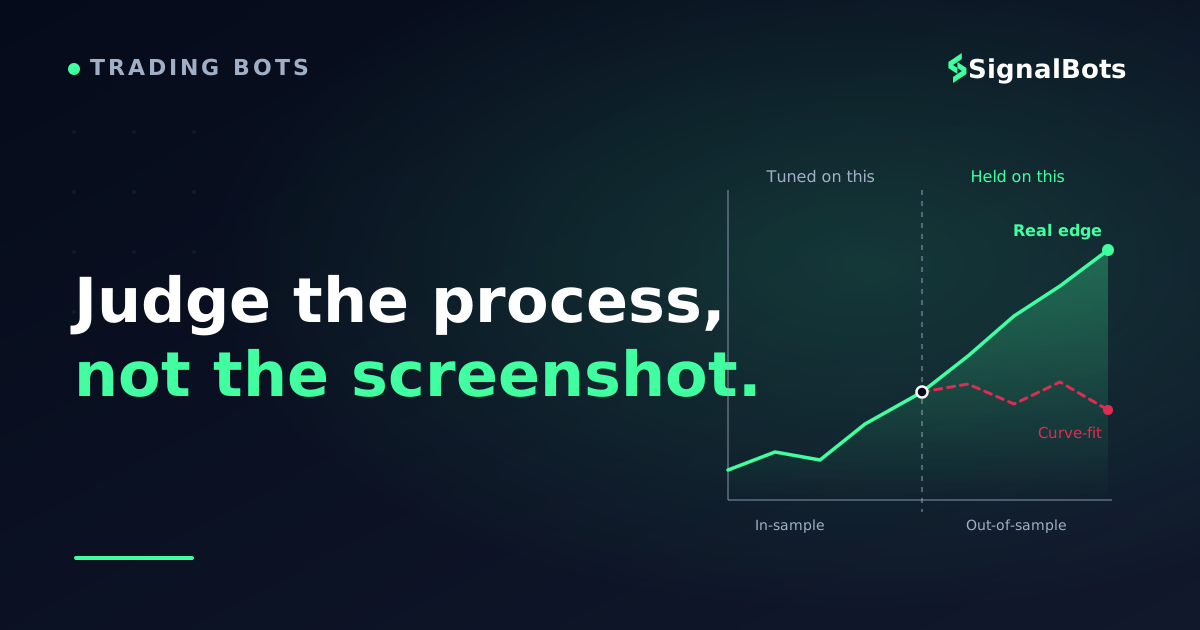
The single biggest silent breaker is overfitting — a bot tuned so tightly to past prices that it falls apart the moment live conditions differ from the test window.
Transparency beats performance claims. If you can't see the logic, the assumptions behind the numbers, or a demo/forward test, treat the bot as unproven regardless of how good its history looks.
"Risk-free", "guaranteed", and a triple-digit monthly return with no drawdown named are the three phrases that should end your evaluation on the spot.
Table of Contents (24 min read)Contents
The One-Sentence Test
Before you look at a single number, ask the question that filters out most bad bots in seconds: can the seller describe what the bot does in one plain sentence?
A good forex bot runs a specific, nameable idea. "It buys pullbacks to the 20-period average during the London session and exits at a fixed reward-to-risk" is a strategy. "Proprietary AI that adapts to any market condition" is not — it's a way of avoiding the question. This matters because a strategy you can state is a strategy you can reason about: you can guess when it will struggle (a choppy, trendless week), when it will shine, and whether its logic even makes sense for the pairs you trade.
The distinction between a trading bot and the strategy inside it is the whole game. A bot is just the delivery mechanism — the code that watches the chart and clicks the button. In the MT4/MT5 world that mechanism is called an Expert Advisor (EA), and the same rule applies: the EA is only as good as the rule set it automates. Opacity is not sophistication. If the logic is hidden "to protect the edge," you have no way to separate a real edge from a lucky backtest.
Want the raw definitions first? See our trading glossary for the plain-English version of every term below.
Trait One: A Transparent, Nameable Strategy
Transparency is the trait everything else depends on, so it comes first. You are not looking for the seller to hand over their source code — you are looking for enough disclosure to evaluate the claim.
Concretely, a transparent forex bot tells you:
What it trades — which pairs, sessions, and timeframes, not "all markets."
Why it enters — the trigger condition in words (a breakout, a mean-reversion snap-back, a session-open momentum push).
How it exits — fixed stop and target, a trailing rule, a time-based close.
What conditions break it — every honest strategy has a weakness; a seller who admits theirs is more trustworthy than one who claims none.
The fourth point is the tell. A bot marketed as working "in all market conditions" is either lying or doesn't understand its own edge. Trends, ranges, high-volatility news spikes, and dead sessions each reward completely different behavior. A design that wins in all of them at once has usually been curve-fit to a single history where those conditions happened to line up — which brings us to the trait that quietly ends most bots.
Trait Two: An Honest Backtest (and How to Read One)
Every bot ships with a backtest. Almost none of them ship with an honest one. The gap between the two is where traders lose money, so this is the trait worth the most of your attention.
The single failure mode to understand is overfitting: tuning a strategy so tightly to past prices that it memorizes that specific history instead of learning a repeatable edge. An overfit bot produces a gorgeous backtest and falls apart the instant live conditions differ from the test window — which they always do. A backtest is a hypothesis about the future, not proof of it.
So how do you read a backtest report like someone who knows the traps? You look past the headline return and check the metrics that reveal durability.
Read the report, not the return
What a trustworthy backtest report actually showsThe metrics to check before the P&L
Out-of-sample tested
Yes
Max drawdown named
Stated openly
Reward-to-risk ratio
Around 1.5:1
Sample size (trades)
Hundreds+
Spread & slippage modeled
Realistic
Curve-fit warning
Dozens of settings
Test window
One calm year
Longest losing streak
Not disclosed
Green traits build confidence; the red and amber ones are how a pretty curve hides a fragile strategy.
The non-negotiables from that report card:
Out-of-sample testing. The strategy is tuned on one slice of history, then tested on a different slice it never saw. If it holds up on unseen data, the edge might be real. If the seller only shows one continuous curve, assume it was fit to that curve. This is also why a short forward test on a demo account — the strategy running live but with no money on the line — is worth more than any historical chart.
A stated maximum drawdown. Any backtest that shows returns without naming its worst peak-to-trough fall is hiding the number that matters most. More on that below.
A believable sample size. Ten winning trades prove nothing. Hundreds across varied conditions start to mean something.
Modeled costs. Spread, commission, and slippage quietly erode a real edge. A backtest that ignores them is describing a market that doesn't exist.
Testing your own strategy rather than buying one? The risk math a backtest should already respect — position sizing, pip value, expectancy — is worth checking against your own numbers as you read the results.
Trait Three: Risk Controls You Can Actually Adjust
Here is the trait that separates a tool from a black box: can you change how much it risks?
A good forex bot treats risk as your decision, not a hard-coded constant. It lets you set the risk per trade as a percentage of your balance, cap the number of simultaneously open positions, and define a maximum loss that halts trading for the day. A bot that risks a fixed lot size regardless of your account, or that has no off-switch when things go wrong, is dangerous no matter how good its logic is — because the strategy's edge and the account's survival are two different problems.
The number that decides survival is drawdown — the peak-to-trough drop in your account before it recovers. And drawdown is brutally non-linear: the deeper the hole, the disproportionately larger the gain you need just to climb back to even. This is the intuition every bot buyer skips, so let it sink in with your own numbers.
Try the numbers
How much gain does a drawdown demand back?
Enter a drawdown and see the return required just to recover to break-even — the reason risk caps matter more than headline returns.
Drawdown from peak
Gain needed to recover
—
Capital remaining per $1,000
—
A 50% drawdown needs a 100% gain to undo. This is why a bot's worst drawdown matters more than its best month.
Drag that slider toward the deep end and watch the required recovery explode — a 50% drawdown demands a 100% gain just to get back to where you started. That asymmetry is exactly why a bot that lets you cap risk is worth more than one boasting a higher return with no drawdown control. A modest, survivable edge you can size to your account beats a spectacular one that can blow it up.
Want to model a full recovery path, not just break-even? The drawdown recovery calculator maps how long different gain rates take to dig out.
Trait Four: It Runs on Your Terms
The last trait is the most practical and the most overlooked: a good bot fits your setup, not a demo video's. That means it runs on a platform you actually use, on a broker whose execution won't quietly eat the edge, and with enough control that you're never watching a mystery process trade your money.
Usability isn't a luxury here — it's a risk control. A bot you can't configure is a bot you can't stop. Look for a clear settings panel, a visible on/off state, and behavior you can verify against the strategy description. If placing the bot on a real account requires trust rather than verification, you don't have a tool; you have a bet.
Execution quality is the other half. Even a genuinely good strategy loses its edge on a broker with wide spreads, frequent requotes, or no permission for automated trading. If you're deploying an EA, you need a broker that explicitly allows algorithmic execution and connects cleanly to your platform — the difference between a backtest and a live result often lives entirely in that gap.
Running signals or an EA into MT5 instead of a packaged bot? A clean MT5 connector bridges broker charts and execution into the platform, and a transparent, inspectable signal feed gives you something to act on — both are one step from here (see the wrap-up below).
Trait Five: The Data It Feeds On — and Guards
Here is the criterion almost every buyer forgets, because it's invisible in a screenshot: a bot is only as good as the data it consumes. Feed a flawless strategy a bad price stream and it produces bad decisions with total confidence. Two distinct data questions decide whether a bot can be trusted with a live account — the price feed it reads from, and the account access it holds.
The price feed — garbage in, garbage out. A bot reads live quotes and often historical bars to make its call, and every one of those numbers arrives from somewhere. Ask where. A bot pulling ticks straight from your broker's server sees the same prices your fills execute against — the ideal. A bot routing through an unnamed third-party aggregator, a free public API, or a scraped source introduces a gap between the price it decides on and the price you get, and that gap quietly eats the edge. The questions that matter:
Source and directness — does it read your broker's own feed, or a detached third-party stream that may not match your fills?
Reliability — what happens on a dropped connection or a data gap? A good bot pauses; a careless one trades on a stale or half-loaded chart.
History quality — the same feed quality that biases a backtest (missing bars, wrong timestamps, no weekend gaps) also degrades a live bot that leans on recent history for its signals.
The warning sign is a bot that hides its data source entirely. If the seller can't tell you where the prices come from, you can't know whether the strategy is even seeing the market you trade in.
Account access — what the bot can touch. The second data question is about your credentials. To trade for you, a bot needs some form of account access — and how it takes that access is a safety criterion, not a footnote. A trustworthy design runs locally, against a trade-only connection that can place orders but never withdraw funds, and never asks for your account password when a scoped API key or an investor-style permission would do. Treat any bot that wants your full login, stores your credentials on its own server, or requests withdrawal rights as a hard stop — the strategy could be perfect and it would still be a risk you don't need to take. A local, trade-only, no-withdrawal footprint is the safe default; anything broader has to justify itself.
The Marketing Red Flags That End Your Evaluation
Some claims aren't yellow flags to weigh — they're the point where you close the tab. If a bot's marketing leans on any of these, no backtest can rescue it, because the pitch itself is the disqualifier.
Know when to walk away
A bot worth evaluating
A bot to walk away from
Names its worst historical drawdown
'No drawdown' or 'never loses'
Describes the strategy in plain words
'Secret proprietary algorithm'
Shows an out-of-sample or demo test
One flawless equity-curve screenshot
Frames results as backtested, not promised
'Risk-free' or 'guaranteed profit'
Lets you set your own risk per trade
Triple-digit monthly return, no risk named
Any single red-flag phrase on the right is enough to stop evaluating — they signal a pitch, not a tool.
The language is the tell. A phrase like "risk-free" or "guaranteed profit" isn't optimism — it's a claim that cannot be true about any trading system, and a seller who uses it is either untrained or dishonest. The same goes for a triple-digit monthly return quoted without ever naming a drawdown: real edges have losing streaks, and hiding them means the number is either cherry-picked or invented. Trading always carries the risk of loss; be honest with yourself about that before any bot promises it away — our risk warning spells out why.
Putting It Together: The Decision
Stack the four traits and the answer usually resolves itself. You don't need every box perfect — you need enough transparency to judge the ones that matter. Here is the evaluation as a single path:
The evaluation, start to finish
Is this forex bot worth running?
Take itProceed with careSkip / stand aside
Transparency gates everything — if you can't inspect the logic and the risk, the return is unproven no matter how good it looks.
Every 'No' is a stop. A bot only earns a trial when transparency, testing, and risk control all clear.
Before you commit capital to any bot that clears the tree, run it against a concrete checklist. Tick each item off — if you can't, you haven't finished evaluating.
Before you deploy
Pre-deploy forex bot checklist
0 / 10
I can describe the bot's strategy — entry, exit, and its weakness — in one sentence.
The backtest was run on out-of-sample data, or I've forward-tested it on a demo account.
The worst historical drawdown is stated, and I've accepted I could see it live.
I can set risk per trade as a percentage of my own balance.
There is a daily-loss stop or kill-switch I control.
Spread, commission, and slippage were modeled in the results I was shown.
My broker allows automated execution and connects cleanly to my platform.
I know where the bot's price data comes from, and it matches the feed I trade on.
The bot runs on a trade-only connection — no full-login or withdrawal access.
The marketing frames results as backtested, not promised — no absolute claims dressed up as certainty.
★
Checklist complete — you’re cleared to proceed.
If every box ticks, you've evaluated the bot on its process — the only thing a screenshot can't fake.
FAQ
Is a forex bot with a higher backtest return automatically better?
No — often the opposite. A very high backtested return with no drawdown named is a classic overfitting signature: the strategy was tuned to memorize one favorable history. A lower, steadier backtested result that survives out-of-sample testing and names its worst drawdown is far more likely to hold up live. Judge durability, not the headline number.
What's the difference between a forex bot and an Expert Advisor?
They're the same idea under two names. "Trading bot" is the generic term for software that automates a strategy; an Expert Advisor (EA) is specifically a bot written for the MetaTrader (MT4/MT5) platform. The evaluation criteria in this guide apply identically — an EA is only as reliable as the transparent, tested, risk-controlled strategy inside it.
How do I know if a bot is overfit before I risk money?
Two checks. First, ask whether the results come from out-of-sample or forward testing rather than one continuous backtest curve — a strategy that only looks good on the exact data it was tuned on is a warning sign. Second, run it yourself on a demo account for a few weeks. A bot that mirrors its backtest on unseen live conditions is far more trustworthy than one you can only judge from a screenshot.
Do I need to understand the code to evaluate a bot?
No. You need the seller to describe the logic in plain language — what it trades, why it enters, how it exits, and when it struggles. You're evaluating the strategy and its risk controls, not auditing the source. If the logic is hidden "to protect the edge," that opacity is itself the reason to be cautious.
Where should I run a forex bot once I've chosen one?
On a platform and broker that support automated execution cleanly, so the live result matches the test. If you'd rather feed transparent, inspectable signals into MetaTrader instead of trusting a packaged bot, a connector that bridges broker charts and execution into the platform — paired with a signal feed you can verify against the market in real time — keeps everything where you can watch it. Both are linked in the wrap-up below.
You started with
“a soaring equity-curve screenshot and a 'download now' button”
and now you have
a five-trait test that a screenshot can't pass.
Judge the process, and the good bots reveal themselves
A reliable forex bot isn't the one with the prettiest chart — it's the one whose strategy you can name, whose backtest survives unseen data, and whose risk you can cap to your own account. Run any candidate through the decision tree and the checklist above, forward-test on demo before real capital, and treat every 'risk-free' or 'guaranteed' claim as the end of the evaluation. The next step is deciding what the bot should actually trade — a transparent signal feed you can inspect, or a connector that puts execution where you can watch it.
The Forex Desk is the SignalBots editorial team responsible for our currency-market coverage. We research and write the guides, explainers and reference articles on how the majors, minors and crosses actually trade — sessions, spreads, swaps and the macro releases that move price.



Discussions 0
Leave a comment