You've probably read the same thing a dozen times: "just automate your trading strategy." But when you actually sit down to hand your strategy to a bot, the wall shows up fast. Some of what you do is a crisp rule — buy when price closes above the range high. Some of it is a gut read you'd struggle to explain to another human, let alone a machine.
That gap is the whole answer to this question. A forex strategy can be automated only to the extent its decisions are objective and repeatable. This article walks through the common trading styles — scalping, day trading, swing, position, carry, news, and range/retracement — and sorts them by how cleanly each translates into code, and why. By the end you'll be able to look at your own approach and know whether a bot can run it, run part of it, or none of it.
Key Takeaways
A strategy is automatable only when its entry, exit and risk rules are objective and repeatable — if you can't write them as if/then conditions, a bot can't run them.
Scalping, grid, breakout and carry styles automate cleanly because their triggers are mechanical; discretionary news and "read the chart" swing calls resist automation because the decision lives in your judgment, not a rule.
Before you code anything, the prerequisite is a backtestable signal: fixed inputs, a measurable edge, and rules that don't quietly change based on how you feel that day.
Partial automation is the realistic middle ground — let a bot handle the mechanical, timing-critical parts and keep the judgment calls for yourself.
Table of Contents (17 min read)Contents
The One Test That Decides Everything
Before we touch a single style, internalize the test that every automation decision reduces to: can you rewrite your strategy as a list of if/then conditions with no "it depends" left over?
A bot has no intuition. It does not "see" that a candle feels weak or that the market "looks" toppy. It evaluates conditions and acts. So the real question isn't "is my strategy good?" — it's "is my strategy specified?" Automation is fundamentally about converting discretion into rules — the same first stage covered in full in how to build an automated forex system. This is the core of algorithmic trading: the strategy becomes a set of instructions a program follows the same way every single time.
Run any rule you use through three questions:
Entry: what exact, observable condition puts you in a trade? ("RSI crosses below 30 on the 5-minute chart" passes; "when it looks oversold" fails.)
Exit: what fixed condition takes you out — a price level, a time, an indicator flip?
Risk: what is your stop, your size, and your maximum exposure, expressed as numbers?
If all three answer cleanly, the rule is codifiable. If any answer is a shrug, that's the part a bot can't run — and once you know which parts qualify, our ranking of the best algorithmic forex trading strategies is the next stop for picking among them.
Can this strategy be automated?
Take itProceed with careSkip / stand aside
Every automation decision collapses to this: are the rules objective, and can you prove the edge before you trust a bot with real money?
Styles That Automate Cleanly
Some trading styles are practically built for a machine. Their defining feature is the same: the trigger is mechanical, not interpretive.
Scalping
Scalping lives on the M1 to M15 charts, taking many small trades for a handful of pips each. It's the poster child for automation for two reasons. First, the entry rules are usually purely technical — a moving-average cross, an RSI extreme, a break of a micro-level — which are trivial to express as conditions. Second, and more importantly, scalping is timing-critical: the edge is measured in milliseconds, and a human simply can't click as fast or as consistently as an expert advisor. This is why so many scalping bots exist — the style rewards exactly the two things a bot does better than you: speed and tirelessness.
Grid trading places buy and sell orders at fixed intervals above and below price, harvesting oscillation on range-bound pairs. Every decision — where the orders sit, how far apart, when to close — is a number you set in advance, which makes a grid bot almost pure arithmetic. Breakout systems are similar: if price crosses this defined level, enter. The level is objective, the trigger is objective, and the bot never hesitates at the moment of the break the way a nervous human does.
Carry
Carry trading is the quiet one on this list. You hold a long position in a higher-yielding currency funded by a lower-yielding one and collect the interest-rate differential — the swap or rollover fee — for as long as you stay in. Classic pairs are AUD/JPY and NZD/JPY. There is barely any "entry timing" to get wrong: the position is a slow, mechanical hold, and a bot can manage the size, the rollover, and the exit condition without any judgment at all. Automation here isn't about speed — it's about discipline and never forgetting to hold the position.
Styles That Fight the Machine
Now the other side. Some styles resist automation not because they're bad, but because the decision that makes them work is a judgment, and judgment doesn't compile.
Discretionary News Trading
Here's the trap. "Trade the news" sounds automatable — an event happens, you react. But the good version of news trading is deeply discretionary: you're weighing whether the number beat expectations, whether the market already priced it in, whether the initial spike is real or a fake-out. None of that is a fixed rule; it's an interpretation of context that changes event to event.
What can be automated is the opposite move — staying out. A news filter is one of the most valuable automation components precisely because it doesn't try to trade the news; it pauses your other rule-based strategies around high-impact releases so a volatility spike doesn't wreck them. That's the honest lesson: the reactive judgment resists automation, but the defensive rule around it automates perfectly.
"Read the Chart" Swing and Position Trading
Swing and position trading hold for days to weeks to capture larger moves, and some versions automate fine — a trend-following mean reversion or moving-average system is fully mechanical. The versions that resist automation are the discretionary ones: where the entry depends on you recognizing a chart pattern, gauging "market structure," or forming a macro view. Those are pattern-recognition and narrative skills that live in your experience, not in a condition. A bot can execute a swing rule; it can't replicate a swing trader's read.
The distinction inside these two styles matters more than the label. Ask not "is swing trading automatable?" but "is my swing entry a rule or a read?"
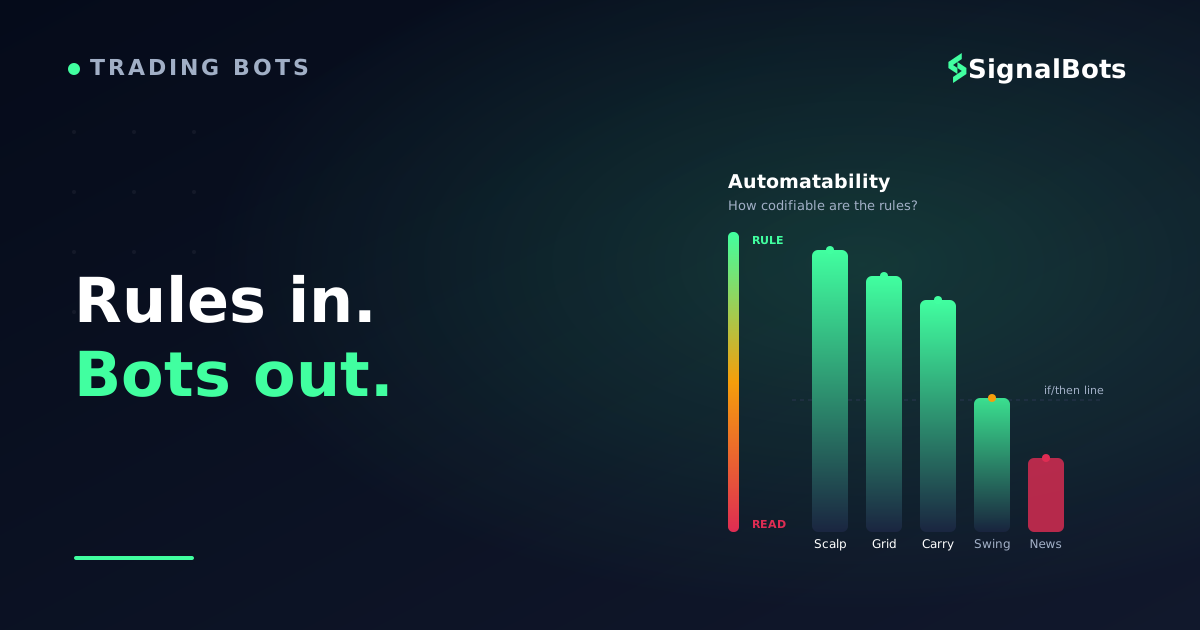
The automatability map
Style
How automatable
Why
Scalping
Fully — ideal fit
Mechanical technical triggers; edge is speed a human can't match.
Grid
Fully
Every order level and interval is a fixed number set in advance.
Breakout
Fully
Enters on a defined level cross — objective trigger, no hesitation.
Carry
Fully
A slow, rule-based hold for the swap; discipline, not timing.
Day trading
Mostly — if rules are fixed
Automatable when entries are indicator/level based, not a live read.
Range / retracement
Mostly
Fixed support/resistance zones codify; defining them still needs care.
Swing / position
Split — depends on the entry
A moving-average rule automates; a discretionary chart read does not.
Discretionary news
Resists
The decision is an interpretation of context that changes each event.
The pattern is consistent: mechanical triggers automate, interpretive judgment resists. The label of the style matters less than whether YOUR version is a rule or a read.
Why "Backtestable" Is the Real Prerequisite
Writing rules is only half the prerequisite. The other half is that those rules must produce a measurable edge you can prove on historical data before you risk money. If you can backtest the strategy — run the exact same rules over past price and read out a win rate and a reward-to-risk profile — then you have something a bot can run and something you can trust it to run.
This is why a vague rule fails twice over. "Buy when it looks oversold" can't be coded, and even if you forced it into code, you couldn't backtest it consistently, because "looks oversold" isn't a fixed input. Objective rules and backtestability are two faces of the same requirement: fixed, observable inputs.
Here's the piece traders under-appreciate: automating a strategy makes its risk numbers concrete, and concrete numbers can be judged. A rule-based system has a defined entry, stop, and target on every trade — so its reward-to-risk ratio isn't a vibe, it's a measurement. Play with the ladder below to feel how the stop and target placement define the edge a bot would execute mechanically on every trade.
Feel the math
An automatable rule has NUMBERS, not feelings
Long setup
Reward zone+0.0060
Risk zone−0.0030
TP 1.0910
Entry 1.0850
SL 1.0820
Reward-to-risk ratioYou aim for 2.00x what you risk
1 : 2.00
Risk (1R)
0.0030
Reward
0.0060
Break-even win rate
33.3%
A bot needs a fixed entry, stop and target on every trade. Move the levels: the reward-to-risk and the break-even win rate update instantly — that measurability is exactly what makes a rule codifiable.
If your strategy can't produce these three numbers before the trade, it isn't ready to hand to a bot.
Because these are illustrative figures, not a promise of results, treat any automated system's output as a historical, backtested profile — and read our risk warning before running one live. A bot removes emotion; it does not remove market risk.
Partial Automation: the Realistic Middle
Most real strategies aren't purely one or the other. They're a mix of mechanical rules and a few judgment calls. The mistake is treating automation as all-or-nothing and giving up because "my strategy has a discretionary part."
The better mental model is isolate and delegate. Break your strategy into its parts, then hand the machine only the parts that are rules:
Let a bot handle the timing-critical execution — the millisecond entry, the exact stop placement, the trailing exit — where a human is slow and inconsistent.
Let a bot enforce your risk rules without flinching — position size, max open trades, the daily loss limit you always break manually.
Keep the contextual judgment for yourself — whether today's macro backdrop even suits your setup, or whether to sit out entirely.
A connected setup makes this practical: signals or rule triggers can flow to your MetaTrader terminal through an MT4/MT5 connector so the mechanical execution happens automatically while you retain the on/off decision. That's how most disciplined traders actually run — not a black box that replaces them, but a tireless executor of the parts they'd otherwise fumble under pressure. If you want a rule-based signal feed to build on, our forex signals are structured as objective triggers, and the forex trading tools help you turn a fuzzy idea into the fixed numbers automation requires.
Is Your Strategy Ready to Automate?
Before you write a line of code or buy an EA, run your strategy through this. Every box you can honestly tick is a part that's ready; every box you can't is a part that stays manual — which is useful to know, not a failure.
Tick what's true
Automation-readiness check for your forex strategy
0 / 7
My entry is a fixed, observable condition — not 'when it looks right'.
My exit is a defined price, time, or indicator flip, decided in advance.
My stop-loss and position size are numbers, not a moment-by-moment feel.
I have a maximum-exposure rule (max open trades or total risk) I can state.
I can backtest these exact rules on historical data and read out a win rate and reward-to-risk.
The rules don't quietly change based on my mood, the news, or how the last trade went.
For the parts that AREN'T rules, I've decided to keep them manual instead of forcing them into code.
★
Checklist complete — you’re cleared to proceed.
Full ticks means the strategy is ready to run mechanically. Gaps just show you which parts stay in your hands — that's partial automation done right.
FAQ
Can any forex strategy be automated?
No — only strategies whose entry, exit, and risk decisions can be written as fixed if/then rules. If a core part of your strategy depends on interpreting context, reading chart structure, or a gut feel you can't specify, that part can't be automated. Many strategies are partly automatable: the mechanical rules go to the bot, the judgment stays with you.
Which forex strategy is easiest to automate?
Scalping, grid, and breakout systems are the easiest, because their triggers are purely mechanical — an indicator cross, a fixed order level, a defined breakout. Carry trading is also very automation-friendly since it's a slow, rule-based hold with almost no entry timing to judge.
Why can't news trading be fully automated?
Because the profitable version of news trading is discretionary: you're judging whether a release beat expectations, whether it's already priced in, and whether the first spike is real. That interpretation changes every event, so it isn't a fixed rule. What is automatable is a news filter that pauses your other rule-based systems around high-impact events to protect them from the volatility spike.
What do I need before I automate a strategy?
Two things: objective rules (entry, exit, and risk written as observable conditions with no "it depends") and a backtestable edge (you can run those exact rules over historical data and measure a win rate and reward-to-risk). If either is missing, make the strategy specifiable and testable first — automating an unproven or fuzzy strategy just executes a bad idea faster.
Does automating a strategy remove the risk?
No. Automation removes emotional execution errors — hesitation, revenge trades, moving your stop — and enforces your rules consistently. It does not remove market risk, and it can't turn a losing strategy into a winning one. A bot faithfully executes whatever edge (or lack of edge) you gave it, which is exactly why the backtest matters before you go live.
Sources & Further Reading
Want to go deeper? These independent, authoritative sources shaped this guide — each one is worth reading in full:
The Forex Desk is the SignalBots editorial team responsible for our currency-market coverage. We research and write the guides, explainers and reference articles on how the majors, minors and crosses actually trade — sessions, spreads, swaps and the macro releases that move price.



Discussions 0
Leave a comment