You searched for a win-rate leaderboard. Not one ICT EA on the MT5 marketplace publishes a verified one.
GO
Gold ICT OrderBlock Expert— where to start, not what to trust
Free, so you produce the win rate instead of buying one
Order blocks, liquidity sweeps and structure shifts
XAUUSD only — a narrow, testable scope
Publishes no performance data, exactly like the other six
Best zero-cost test bed
Best for
#2ExpertSMCWidest concept coverage
#3Order Block EA MT5Simplest free option
#4Ultimate SMCLongest feature list
#5Stratum EARead its disclaimer first
Ranked on concept coverage, instrument scope, access model and red-flag severity — not on numbers nobody published.See the full comparison →
Seven ICT expert advisors for MT5, none with a verified track record — so the top pick is the one that costs nothing to disprove.
You already know what an order block is. You have already decided you would rather your rules fire at the New York open whether or not you are awake for it. What you want from this page is the shortlist: which expert advisor built on ICT logic is actually worth running on MT5, ranked by something harder than a sales page.
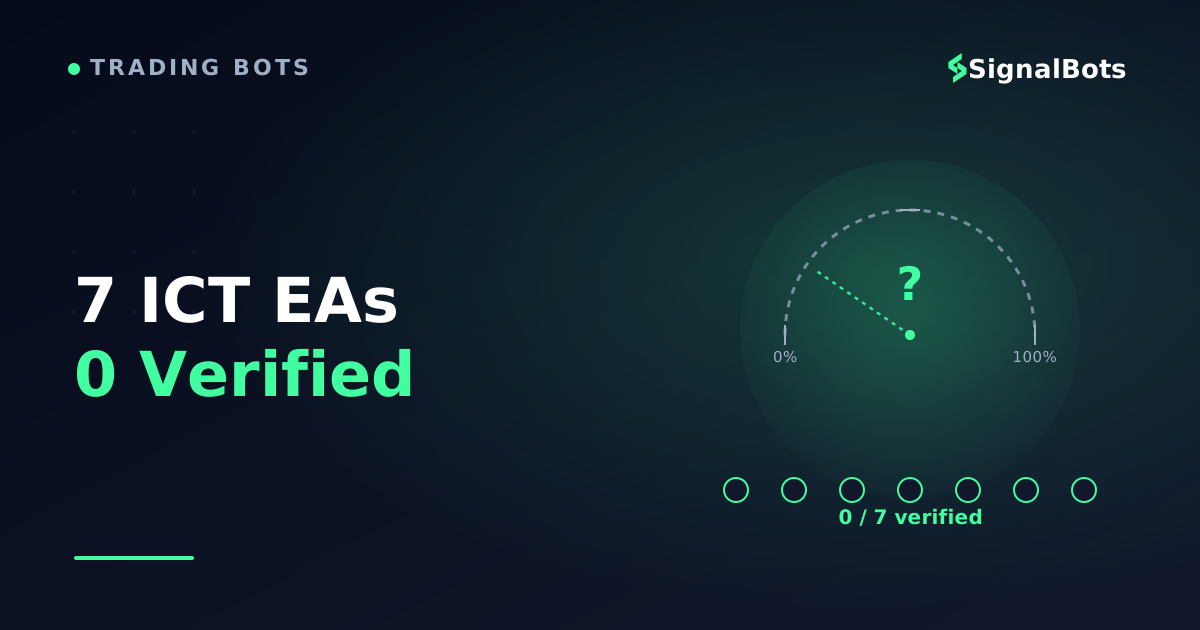
Here is the finding up front, because burying it would make this page the exact thing you are trying to get away from. That ranking does not exist yet. We opened seven named ICT and Smart Money Concepts expert advisors on the MT5 marketplace, one listing at a time, looking for a published win rate, a profit factor, a drawdown figure, or a link to a monitored account. Not one of the seven publishes any of it.
So this article does two jobs instead of one. It gives you the seven concrete options with what each actually automates, what it costs to try, and where each one's story gets thin. And it gives you the scoring standard this corner of the market is missing — so that the day an ICT EA finally does post a real track record, you will know within half a minute whether it means anything.
Key Takeaways
Seven named ICT / Smart Money expert advisors for MT5 exist, and not one publishes a verified live track record or a disclosed backtest win rate on its own listing.
With comparable performance numbers unavailable, the honest ranking axes are ICT-concept coverage, instrument and session scope, access model (two are free, the other five run $79–$249 outright), and red-flag severity.
Judge any EA on a proof ladder: a third-party-monitored live account beats a vendor-published tester report, which beats screenshots and vocabulary.
Before paying, re-run the vendor's own claim yourself: every MQL5 listing ships a demo build that runs in the MT5 Strategy Tester, so an unverified claim costs an afternoon to test rather than a licence fee.
Table of Contents (28 min read)Contents
Why Do "Best MT5 EA" Lists Skip ICT Entirely?
Every general "best MT5 expert advisor" roundup you have already scrolled past ranks a completely different population: trend-followers, grid systems, news traders, gold scalpers. Order blocks are not mentioned once. That is not an oversight, it is a selection rule.
A roundup needs something to sort by, and the only thing sortable in the EA market is a monitored account with a public history. So what those lists really publish is EAs that have a public statement, ordered by that statement. Products without one are invisible to the sorting step, and therefore to the list.
ICT and Smart Money products sit outside that population for two structural reasons, and both are worth understanding before you judge any of them.
The proof currency is different. An ICT buyer is persuaded by vocabulary — breaker blocks, inversions, killzones, the sweep-then-displacement sequence — because in that community fluency is the credential. A listing that names nine concepts correctly reads as competent to an ICT trader in a way a profit-factor table never quite does. Developers respond to the demand in front of them.
A track record costs calendar time. Most ICT EAs are recent, single-developer products. A monitored live account is the one asset you cannot rush, buy, or optimise into existence; it takes months of real fills. New products in a young niche simply have not had them yet.
Put those together and the two shelves barely touch. Mainstream roundups ignore ICT because ICT products publish nothing sortable, and ICT products publish nothing sortable because their audience never made it a condition of the sale. That gap is the reason your last three searches wasted your time — and it is the reason this page exists.
How We Score an ICT EA, and Why Proof Outranks Features
One question ranks an expert advisor better than any feature list: how much of what it claims can you check before you pay? Everything below is a way of answering that, and it produces three tiers.
Tier 1 — a verified track record. A monitored account where a third party, not the developer, records every fill. The account, its equity curve and its trade list are readable by a stranger. This is the only tier where a historical win rate carries real information, because it was produced by live fills at live spread with live slippage, on an account nobody could quietly restart after a bad month.
Tier 2 — a vendor-published backtest. A complete tester report on the listing: net profit, profit factor, maximum drawdown, trade count, symbol, timeframe, date range and modelling mode. It is the developer's own number and you label it as such — but it is a checkable number, because you can reproduce the run yourself and see whether it survives contact with your broker's data.
Tier 3 — nothing published. Screenshots, an animated GIF of a winning sequence, a video thumbnail, a paragraph of concept vocabulary. Nothing to re-run, nothing anyone independent recorded.
The proof ladder every ICT EA is ranked on
How much can you check for free?The only question that separates these products
Tier 1 · Trust the number
Verified live track recordA third party records every fill on a real account
Tier 2 · Check the number
Vendor-published backtestFull tester report you can re-run yourself
Tier 3 · Assume nothing
Screenshots and adjectivesFeature lists, GIFs, a video thumbnail, no data
All seven ICT EAs checked for this article currently sit on the bottom rung — not because they are bad, but because nothing on their listings can be checked.
Checkability, not honesty, is what the tiers measure: a Tier 3 EA may be excellent, but you cannot find out before you pay.
Two things about this ladder matter more than the tiers themselves. First, it measures checkability, not honesty — a Tier 3 expert advisor may be genuinely excellent, and you have no way of establishing that before your money is gone. Second, it is a standing bar, not a verdict on this year's crop. The moment any ICT EA posts a monitored account, it jumps to Tier 1 and the ranking further down this page is obsolete. That is the outcome we would like this article to cause.
Why a High Win Rate Alone Can't Rank Anything
Even at Tier 1, a win rate is an input, not a ranking. The other input is the reward-to-risk ratio, and the two only mean something together.
Picture two ICT expert advisors. The first takes the optimal-trade-entry retracement with its stop just beyond the sweep and its target at the opposing liquidity pool; it is wrong more often than it is right, and each win pays roughly three times each loss. The second scalps the first displacement candle for a fraction of its risk and is right most of the time. The second has by far the better headline number and by far the worse expectancy. A ranking built on the headline would invert reality.
Why the headline number is not a ranking
Where a win rate actually turns profitable
Hover a cell to see the expected value per $100 risked.
Expected value per $100 risked. Hover any cell: a high win rate at a poor reward-to-risk ratio still bleeds, which is why a win rate on its own ranks nothing.
That is why a published win rate becomes a ranking input only when sample size, reward-to-risk and drawdown arrive attached to it. On its own it is a headline. If you want to feel the effect on your own numbers rather than a generic grid, our risk-reward calculator shows the break-even win rate any stop-and-target pair implies. Validating the figures themselves — the backtesting methodology behind the win-rate numbers — is a separate discipline from choosing which EA to point it at, and it deserves its own treatment.
The Honest Finding: Not One of the Seven Publishes a Win Rate
Seven named ICT or Smart Money Concepts expert advisors for MT5, checked one listing at a time: Ultimate SMC, EA ICT Price Action MT5, Gold ICT OrderBlock Expert, Stratum EA, FVG EA Pro, Order Block EA MT5 and ExpertSMC.
Every one of them sits in Tier 3. None links a monitored live account. None publishes a tester report with a win rate, a profit factor and a drawdown figure attached to it. The nearest thing to a quantitative claim across all seven is a test date range on the ExpertSMC listing — a period, with no result beside it. A date is not a number.
We say that plainly because the alternative is what the category already does: invent a percentage, put it in a table, and let the table do the persuading. Every figure on this page is either a product fact taken from a public listing or a clearly framed hypothetical. Nothing here is a performance claim, and nothing about automated trading removes the possibility of loss — our full risk warning covers what that means before you commit capital.
What follows from the finding is the shape of the ranking below. It cannot be ordered by win rate, so it is ordered by three things that are actually observable: how much you can learn before spending anything, how completely the EA covers the ICT concepts you personally trade, and how severe the credibility problems on its page are. Seven real candidates, and nothing to rank them by — the ordering that follows is built on concept coverage and credibility, not on performance numbers.
The Red Flags That Turn a Headline Win Rate Into Marketing Copy
When one of these products does eventually publish a number, you will need to judge it in the ninety seconds before the buy button starts looking reasonable. These are the flags that matter, in rough order of how often they appear:
Zero spread and no slippage modelled. An ICT EA that enters on displacement is trading the fastest, thinnest moments of the session. Remove the cost of crossing the spread there and you have removed the strategy's hardest problem.
Optimised and reported on the same history. The result is a description of the past, not a prediction — the textbook signature of overfitting.
No forward period held back. If no stretch of history was kept untouched, nothing has been tested; something has been fitted.
No trade count. Without it, a lucky handful of sequences is indistinguishable from an edge.
An equity curve with no maximum drawdown beside it. The rising line is the easy half of the picture.
A start date that arrives after the fact. A period chosen once the outcome is known is a choice, not a test.
"Our engine cannot be backtested." The newest flag, and the one worth dwelling on below.
Two of the seven listings supply real, concrete instances rather than hypothetical ones.
Stratum EA states that its own Strategy Tester results should not be treated as representative, on the grounds that the adaptive engine it runs live cannot be reproduced inside the tester. Read alone, that is unusually candid — more candid than most of the category. The problem is what does not follow it. No monitored live account is offered in place of the discounted backtest. You are asked to disregard the only checkable evidence and accept nothing in its stead, which leaves the product harder to evaluate than if it had published nothing at all.
FVG EA Pro carries buyer reviews on its own listing reporting real-world results materially below what the product page presents. That gap between the page and the purchasers is the classic curve-fitting signature: parameters tuned until the historical curve became a sales asset, then sold as though the curve were a forecast.
A backtest built to sell
Spread fixed at zero, slippage switched off
Parameters optimised on the same history the result is shown from
No forward period held back
Trade count absent, so a lucky handful looks like an edge
An equity curve with no drawdown reported beside it
A start date chosen after the fact, conveniently ahead of a strong trend
A backtest built to test
Real spread from your own broker feed, slippage modelled
Parameters fixed before the reported period begins
A forward stretch the developer never touched
Trade count published, so the sample can be judged
Maximum drawdown printed next to net profit
A period chosen because it contains conditions the strategy hates
The two reports use the same software. Only one of them is trying to find out whether the strategy works.
Every red flag on the left is a setting, not an accident — which is why an unexplained backtest tells you about the seller, not the strategy.
None of this obliges you to take a vendor's word for anything: every MQL5 Market product ships a demo build that runs inside the Strategy Tester, so any claim a listing makes can be re-run on your own broker's data before a licence fee changes hands. Running that check properly — real costs modelled, history the developer never mentioned, then a demo forward test long enough to mean something — is the separate discipline this page keeps deferring to rather than teaching, and it is worth reading before you judge any of the seven below.
The Seven ICT EAs for MT5, Compared
The order below is not a performance ranking, because the data for one does not exist. It runs from the options you can evaluate at zero cost, through the paid products whose concept coverage justifies a closer look, down to the listings whose credibility problems are severe enough that they belong at the bottom of any shortlist. Prices are the figures each MQL5 listing showed at the time of writing; marketplace pricing moves, so read them as the size of the commitment rather than as a quote.
The ranked list
ICT EA (MT5)
Access and price
Instruments
ICT concepts it automates
Performance data published
Biggest credibility gap
Gold ICT OrderBlock Expert
Free
XAUUSD only
Order blocks, liquidity sweeps, structure shifts, London/NY windows
None
Narrow scope, and nothing on the page to check
ExpertSMC
$169 one-time, or $50 for 3 months
Multi-symbol
BOS/CHoCH, breaker blocks, FVG, liquidity, Fibonacci, session windows
Its own listing calls the default inputs arbitrary
Stratum EA
$129 one-time, or $49 a month
Multi-symbol
BOS/CHoCH, order blocks, FVG, breaker blocks, liquidity pools
None — own backtest disclaimed
Discounts its own tester results, offers no live account instead
FVG EA Pro
$249 one-time, or $99 for 3 months
Multi-symbol
Fair value gaps
None on the listing
Buyer reports contradict what the page shows
EA ICT Price Action MT5
$79 one-time, no rental
XAUUSD only
Loosely ICT-flavoured price action
None
Least detail of the seven, no verification of any kind
Ordered by what you can learn before spending, then concept coverage, then how severe the credibility gap is — because the win-rate column would be empty for all seven. Prices as listed at the time of writing.
1. Gold ICT OrderBlock Expert
A free XAUUSD-only expert advisor built on order blocks, liquidity sweeps and market-structure shifts, with entries restricted to the London and New York sessions and a volatility-scaled risk setting. It publishes nothing about its results, exactly like the other six — but it is free, which converts the missing data from a dealbreaker into a weekend project. Who it is for: a gold trader whose ICT entries genuinely key off order blocks and sweeps, who would rather generate their own tester report than read someone else's.
2. ExpertSMC
The widest concept coverage of the seven: break of structure and change of character, breaker blocks, fair value gaps, liquidity, Fibonacci levels, and session windows including the Asian range and the New York midnight open. It sells for $169 outright, or $50 for a three-month rental (about $90 for a year), so you can size the cost of an evaluation to how serious you are rather than pay the full ticket to find out. Its listing carries a test date range with no result attached, which is the mildest credibility gap in the group — a period, not a claim. Who it is for: a trader whose setup depends on session context as much as structure, and who wants one EA to cover most of an ICT playbook rather than one concept of it.
3. Order Block EA MT5
Free, works on any symbol though it is tuned for trending instruments such as gold, and trades order blocks filtered by a moving average. It is the thinnest ICT implementation here — one concept plus a trend filter — which is a genuine advantage if you want to isolate whether order-block entries alone survive on your instrument. Who it is for: anyone testing the narrow question "do order blocks hold up on this pair without any other confluence," at no cost.
4. Ultimate SMC
The longest feature list of the seven — killzone timing, liquidity sweeps, fair value gaps, inverted fair value gaps, optimal trade entry and structure shifts — and, at $249 outright or $99 for three months, joint-priciest with FVG EA Pro. Its own listing tells you the default inputs are effectively arbitrary and must be tuned before use, which is honest and also a warning — an EA with that many interacting filters and no published baseline hands you a large optimisation surface and no starting point on it. Who it is for: an experienced ICT trader with the patience to optimise, who already knows which of those six concepts their edge actually depends on.
5. Stratum EA
Break of structure and change of character, order blocks, fair value gaps, breaker blocks and liquidity pools, sold at $129 outright or $49 a month — the only true monthly rental here, and the cheapest way to sample a paid listing — and driven by an adaptive engine the developer says the Strategy Tester cannot reproduce. The concept coverage is real. The evaluation problem is that the disclaimer removes the tester as a tool without replacing it with a live account. Who it is for: honestly, nobody who has not already seen it run — unless and until a monitored account appears, there is no route to checking it before you buy.
6. FVG EA Pro
A single-concept expert advisor trading fair value gaps, at $249 outright or $99 for three months — the top of this price range for the narrowest feature set on it. It publishes no metrics on its own listing, and its buyer reviews describe outcomes below what the page implies. Who it is for: a trader who wants the fair-value-gap leg of their strategy automated in isolation — and who treats the buyer-versus-page gap as a reason to insist on their own tester run first.
7. EA ICT Price Action MT5
A gold-only expert advisor described as ICT-inspired price action, and at $79 the cheapest paid entry of the seven — with the least detail of any listing here: no concept breakdown specific enough to reverse-engineer, a single screenshot, no verification of any kind. Who it is for: difficult to say, which is the point — when a listing does not specify which ICT concepts trigger its entries, you cannot match it to your strategy even in principle.
Matching an EA to Your Own ICT Playbook
With win rate off the table as a filter, three questions do the sorting instead. Work through them in order and the seven collapse to two or three quickly.
Which concept actually pulls your trigger? Not which ones you watch — which one, if it were absent, would mean no trade. If that is an order block, the two free options cover you and there is no reason to pay before testing them. If it is a fair value gap in isolation, FVG EA Pro is the only single-purpose tool here. If your entry requires a structure shift plus a sweep plus a session window all lining up, only ExpertSMC and Ultimate SMC list that full stack.
Which instrument and which session? Two of the seven are XAUUSD-only, which is either perfect or disqualifying depending on your pairs — there is no middle. And if your edge lives in specific windows, you need an EA with a genuine trading session filter rather than one that trades whenever a pattern appears; a killzone-based strategy running around the clock is not your strategy with extra trades, it is a different strategy.
How much discretion are you handing over? ICT as most people trade it involves judgment calls that no parameter captures: whether a sweep was convincing, whether displacement was real. An EA takes those calls away and replaces them with thresholds. The narrower products let you keep more of the decision by design; the wide ones take more of it. Neither is better — but choosing the wide one and then over-riding it manually is the worst of both, because you end up unable to attribute the results to anything.
Want to See Verified Setups Before You Automate?
The reason none of these seven can be ranked is that nothing on their pages can be watched. A win rate you cannot follow forward is a claim; a trade you can watch open, run and close is evidence. That distinction is the whole article, and it is also something you can go and build for yourself in a week without spending anything.
Our free live Forex signals feed exists for that. Each entry publishes a direction, an entry level, a stop-loss and a take-profit, timestamped when it fires — so you can note it, leave it, and come back later to see how the levels actually behaved against real price. Do that across enough setups and you build your own calibrated sense of what a genuine hit rate feels like, and of how often a clean-looking level fails. That reference point is what makes the next vendor's headline win-rate claim land as a number you can weigh, rather than one you can only accept or reject on instinct.
It is not an ICT product and it does not pretend to be. The feed is not tagged by order block, killzone or fair value gap, it will not tell you which ICT concept produced a level, and it is not an installable MT5 expert advisor — you act on it by hand or route it into your own tooling. It replaces none of the automation discussed above. What it gives you is a transparent, watchable reference of your own before you trust anybody else's unverifiable one.
If None of These Fit, Build Your Own
There is a real possibility that after working through the three questions above, none of the seven matches the way you actually trade — and given how specific most ICT playbooks are, that is the likely outcome rather than the unlucky one. If your edge is the sweep of a particular session's high followed by a structure shift on a timeframe you have chosen deliberately, no general-purpose listing is going to reproduce it, and tuning someone else's six-filter EA until it approximates your rules is more work than writing your rules down properly.
Building your own ICT EA is the other route, and it changes the evaluation problem completely: you know exactly what it does, the backtest is yours, and nothing on the page can mislead you because there is no page. The concepts are all mechanically definable, which is the part that surprises people — a sweep is a level taken and reclaimed inside a defined window, a structure shift is a specific sequence of highs and lows, and both reduce to conditions a script can evaluate on every bar.
Either way, the discipline from this article travels with you. Hold your own strategy to the same proof ladder you would hold a vendor's, because being the developer removes none of the ways a backtest can flatter you — it just removes the person you would otherwise blame.
You arrived wanting
“the ICT EA for MT5 with the best backtested win rate”
and what the market actually offers is
seven products, zero verified numbers, and a testing plan you run yourself.
The shortlist is real. The leaderboard is not — yet.
Seven named ICT expert advisors for MT5 exist and each automates a genuinely different slice of the methodology, so the choice in front of you is a concept-coverage choice, not a performance choice. Start with a free one on gold, run it in the tester against history its developer never mentioned, and keep the proof ladder handy — the first ICT EA to post a monitored live account jumps straight past all seven, and you will know it in thirty seconds.
Test before you trust: the cheapest ICT EA to evaluate is the one that costs nothing to disprove.
FAQ
Is there any ICT EA for MT5 with a verified live track record?
Not among the seven named ICT and Smart Money Concepts products checked for this article. Verified monitoring is a normal, widely used mechanism in the broader MT5 EA market — plenty of trend and scalping robots link a third-party-monitored account — so the absence here is not a platform limitation. It is a choice this corner of the market has not yet made. Check the listing yourself before assuming it still holds: the first ICT EA to publish one deserves to be found.
What win rate should an ICT EA have?
There is no target number, and any vendor who gives you one without naming its reward-to-risk ratio is telling you nothing. An EA taking optimal-trade-entry retracements toward a distant liquidity target can be strongly profitable while losing most of its trades; a fast displacement scalper can win the large majority of them and still bleed after costs. Ask for win rate, average reward-to-risk, maximum drawdown and trade count as a set — individually they are all unfalsifiable.
Are the free ICT EAs worse than the paid ones?
On published evidence they are identical, because none of the seven publishes any. What differs is concept coverage: the two free options implement order blocks with supporting logic, while the wider paid products add session windows, breaker blocks, fair value gaps and structure shifts. The paid five run from $79 to $249 outright, with rentals from $49 a month, so the spread between the cheapest and the dearest is real money for no difference in evidence. Since price buys features rather than proof here, running a free one through the tester first costs you nothing and tells you whether an ICT EA behaves the way you expect on your instrument before you spend anything.
Can an expert advisor really trade order blocks and fair value gaps?
The detection is mechanically definable — both concepts reduce to relationships between specific candles that a script can evaluate bar by bar, which is why so many of these products exist. The harder part is not detection but qualification: deciding which of the many valid zones on a chart is the one worth trading, a judgment discretionary ICT traders make constantly and mostly without articulating. That gap between detecting a pattern and selecting a trade is where these EAs differ from each other far more than in their feature lists.
Should I trust a backtest with no losing months?
Treat it as a warning rather than an achievement. A smooth curve is the natural product of optimising parameters against the same history the curve is drawn from, and it is far easier to manufacture than a merely good result. What is genuinely hard to fake is a report that shows a bad stretch, states its maximum drawdown honestly, and still finishes ahead — with a trade count large enough that the outcome was not luck.
Do ICT EAs only work on gold?
Several are gold-only by design — two of the seven here restrict themselves to XAUUSD, and a third is tuned for it — because gold's volatility produces the large displacement moves ICT logic keys on, and because that is where the buyers are. The concepts themselves are not instrument-specific. But an EA optimised on gold's volatility profile will not transfer to a quiet major pair without re-testing, so treat any cross-instrument claim as something to verify in the tester rather than accept.
Sources & Further Reading
Want to go deeper? These independent, authoritative sources shaped this guide — each one is worth reading in full:
The Forex Desk is the SignalBots editorial team responsible for our currency-market coverage. We research and write the guides, explainers and reference articles on how the majors, minors and crosses actually trade — sessions, spreads, swaps and the macro releases that move price.




Discussions 0
Leave a comment