You have seen the pitch. A forex robot that trades while you sleep. An EA that never gets shaken out of a good position. A "fully automated strategy" that supposedly only needs a login. If you already trade currency pairs by hand — you read the chart, you decide, you click — the useful question is not whether the pitch sounds good. It is what actually changes when a program makes the decision, and whether any of it connects to the way you already trade.
This page answers that in forex terms rather than general ones. By the end you will be able to say what rule-based execution really is, why this market's own plumbing — no central exchange, five days of near-continuous trading, liquidity that swings with the clock — makes an algorithm behave differently here than it would on a stock exchange, what you genuinely gain and give up against trading manually, and what a realistic first step looks like.
Key Takeaways
Algorithmic trading in forex automates the decision, not the clicking — a trigger condition, an order instruction and a risk rule, written in advance and applied identically every time they come true.
Forex's market structure changes how those rules behave. Quotes are your broker's, not a central exchange's, so backtests and symbol names are broker-specific; liquidity and spreads swing with the session clock; and the weekend can gap straight through a stop.
The gains are coverage, consistency and testability; the costs are regime blindness, overfitted backtests and infrastructure that is now a trading risk.
A realistic path is: learn the mechanics, choose build-or-use, backtest then forward-test on demo, then go live small with hard limits — and confirm your broker actually permits automated execution first.
Table of Contents (35 min read)Contents
What Is Algorithmic Trading in the Forex Market?
Algorithmic trading in forex is currency trading in which a computer program — not you, in the moment — decides when to open, modify or close a position, by applying rules that were written down in advance.
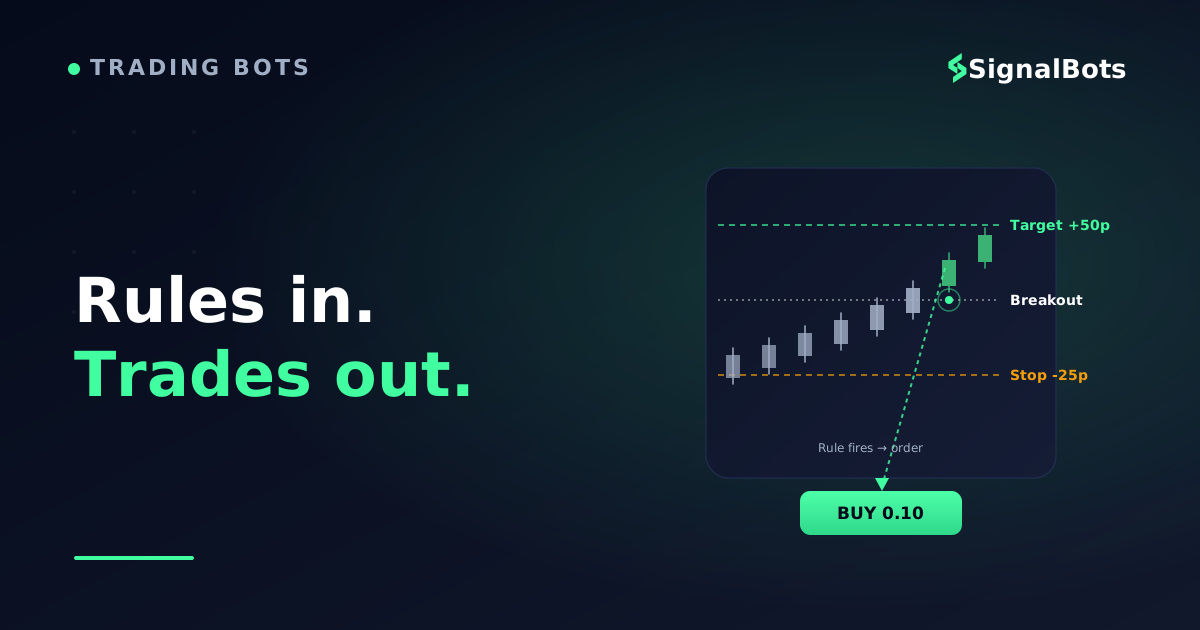
The load-bearing word there is decides. You are not automating your clicking; you are automating your judgement. A rule such as "if the 15-minute candle closes above the highest high of the last twenty candles, buy 0.10 lots of EUR/USD, place the stop 25 pips below entry and the target 50 pips above" is not a suggestion the program shows you and waits on. It is the entire decision, made once, then applied identically every time the condition is true — at 09:00 and at 03:00, after a winning week and after a losing one.
You will meet four words for roughly the same territory, and it helps to keep them apart:
Algorithmic trading — the umbrella idea: rules, written in advance, evaluated by a machine.
Auto-trading — the execution half of it. The rules do not just signal; they send the order.
Trading bot — the packaged program someone hands you, usually with the rules already inside.
Expert Advisor (EA) — forex's own native name for that program, inherited from MetaTrader, where most retail forex automation still lives.
None of that is specific to currencies. The market-agnostic foundation — what algorithmic trading is, how a written condition becomes a live order, what each moving part is called — reads the same whether the instrument is an index, a share or a crypto pair, and it is worth having straight before you add anything forex-shaped on top of it.
What is specific to forex is the venue. Three facts about it drive everything on this page:
There is no central exchange. Currencies trade over the counter, through a network of banks, liquidity providers and brokers quoting to each other.
The market runs almost continuously for five days, opening in Asia on Monday and closing in New York on Friday — then shutting entirely for the weekend.
Conditions inside those five days are not constant. Liquidity, spreads and typical range all move with the clock.
A human trader absorbs all three without ever stating them. A program has to be told.
How Rule-Based Execution Plays Out in the Forex Market
For the universal mechanics — how a condition gets evaluated on each new price, how the resulting order is assembled and sent — the general algorithmic-trading explainer does that job better than a recap here would. What follows is the forex layer that sits on top of it.
Strip any rule-based forex system down and you find three parts:
A trigger condition — the test that has to come back true. A price crossing a level, an indicator flipping, a candle closing somewhere specific.
An order instruction — direction, size, order type, where the stop goes, where the target goes.
A risk rule — how much of the account this one trade is allowed to cost, and how many trades may be open at once.
In forex, each of the three collides with something about the market itself. The trigger reads a price that is your broker's quote rather than a universal exchange print. The order lands at a venue whose spread widens and narrows through the day. And the risk rule has to survive a weekend, because the market closes on Friday and reopens on Sunday — occasionally somewhere else entirely.
Example: A Simple Forex Rule in Action
Suppose you trade EUR/USD on the 15-minute chart, and your rule is a plain range breakout. Written the way a program would read it:
Trigger: a 15-minute candle closes above the highest high of the previous 20 candles.
Order: buy 0.10 lots at market.
Stop-loss: 25 pips below the entry price.
Take-profit: 50 pips above it — a 2:1 reward-to-risk ratio.
Illustrative example
EUR/USD — the same breakout rule, drawn outEUR/USD15m
The rule has no opinion: the candle closes above the range high, the order goes out, and risk and reward are already fixed at 25 and 50 pips.
The range top sits at 1.0888. The breakout candle closes at 1.0895, the condition comes back true, and the program buys at 1.0895 with the stop at 1.0870 and the target at 1.0945. There is no "let me see one more candle," no widening the stop because the trade went against it first. That is the whole appeal, and it is genuine.
Now run that identical rule at two different times of day. Once at 13:00 UTC, in the middle of the London and New York overlap. Once at 23:00 UTC, after New York has closed and before Tokyo has properly warmed up. Same code, same pair, same signal shape — two materially different trades.
In the overlap, a lot of participants are quoting at the same moment. The spread sits near its tightest, the breakout has real interest behind it, and the fill lands close to the price that triggered it. In the quiet window, the same "breakout" may be a handful of ticks on thin participation: the spread is wider, the move has less follow-through, and the fill can come back worse than the trigger price. That gap between the price your rule saw and the price you actually got is slippage, and it comes straight out of the 2:1 you carefully designed.
You already handle this without noticing — you glance at the clock and think "it's dead out there." An algorithm has no such instinct. It only knows the hours you allow it, which is why a trading session filter is usually the first thing a forex rule set gains after the entry logic itself.
Why Forex's 24/5, OTC Structure Changes How Algorithms Behave
Forex has no single tape. The price your algorithm reads is one broker's view of a decentralised network — which is why a backtest is a statement about that broker as much as about the strategy. There is no central exchange, so there is no single price. Forex is an over-the-counter market: quotes come out of a network of banks, liquidity providers and brokers dealing with one another, not off one venue's tape that everybody reads. The EUR/USD price your algorithm sees is your broker's price, sourced from its own liquidity, and a broker down the road can be showing something a fraction different at the same instant.
That has three practical consequences for anything automated:
A backtest built on one broker's history will not necessarily reproduce on another's feed, because the two feeds are not the same data. A strategy whose edge is a pip wide is really a statement about one broker.
Brokers name the same instrument differently — EURUSD, EURUSD.m, EURUSD.pro — so symbol mapping is a real chore rather than a detail. A rule aimed at a symbol string the broker does not use simply never fires.
Execution speed is a property of your broker and your connection, not a constant of the market. Two traders running byte-identical rules can get measurably different fills.
The clock is part of the strategy. Because forex never really closes during the week, "when" stops being background and becomes a rule input. The four session windows overlap in a fixed pattern, and liquidity follows that pattern rather than the calendar date.
Why the hour matters
One forex day, in UTC24-hour clock · times in UTC
UTC timeline
SydneyAESTTokyoJSTLondonGMT/BSTNew YorkEST/EDT
21:00–24:0021:0000:00–6:00–6:00
0:00–9:000:00
7:00–16:007:00
12:00–21:0012:00
000306091215182124
Tokyo + Sydney0:00–6:00 UTC · Calmer, narrower ranges
London + New York12:00–16:00 UTC · Deepest liquidity of the day
Sydney
Tokyo
London
New York
Overlap (peak liquidity)
London and New York overlap for roughly four hours a day, and that window is where spreads are tightest and moves carry furthest. An algorithm given no trading hours treats it and the dead stretch after the New York close as one market.
Your rule does not change through the day — the market it fires into does.
Those bands are in UTC, so line them up against your own clock before you write an algorithm's trading hours into the rules — the stretch that feels like a normal working evening where you live can be the deadest hour of the market's day.
Near-continuous is not continuous. The one hard stop in the forex week is the weekend, and it is where automation gets caught out. Between the Friday close and the Sunday open, news keeps happening while the market cannot price it — so trading can resume at a level the previous session never traded through. That jump is a price gap, and a stop-loss cannot protect against it: a stop is an instruction to exit at a price, and over a gap that price may never exist. Any position an algorithm holds through Friday inherits whatever the weekend does.
None of this is an argument against automating forex. It is an argument for building the market's actual shape into the rules — hours, spread limits, weekend behaviour, symbol names — instead of writing a rule that would only be true on a market with an opening bell.
Benefits and Risks of Automating Your Forex Trades
Weigh this the way you would weigh any tool: by what it reliably does and what it reliably costs.
What you actually gain:
Coverage. The market runs five days straight and you do not. Rules can watch the Tokyo session while you sleep, and act at the London open before you have opened a chart.
Consistency. The rule that says skip this one applies just as hard after three losses as after three wins. Most of the damage in a discretionary forex account comes from the trades the plan did not contain.
Testability. A written rule can be run over history and over a demo account before it costs you anything. A feeling cannot.
Reaction time. Between a condition becoming true and an order arriving, a program is not the bottleneck.
What you take on:
Rules keep firing when conditions change. A breakout rule built in a trending stretch will keep buying breakouts in a range that has stopped producing them. It has no way of noticing that the regime moved.
A historical test flatters. It is very easy to tune a rule until it looks excellent on data it has already seen, and much harder to make it hold up on data it has not.
Costs the test never charged you. Spread widening around scheduled news, requotes, and slippage on the fill all live in the gap between a clean backtest and a real account.
Infrastructure becomes a trading risk. A dropped connection, a laptop that sleeps, a platform update mid-session — these are now ways to lose money, which they never were when you clicked manually.
One flag worth naming plainly: treat any forex bot marketed as "risk-free" or as a guaranteed win rate as a warning sign rather than an offer. The claim itself tells you how the seller thinks about risk.
How Forex Traders Get Started with Algorithmic Trading
There is no single on-ramp, and the platform matters far less than the order you do things in.
Getting started
The order most forex traders actually go in
1
Get the mechanics straight
Know what a trigger, an order instruction and a risk rule are before you evaluate anyone's product. This page is that step.
2
Decide: build it or use one
Write your own rules on a platform or through a broker API, or start from a packaged bot, an EA, or a rule-based signal feed you act on.
3
Test where being wrong is free
Backtest the rules over history, then forward-test the same rules on a demo account against live, unseen prices for a few weeks.
4
Go live small, with hard limits
Size positions so a bad stretch is survivable, set a maximum daily loss, and decide in advance what makes you switch it off.
Skipping step three is the single most common reason a technically sound forex algorithm still loses money.
Route one: build it. You write the rules yourself — in your platform's own language, or against a broker API if your broker exposes one — and you own every part of the result, including the bugs. This route is slower, and it is the only one that teaches you exactly why the system does what it does.
Route two: use something already built. A packaged trading bot, a ready-made EA, or a rule-based signal service that produces the decision and leaves the execution to you. Faster to start, and the trade-off is that somebody else's assumptions are now inside your account. The judgement you cannot outsource is whether those assumptions are any good.
Either route eventually forces the same question: what should the rules actually be? The menu of algo trading strategies applicable to forex — trend-following, mean reversion, breakout, range-fade, carry — is a separate decision from learning how automation works, and choosing badly there is the most common way a technically sound setup still loses money.
Whichever route you take, test in two stages before real money is involved. A backtest replays the rules over historical prices and tells you how they would have behaved. Its failure mode is overfitting: adjusting parameters until the curve looks beautiful on the exact stretch of history you tuned it on, which proves nothing about next month.
Then forward-test the same rules, unchanged, on a demo account against live prices for several weeks. This is the stage that catches the forex-specific problems — the spread widening you did not model, the hours where your edge quietly disappears, the weekend behaviour you never specified. Demo fills are still friendlier than live ones, so treat the result as an upper bound rather than a preview.
When you do go live, go live small enough that being wrong is boring. Fix the risk per trade first and let position size follow from the stop distance rather than the other way round: the stop belongs to the rule, and the size is simply whatever makes that stop cost the fixed, small share of the account you decided on in advance.
Before any of that, though, there is a shorter list — things that have to be true about your setup rather than your strategy.
Before you start
Forex-specific readiness: can your setup actually run an algorithm?
0 / 7
Your broker permits automated execution on the account type you intend to use — some restrict or forbid it, and some restrict it only on certain accounts.
You know which price feed the rules will read, and that your backtest history came from that same feed rather than a different broker's.
You have checked how your broker names the symbols you trade, because a rule pointed at the wrong symbol string simply never fires.
Something keeps the program running around the clock — a machine that does not sleep, close the lid, or drop its connection mid-session.
You have decided what the algorithm does into a weekend: flatten before the Friday close, or hold and accept the gap risk on the Sunday open.
You know your leverage and margin terms well enough to say what happens when several positions are open at once, not just one.
There is a manual off switch you can reach quickly, and you know what would make you use it.
★
Checklist complete — you’re cleared to proceed.
These are questions about your setup, not your strategy — and every one of them can stop a working strategy dead.
Two of those deserve a note. Brokers genuinely differ on algo trading permission, and finding out after you have built something is an expensive way to learn it. And because the market runs while you are asleep, most people running anything continuously end up on a VPS rather than a home machine — not for speed, but so the thing stays awake.
See What a Rule-Based Forex Signal Looks Like
Everything above describes rules producing output. It gets considerably easier to grasp once you have seen the output itself, in live conditions, rather than only reading about it.
Our free live forex signals feed publishes real-time buy and sell alerts across the major pairs, generated by rule-based technical logic. Each alert carries the same pieces a rule set produces internally — direction, pair, the level it fired at, the time it fired — so you can watch across a few sessions how a mechanical process behaves when it is not being edited: how often it fires, how the London and New York hours differ from the quiet ones, and what a run of consecutive losses looks like when nobody intervenes.
Be clear about what that is and is not. It is a signal feed, not an execution system: the alert arrives, and you — or a setup you have built yourself — decide what to do with it. It does not size, place or close trades on your account. If what you want is genuinely hands-off, end-to-end execution, a signal feed is not that, and you should treat it as a way to study rule-based output rather than a substitute for building or buying a full system.
Where This Leaves You
Go back to the pitch you started with. The forex robot that trades while you sleep is not a different species of trading — it is your own decision, written down precisely enough that a machine can apply it at three in the morning without you there. What that buys is consistency and coverage. What it costs is the discretion you used to apply without noticing, the instinct that says it's thin out there tonight, which you now have to encode explicitly or lose entirely.
The market's own shape is the part most explanations skip, and it is the part that decides whether a forex algorithm survives contact with a live account. Currencies trade over the counter, around the clock for five days, at conditions that change by the hour and stop dead at the weekend. An algorithm inherits all of it. Build those facts into the rules, test them somewhere that being wrong is free, and the question stops being should I automate and becomes the more useful one: which of my rules is actually worth automating?
FAQ
Do you need to know how to code to trade forex algorithmically?
Not to start. If you use a packaged bot, an existing EA, or a rule-based signal feed you act on manually, no code is involved at any point. Coding becomes necessary the moment you want rules nobody has written yet — or the moment you want to know exactly why the system did something, which is hard to answer about software you cannot read. Many traders spend a long time on the no-code route first and only learn to code once they have a rule of their own worth building.
Is algorithmic forex trading legal?
Rule-based and automated execution is a normal, widely used part of the currency market, from bank desks down to retail accounts, and regulators treat it as a regulated activity rather than a prohibited one. Two things still need checking on your side: that your broker permits automated execution on your account type, since some restrict it, and that retail forex or CFD trading is itself permitted where you live, because that varies far more by country than the automation question does.
Can a forex algorithm really trade 24 hours a day?
For five days a week, yes — the currency market runs from the Asian open on Monday to the New York close on Friday, and a program does not need to sleep through any of it. It cannot trade the weekend, because the market is shut. Whether it should trade all five days is a separate question: the quiet hours between the New York close and the Asian open carry wider spreads and thinner participation, and many rule sets perform noticeably worse there than in the busy windows.
What is the difference between a forex EA and a trading bot?
Mostly vocabulary and platform. "Expert Advisor" is MetaTrader's own term for a program attached to a chart that applies coded rules to it, so in forex the two words point at more or less the same thing. "Trading bot" is the broader, platform-neutral word, used just as often for crypto and for tools that run outside a trading terminal entirely. If someone selling you an EA and someone selling you a bot describe identical behaviour, they are describing identical behaviour.
How much money do you need to start?
There is no universal minimum, and the real constraint is not the broker's account minimum — it is the relationship between your stop distance, your position size and the share of the account a single loss is allowed to cost. An account too small to size a position properly forces you into stops that are too tight for the rule you are running, which is how a sound strategy gets stopped out by ordinary noise. Work backwards from the risk per trade your rules assume, and start on demo until that arithmetic is comfortable.
Sources & Further Reading
Want to go deeper? These independent, authoritative sources shaped this guide — each one is worth reading in full:
The Forex Desk is the SignalBots editorial team responsible for our currency-market coverage. We research and write the guides, explainers and reference articles on how the majors, minors and crosses actually trade — sessions, spreads, swaps and the macro releases that move price.




Discussions 0
Leave a comment