Your ICT read works on forex. You have spent months marking displacement on EUR/USD, waiting for the London killzone to open, refusing to trust a break of structure until the candle actually settled. Then you point the same Expert Advisor at BTC and one of two things happens: it fires all night on wicks that mean nothing, or it sits idle for a week waiting for a session that never opens.
Nothing is wrong with your ICT logic. The problem is that an EA does not trade concepts — it trades events. A bar closing. A session starting. A day rolling over. Forex hands it all three for free. Crypto hands it none of them and quietly substitutes lookalikes that pass every syntax check and fail every intent check. This page maps what survives the jump untouched, what breaks silently, and which follow-up question is actually yours.
Key Takeaways
ICT concepts describe order flow, so they travel between markets — but three of the five links in an automated ICT entry reference a market clock crypto does not have.
The silent breakage is the closing candle: in forex it is a real rollover, in crypto it is a label a venue drew at 00:00 UTC, so calendar-day bias must become a rolling lookback.
Killzones are causal in forex and only borrowed from traditional-market hours in crypto; funding on perpetuals is the one mechanic with no forex equivalent at all.
One EA file can run both markets, but never one settings file — session filter, bias lookback, weekend rule and position sizing all have to differ per market.
Table of Contents (22 min read)Contents
Why the Same ICT Playbook Needs Two Different Setups
ICT — Inner Circle Trader's dialect of smart money concepts — is a description of order flow, not of a trading calendar. Stops accumulate somewhere obvious. Price runs them. A displacement leg tears back through structure. Price returns to the inefficiency that leg left behind. Read that sentence again and notice what is missing: any reference to what time it is, or whether an exchange is open. That is precisely why the framework travels between asset classes at all.
An Expert Advisor is a different animal. It cannot "read" anything. To run your discretionary process mechanically, that process has to be flattened into a chain of discrete, testable events — and each link in the chain has to be true of the instrument you point it at.
The chain your EA actually runs
The five links in an automated ICT entry
1
Set the higher-timeframe bias
Read the previous settled session or day to decide whether today's entries are long-only, short-only, or off.
2
Open the session window
Allow entries only inside the time window the strategy trusts — London, New York, or the London close.
3
Mark the liquidity pool
Locate the resting stops: equal highs and lows, session extremes, the prior range boundaries.
4
Confirm the sweep on a close
Require a closed bar beyond the pool, then a displacement leg back through structure, before arming an entry.
5
Size, place, and manage
Convert stop distance into a position size for that symbol and contract type, then send the order.
Only one of these five links is genuinely market-agnostic — the rest quietly depend on a market clock or a contract type.
Look at where each link gets its truth. Step 3 — marking the pool — is pure price geometry and ports to any market that has a chart. Steps 1, 2 and 4 all reference a market clock: a settled day, a named session, a bar that closed for a reason. Step 5 references the venue's contract semantics. So the honest framing of the crypto-versus-forex question is not "does ICT work on Bitcoin." It is: three of the five links in your automation reference a clock, and crypto does not have the clock they were written against.
Crypto vs Forex Market Structure, Side by Side
Before any reconfiguration decision, get the structural differences in front of you in one screen. Most of these rows are familiar as trading trivia; the point here is which of them an EA can actually see.
Structural comparison
Dimension
Forex (session-based)
Crypto (continuous)
Trading week
Opens Sunday evening UTC, closes Friday evening UTC, shut over the weekend
Never closes — no weekly open, no weekly close, no weekend
Daily candle close
A real rollover at the broker's server midnight; the day's range is finished
A clock boundary the venue picked, usually 00:00 UTC; nothing settles
Session structure
Sydney, Tokyo, London and New York hand over to each other in sequence
No native sessions; the only rhythm is borrowed from equity and futures hours
Who supplies liquidity
Bank dealers and non-bank market makers on a decentralised OTC network
Exchange order books, visible on-screen, plus automated market makers
Cost of holding overnight
A swap the broker charges or pays you at rollover — it does not move price
On perpetuals, funding paid between longs and shorts on a fixed schedule
Weekend behaviour
Market shuts, then reopens with a gap your EA has to survive
Keeps trading thin; the gap arrives later, when traditional markets reopen
Volatility rhythm
Shaped by the session handovers; a genuine overnight lull exists
Event-shaped and around the clock; no reliable quiet window
Killzone validity
Native — the windows exist because the desks behind them exist
Approximate — borrowed from the hours when the same desks trade indices
The flagged rows are where a forex-native EA breaks without throwing a single error.
Three rows above matter more than the others for automation, and they are the ones flagged in the table. The daily close is a real event in one market and an accounting convention in the other. Sessions are a real handover in one and a borrowed proxy in the other. And crypto adds a cash flow — funding — that has no forex equivalent at all, because a swap is charged to you by your broker while funding is paid between traders and therefore shows up in price.
Does ICT Still Need a Closing Candle When the Market Never Sleeps?
This is the single assumption most likely to break your port, and it breaks quietly. Start with what a closing candle actually gives an EA, as opposed to what it gives you.
To a human, a close is a reading aid. To an EA, a close is a commitment point — the instant at which a level either held or did not, and the wick that poked through it stops being negotiable. That is why almost every mechanical break-of-structure rule is written against a body close rather than a touch: the close is what turns a confirmation candle into a boolean. It is also the anchor for daily bias, because "yesterday" is only a usable reference if yesterday finished.
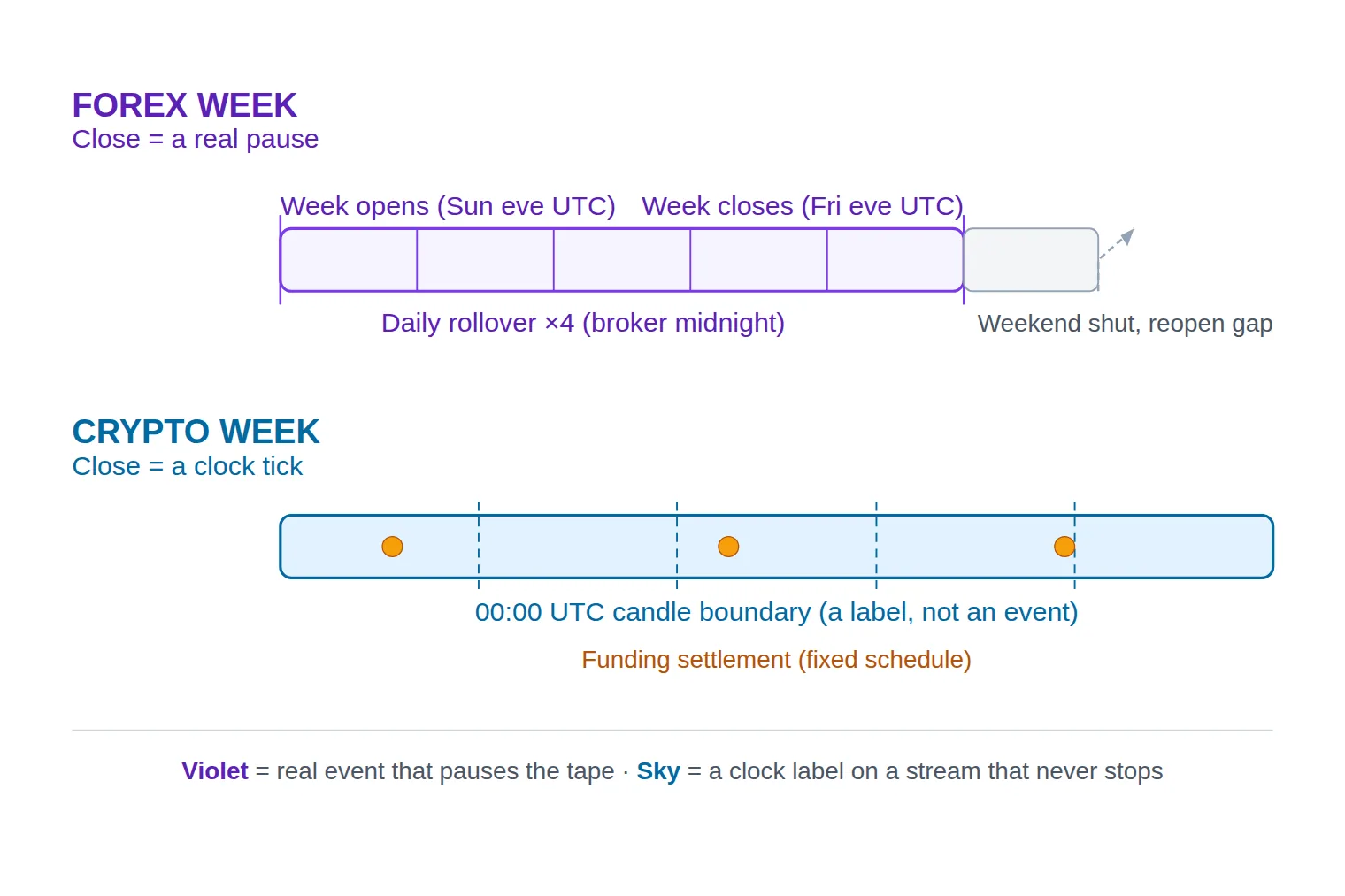
The forex week has real edges an EA can trigger on. The crypto week has only the boundaries a venue chose to draw.
In forex, both of those are underwritten by something real. Liquidity genuinely thins into the rollover, the book genuinely resets, and the new daily bar genuinely starts after a pause. The weekly open is a real event with a real gap, which is why ICT treats it as a reference point at all.
In crypto, neither is underwritten by anything. Midnight UTC is a labelling decision. Nothing pauses, no book resets, and two venues can legitimately draw different daily candles from the same tape. Your EA's daily-bias filter is therefore computed from an arbitrary slice of a continuous stream — and it will compute it with total confidence, because from inside the code the bar looks identical.
Four consequences follow, in rough order of how much damage they do:
Calendar-day bias becomes noise. "Yesterday's high and low" describes nothing a participant actually respected. Replace the calendar reference with a rolling one — a trailing 24-hour or 48-hour extreme, or a rolling volatility band — so the lookback describes recent behaviour rather than a date.
Close-based confirmation still works, but the timeframe boundary does not. Requiring a closed body beyond the pool is still a good wick filter, and you should keep it. What you must stop doing is caring which day the break landed in: a level broken two minutes before the boundary and one broken two minutes after are the same event wearing different date stamps. Judge the break by displacement magnitude — how much of the bar is body — not by its calendar position.
The weekly open has no crypto twin. If your logic references it, either drop the reference or substitute the moment traditional markets reopen, which is the closest thing crypto has to a scheduled participation change.
The clock your EA reads is probably not the clock your data uses. MetaTrader server time is typically two or three hours off UTC and shifts with daylight saving; a crypto venue stamps its candles in UTC and never shifts. Run a "new daily bar" gate across both and it fires at the wrong instant on one of them, forever, with no error. Clock drift between a terminal, a VPS and an exchange is the most boring bug in automated ICT and one of the most expensive.
The practical rule: keep close-based confirmation, delete calendar-based context, and make every time reference in the code explicit about which clock it means. If your EA also uses multi-timeframe confirmation, apply the same test to every timeframe in the stack, not just the daily.
How Liquidity, Killzones, and Institutional Flow Actually Differ
Forex sessions are not a convention someone invented for charting. They exist because the people providing liquidity are physically at desks in Sydney, Tokyo, London and New York, and they hand the book to each other. ICT killzones are a map of that handover — which is exactly why the London/New York overlap carries the reputation it does.
The clock your EA was written against
Where forex sessions actually sit (UTC)24-hour clock · times in UTC
UTC timeline
SydneyAESTTokyoJSTLondonGMT/BSTNew YorkET
22:00–24:0022:0000:00–7:00–7:00
0:00–9:000:00
8:00–17:008:00
13:00–22:0013:00
000306091215182124
Tokyo + Sydney0:00–7:00 UTC · The Asian range forms in here
London + New York13:00–17:00 UTC · Deepest book of the day
Sydney
Tokyo
London
New York
Overlap (peak liquidity)
A forex EA can gate entries on these bands because the desks behind them genuinely change over; crypto has no equivalent handover to gate on.
Crypto has no handover. There is no moment when one region's liquidity providers go home and another's arrive, because the providers are largely automated and never leave. What crypto does have is an imported rhythm: when the traditional trading day opens, the same institutions that trade index futures also take positions in the majors, and participation genuinely thickens. A "crypto killzone" is that borrowed window — a real effect, but a second-order one, and much weaker than the forex original. Treat it as a probability tilt, not a gate. If you want to see the underlying forex windows in your own timezone before wiring them into a trading session filter, the forex market hours tool lays them out.
There is a compensating advantage on the crypto side, and it is under-appreciated. Forex liquidity is off-book and has to be inferred — you reason about where stops must be sitting. Crypto liquidity is largely on-book and leverage makes stop placement partly mechanical, because liquidation levels are computable from position size and leverage rather than guessed. ICT's "liquidity resting above equal highs" is a more literal statement in crypto than it has ever been in forex.
Then there is the mechanic with no forex analogue at all. On perpetual contracts, a funding rate transfers cash between longs and shorts on a fixed intraday schedule, most commonly every eight hours. When positioning is lopsided, that schedule creates a standing, predictable incentive to push price into the settlement — a manipulation window that arrives on a timetable rather than at a session open. Nothing in forex does this: a swap or rollover fee is a financing charge between you and your broker, and it moves no one's price.
One Mechanic, Two Markets: What Changes and What Doesn't
Here is the short verdict on each mechanic you already use, so you can decide what is worth a deeper read before you click anywhere.
Killzones — forex-native, crypto-approximate. In forex the windows are causal; in crypto they are inherited from equity and futures hours and carry a weaker edge. A crypto EA that hard-blocks entries outside London hours is throwing away most of the tape for no reason. If your forex configuration is the one that needs tightening, the exact London and New York killzone hours and how to trade inside them is its own subject.
Judas swing — same shape, different trigger. The false move that sweeps liquidity before the real direction reveals itself is a behaviour, not a schedule, and it shows up in both markets. What differs is what sets it off: a session open in forex, versus a funding settlement or the traditional-market open in crypto. How the Judas swing behaves across forex and crypto sessions deserves its own treatment.
Fair value gaps — same geometry, different economics. The three-candle imbalance forms identically on any chart. What changes is frequency and quality: crypto's volatility prints far more of them, and a much larger share are noise rather than institutional footprints. If you port an FVG entry unchanged, raise the displacement requirement so only bars whose body dominates the range qualify. Whether fair value gaps actually fill alike in crypto and forex is a question with a real answer, and it is not the same answer in both markets.
Liquidity sweeps — more mechanical, less scheduled. Because leverage makes liquidation clusters calculable, sweeps in crypto are less inferential than in forex. The trade-off is that they can happen at any hour, including hours when nobody is at the screen. How liquidity sweeps behave in a market with no daily close is where this gets concrete.
Spot versus perpetual — the biggest execution fork on this list. This is not a nuance, it is a different instrument. Spot has no funding, no liquidation price, and no leverage; perpetuals have all three. An EA that sizes purely from stop distance behaves differently the moment a liquidation price can pre-empt the stop it just placed, and on the perpetual side a liquidation price calculator is worth running before you commit to a leverage setting. Deciding whether an ICT EA should trade spot or perpetual futures comes before every other setting here, and that choice is worth working through on its own.
Should You Even Automate ICT on Crypto? A Quick Verdict Preview
Short version: the concepts hold, the scaffolding does not. ICT describes how order flow behaves around pools of resting stops, and crypto has stops, leverage and displacement in abundance — arguably more legibly than forex does. What does not survive is the timing apparatus bolted around those concepts. Automate it if you are willing to replace calendar logic with rolling logic, accept a weaker signal outside the imported traditional-market windows, and treat crypto's bot-dense order flow as a real counter-argument rather than a detail. That counter-argument — whether ICT is worth automating on crypto at all once you account for how much of the flow is already algorithmic — is the full debate, and it is a separate one from this page's job.
Before You Flip the EA On: A Cross-Market Setup Checklist
Everything above collapses into three practical axes: the clock, the weekend, and the size. The clock decides when your EA is allowed to act, the weekend decides what it does with a market that stops (or doesn't), and the size decides whether one shared setting quietly leaves you far larger on one instrument than the other. Volatility differs enough between a major FX pair and a major crypto pair that one lot setting cannot be correct for both — derive each from its own instrument, and if you want to sanity-check the arithmetic, the crypto position size calculator does it in one screen.
Pre-flight
Cross-market pre-flight for one ICT EA
0 / 10
Express every time reference in the code as UTC, and confirm what your terminal's server time actually is — it is usually offset from UTC and shifts with daylight saving.
Confirm which hour each venue starts its daily candle, and make sure your bias logic reads that exact boundary rather than assuming midnight.
Replace calendar-day highs and lows with a rolling lookback window on every crypto instrument.
Decide the weekend rule per symbol: forex symbols must survive a reopen gap, crypto symbols must survive thin weekend liquidity with no gap.
Either gate crypto entries to the imported traditional-market windows deliberately, or disable the session filter — never leave forex hours in place by default.
Re-derive position size per instrument from its own volatility instead of sharing one lot or risk setting across both markets.
On perpetuals, verify the stop sits well inside the liquidation price at your chosen leverage.
Map symbol names per venue so the EA is not silently watching an instrument that does not exist there.
Forward-test each market separately, on its own configuration, before running both from one deployment.
Keep a kill switch tied to a consecutive-loss or daily-loss threshold — crypto trades at 3 a.m. whether or not you are awake.
★
Checklist complete — you’re cleared to proceed.
Work down this list once per market, not once per EA — the same file behaves like two different strategies.
Two items deserve emphasis because they are the ones people skip. Symbol naming is trivial until it isn't: the same asset can be quoted under different tickers and different contract suffixes across venues, and a symbol mapping mistake produces an EA that runs cleanly and trades nothing. And a kill switch is not optional on a 24/7 market in a way it arguably is on forex — the market that never closes is also the market that never waits for you to wake up.
Seeing the Difference in Real Signals
Once the "crypto liquidity never pauses" idea clicks, the natural next question is what that continuously running flow actually looks like — not as an argument, but as output. That is easiest to see side by side. Our crypto live signal feed streams signals around the clock with the same reward-to-risk context our forex feed only produces while sessions are open; watching both for a day makes the structural point far faster than another comparison table can, because you can literally see entries appearing in the hours where the forex column is empty.
Be clear about what that is and isn't. It is a feed to read and learn the rhythm from, not an execution layer — if your EA needs something to actually place the trade on an exchange, that is the job of a crypto MT4/MT5 connector or an exchange-specific bot, which is a different decision entirely.
Which Question Is Actually Yours?
You came here with one specific question hiding behind "does ICT work the same on crypto". Name yours and go straight to it:
"Is automating ICT on crypto even worth it?" — the efficacy argument, including the bot-versus-bot counter-case.
"How do I actually set it up on Binance?" — the click-by-click setup walkthrough.
"Should the EA trade spot or perpetual futures?" — the instrument choice, with funding and liquidation attached to it.
"What exactly are the killzone hours?" — the London and New York session windows in detail.
"How do I trade the Judas swing in each market?" — the setup itself, across both session models.
"Do fair value gaps fill the same way?" — the cross-market fill behaviour.
"How do sweeps work without a daily close?" — liquidity-sweep mechanics in a continuous market.
If you only remember one thing from this page, make it the reframe: you are not porting a strategy, you are porting a set of assumptions about time. The ICT read is the part that travels. The clock it was written against is the part you have to rebuild.
FAQ
Do ICT killzones work on crypto?
Partially, and for a different reason than in forex. Forex killzones exist because liquidity providers in different regions genuinely hand over to each other. Crypto has no such handover, so any "crypto killzone" is really the window during which institutions active in traditional markets are also positioned in crypto. That produces a genuine thickening of participation but a weaker, second-order edge — useful as a tilt in your EA's scoring, damaging as a hard entry gate.
What timeframe should an ICT EA use on crypto if there is no real daily close?
Keep whatever execution timeframe you already trust — the bar close on a 5-minute or 15-minute chart is still a valid wick filter regardless of market. What you should change is the context timeframe. Instead of anchoring bias to a calendar day whose boundary the market never observed, anchor it to a rolling window: a trailing 24-hour extreme, a rolling volatility measure, or the range since the last funding settlement. The logic stays the same; only the reference frame stops being fictional.
Does the funding rate actually move price, or is it just a fee?
Both, and that is what makes it structurally different from a forex swap. It is a payment between traders rather than a charge from your broker, so when positioning becomes lopsided there is a real, scheduled incentive for the crowded side to be squeezed before settlement. A forex swap is a cost you absorb; a funding rate is a cost that changes other people's behaviour, which means it shows up in the tape.
Can one EA run forex and crypto from the same settings file?
One EA file, yes. One settings file, no — not safely. At minimum the session filter, the bias lookback method, the weekend rule, and the position-sizing basis have to differ per market, because each of those encodes an assumption that is true in exactly one of the two. Treat it as one strategy with two profiles, and validate each profile independently before running them together.
What breaks first when you port a forex ICT EA to crypto?
Usually the time gates, and usually without an error message. Either the session filter blocks nearly everything because it is still holding London hours against a 24-hour instrument, or the "new day" trigger fires at the wrong instant because the terminal's server time and the venue's candle boundary disagree. Both look like the EA is working fine — it just takes very few trades, or takes them at strange moments — which is why they survive weeks of live running before anyone catches them.
Sources & Further Reading
Want to go deeper? These independent, authoritative sources shaped this guide — each one is worth reading in full:
The Crypto Desk is the SignalBots editorial team behind our digital-asset coverage. We research and write the guides and explainers on spot and perpetuals, exchange mechanics, funding rates and the 24/7 structure that sets crypto apart from every other market.



Discussions 0
Leave a comment