Every 'best copy trading platform' list ranks the same names — but they copy trades in completely different ways, and the wrong model quietly costs you control.
CT
Match the model to how you trade— not the leaderboard
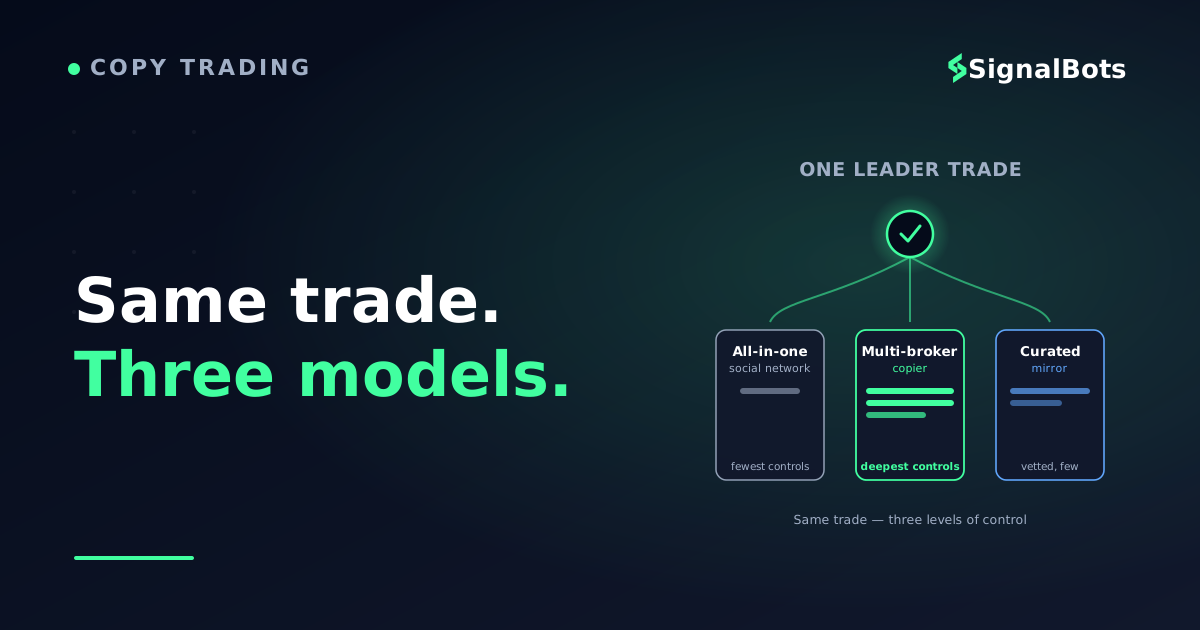
All-in-one social network: easiest to start
Multi-broker copier: most copier controls
Curated mirror: fewest, vetted strategies
Verify the track record before you copy
Decision-first
How to read this
#1eToroAll-in-one social
#2ZuluTradeMulti-broker copier
#3DupliTradeCurated mirror
#4NAGASocial + broker
Compared by model, markets, copier controls and track-record transparency — not by a headline win rate.See the full comparison →
There is no single 'best' platform — there is the model that fits how much control you want to keep.
You have probably read three "best copy trading platform" lists already, and they all crowned a slightly different name. That is the tell that these lists are answering the wrong question. The platforms they rank are not competing on which one is better — they are built on genuinely different copy-trading models, and the model you pick decides how much control you keep, how you vet the people you copy, and what happens on your account when a leader has a bad week.
This page compares the leading standalone copy-trading platforms the way a trader who cares about automation and risk control would: by model, by copier controls, and by how honestly each one lets you inspect the track record you are about to trust. If you already know you want a copy platform bundled with a specific forex broker, or one of the crypto-only copy platforms, those are separate decisions — here we stay on the standalone platforms that let you copy across markets.
Key Takeaways
The model matters more than the leaderboard. All-in-one social networks (eToro), multi-broker copiers (ZuluTrade), and curated mirror services (DupliTrade) copy trades in very different ways — pick the model that matches how much control you want to keep.
Copier controls are the real feature. Per-copy stop-loss, max-loss guards, position-size scaling and a one-click stop-copying button decide whether a bad week on a leader's account becomes a bad week on yours.
A track record you can't verify is a story. Favor platforms that show drawdown, sample size and how long a leader has traded — not just a headline win rate on a short, cherry-picked window.
You are still the risk manager. Copying automates the entry, not the judgement; size every leader as a position, keep a hard stop on the whole allocation, and diversify across uncorrelated strategies.
Table of Contents (20 min read)Contents
What "copy trading" actually does to your account
Before comparing platforms, be clear on the mechanic you are buying. In copy trading, you link your funded account to a leader (also called a strategy provider or signal provider), and every trade they open is mirrored onto your account — sized proportionally to your balance and risk setting, not theirs. When the leader closes, you close. The appeal is obvious: you get a systematic, emotion-free stream of trades without building a strategy yourself. The catch is just as important — you have outsourced the entry decision, but not the risk. That still sits with you.
The scaling is the part most beginners miss, so it is worth seeing rather than reading:
One leader trade, mirrored and scaled to each follower
Lead strategy accountBUY EUR/USD · risks 2% · 1.00 lot on $50k
Mirrored proportionally to each account
Follower — $2,0000.04 lot · same 2% risk
Follower — $10,0000.20 lot · same 2% risk
Follower — $25,0000.50 lot · same 2% risk
The leader's dollar size is irrelevant — what copies is the risk percentage, scaled to your balance. This is why a small account can follow a large leader safely.
Copying replicates the leader's risk, proportionally sized to your account — not their raw lot size.
This proportional scaling is why copy trading works for a small account and why it can still hurt one: a leader who risks too much per trade exports that same aggression to you, just smaller in dollars. That is the first thing a platform's controls have to let you rein in. If the mechanic is new to you, our plain-language explainer on what copy trading is and how it works covers it in full.
Three models hide behind one label
The word "copy trading" gets slapped on three different products, and telling them apart is most of the decision. Google groups them, but they behave differently once your money is on the line:
All-in-one social networks (eToro is the archetype) bundle discovery, the leader profiles, the copy engine and the execution venue into one app. You fund an account with them, browse traders, and copy inside the same interface. Lowest friction, least portability.
Multi-broker copiers (ZuluTrade, Myfxbook AutoTrade) sit between a huge network of leaders and a range of regulated brokers. You keep your money at a broker you choose, and the platform routes the copied trades into it. More setup, far more control and choice.
Curated mirror services (DupliTrade) hand-pick a small roster of vetted strategies and mirror them straight into your MetaTrader 5 or MT4 account. Fewer choices, but each is audited before it reaches the shelf — closer to classic mirror trading.
That last term matters. Pure mirror trading replicates strategies (often algorithmic, sometimes a black box) rather than letting you follow a named human and adjust them freely — so a curated mirror service typically gives you less per-trade tuning than a social copier. Knowing which model a platform really is tells you, before you sign up, how much control you will actually have.
Two philosophies
The real decision axis: bundled network vs multi-broker copier
All-in-one social network
Discovery, copying and execution in one app
Fastest to start — fund, browse, copy
Widest markets (stocks, crypto, forex, ETFs)
You are tied to that platform's own broker
Copier controls tend to be simpler
Best when you want everything in one place and low effort.
VS
Multi-broker copier
Keeps your money at a broker you choose
Deepest copier controls and risk guards
Copy the same leaders into different accounts
More setup — connect broker, then copy
Analytics skew advanced, not beginner-friendly
Best when control, portability and risk tools matter most.
Neither wins outright — the bundled network trades control for simplicity; the copier trades simplicity for control.
The platforms, side by side
Here are the standalone copy-trading platforms that genuinely serve a choose-one-to-start intent, compared on the dimensions that actually change your experience. Read across each row, not down a single "winner" column — the right pick is the row profile that matches you.
The core comparison
Platform
Model
Markets covered
Copier controls
Track-record transparency
eToro
All-in-one social network
Stocks, crypto, forex, ETFs, commodities
Copy-stop, allocation cap; fewer per-trade guards
Public profiles, history, risk score in-app
ZuluTrade
Multi-broker copier
Forex, indices, commodities, some crypto
Per-copy SL, max loss, ZuluGuard auto-exit
Deep provider analytics: drawdown, consistency
DupliTrade
Curated mirror (MT4/MT5)
Forex, indices, metals
Risk sizing at connect; less per-trade tuning
Small vetted roster, audited before listing
Myfxbook AutoTrade
Multi-broker copier
Forex-focused
Risk multiplier, reverse-copy, drawdown limits
Independently verified stats — its core selling point
NAGA
Social network + broker
Forex, stocks, crypto, indices
Copy-stop and allocation; social-first UX
In-app profiles and feed; less granular history
Match the row profile to your priority — breadth of markets, depth of copier controls, or how independently the track record is verified.
A few things fall out of that table that no leaderboard will tell you.
Copier controls are the feature, not a footnote
The difference that will affect your account most is buried in the fourth column. A platform that only lets you start and stop copying hands you a blunt instrument; a platform with copier controls — a per-copy stop-loss, a maximum-loss guard, position-size scaling and an automatic "disable this leader if they misbehave" rule — lets you keep the leader's edge while capping their worst behavior. ZuluTrade's guard-style auto-exit and Myfxbook's risk multiplier are the clearest examples; the all-in-one networks tend to keep it simpler for the sake of an easy first experience. If you plan to copy aggressively, weigh the copiers more heavily.
A track record is only as good as its transparency
Every platform shows you a leader's past. The question is how much of the bad it shows. A three-month equity curve that only goes up is not a track record — it is a marketing window. What you want to see is drawdown (how deep the losing stretches ran), how long the leader has traded, and how many trades that record is built on. A dazzling win rate over 40 trades tells you almost nothing; the same win rate over 4,000 trades is evidence. Platforms that surface maximum drawdown and consistency metrics — or, like Myfxbook, verify the numbers independently — are handing you a real basis for a decision. The ones that show only a headline number are asking you to trust a story.
This is also where the historical win rate trap lives: a high win rate with a poor reward-to-risk profile still loses money over time, because a handful of large losses erases many small wins. Read the drawdown and the average loss before you fall for the win-rate headline.
Which model fits you
Strip away the brand names and the choice is really about three trade-offs: how much setup you will tolerate, how much control you want, and how wide a market range you need. This tree walks the decision the way you would actually reason through it:
Which copy-trading model should you start with?
Take itProceed with careSkip / stand aside
There is no universally best platform — only the model that matches your appetite for setup, control and market breadth.
If you lean toward the control end of that tree, you are really describing an automation-first workflow — leaders as signal sources, executed with your own risk rules on top. That is the same territory our MT5 connectors and trading signals cover: they let you take a stream of ideas and keep the risk logic in your own hands rather than a black box. Copying is one way to automate; a signal-plus-connector setup is another, and it hands you more of the wheel.
Vetting a leader before you copy a single trade
Whichever platform you land on, the platform is not the risk — the leader you choose is. Most first losses in copy trading come from copying a leader on a hot streak that was really just variance, or from copying someone whose risk-per-trade is far higher than you realized. Run this check before you allocate. Tick each item; if you can't confirm one, you don't have enough information to copy yet.
Do this before you allocate
Pre-copy leader vetting checklist
0 / 8
The leader has a track record of at least a year, not just a hot few months.
The record is built on a large number of trades, not a handful of lucky wins.
You have seen the maximum drawdown — the deepest losing stretch — not just the win rate.
You know the leader's risk-per-trade and it fits your own risk tolerance.
The strategy makes sense (a market and style you understand), not a black box.
You have set a per-copy stop-loss or a max-loss guard on the allocation.
You are copying with money you can afford to have in drawdown for months.
You have decided, in advance, what result would make you stop copying.
★
Checklist complete — you’re cleared to proceed.
A leader you can't fully vet is a leader you can't size correctly — wait until every box is ticked.
Notice the last item. The single most common copy-trading mistake is having no exit rule — riding a leader all the way down because there was never a plan for when to pull the plug. Decide the stop before you start.
Fees, minimums and the fine print
Costs differ by model more than by brand, so reason about them structurally rather than chasing a number that will be stale by the time you read it. All-in-one networks usually price through the spread — the platform is also your broker, so its markup is baked into every fill, and copying itself is often free. Multi-broker copiers add their own layer on top of whatever your connected broker charges, so your total cost is platform fee plus broker spread; many keep deposits and withdrawals free but earn on volume. Curated mirror services frequently run a performance or subscription model on top of broker costs, reflecting the audit work behind the roster.
The practical rule: read cost as a total, not a headline. A platform advertising "free copying" may carry a wider spread than a paid copier sitting on a raw-spread broker. Before you fund, add up every layer — spread, any platform fee, and the minimum per-leader allocation — and compare the all-in figure.
Conclusion — pick the model, then the leader
The honest answer to "which is the best copy trading platform" is that the question is aimed one level too high. Decide the model first — the low-friction all-in-one network, the control-heavy multi-broker copier, or the vetted curated mirror — because that choice sets how much control you keep and how you will verify who you copy. Only then does the brand name matter, and even then, the leader you pick inside it will drive your results more than the logo on the app.
The bottom line
You came in asking
“which copy trading platform is best”
and the real answer is
pick the model that fits your control and markets.
Choose the model, verify the track record, keep the risk in your own hands.
The platforms differ less in quality than in model: an all-in-one social network trades control for simplicity, a multi-broker copier trades simplicity for control, and a curated mirror trades choice for a vetted short-list. Whichever you pick, the copier controls and the transparency of the leader's track record decide your outcome far more than the brand. If you would rather keep the risk logic in your own hands — leaders as signal sources, executed on your terms — an automation-first setup gives you more of the wheel than any bundled copier.
Continue your researchHow a trade copier replicates tradesThe engine underneath every copy platform→What a signal provider (leader) really isWho you are trusting when you copy→How to read a verified track recordTell a real record from a marketing window→
FAQ
What is the difference between copy trading and mirror trading?
Copy trading follows a specific human leader: their trades are replicated onto your account in real time, and you can usually adjust allocation, set a stop, or stop copying whenever you like. Mirror trading replicates a strategy — often algorithmic and sometimes a black box — with less room to tune individual trades. In practice, all-in-one social networks and multi-broker copiers lean toward copy trading, while curated mirror services sit closer to mirror trading.
Do I need a big account to start copy trading?
No. Because a leader's trade is scaled to your balance and risk setting rather than copied at their raw size, a small account can follow a large leader safely. What matters is not the account size but the risk-per-trade you allow and whether you have set a stop on the allocation. Start small, confirm the copier controls behave as expected, then scale.
Is copy trading safe?
Copy trading is as safe as the leader you copy and the controls you put around them — no safer. It removes the emotion of entering trades, but it does not remove market risk: a leader can have a losing stretch, and that loss flows straight to your account. Treat every allocation as a real position with a hard stop, vet the leader's drawdown and sample size before you copy, and never copy money you cannot afford to have in drawdown for months.
How do I know a leader's track record is real?
Look past the win rate. A trustworthy record shows the maximum drawdown, how long the leader has traded, and how many trades the numbers are built on — a strong win rate over a few dozen trades is likely luck, while the same rate over thousands is evidence. Platforms that verify stats independently, or that surface drawdown and consistency rather than a single headline figure, give you a real basis to judge; a curve that only ever goes up is a marketing window, not a track record.
Which copy-trading platform is best for beginners?
For a first-timer who wants the least setup, an all-in-one social network is the gentlest entry — discovery, copying and execution live in one app, and the copier controls are deliberately simple. The trade-off is less control and being tied to that platform's own broker. Once you understand the mechanic and want deeper risk tools or to keep your money at your own broker, a multi-broker copier becomes the better fit. Start where the friction is lowest, then graduate as your control needs grow.
Sources & Further Reading
Want to go deeper? These independent, authoritative sources shaped this guide — each one is worth reading in full:
The Cross-Market Desk is the SignalBots editorial team for topics that span every market — platform connectors, copy trading, partnership and IB programs, and the general mechanics of trading automation. We research and write the guides that apply no matter what you trade.



Discussions 0
Leave a comment