A scalping bot lives or dies on execution quality, not the headline spread — an ECN/STP broker with raw spread plus a fixed commission almost always beats a "zero-spread" market-maker once slippage and requotes are counted.
Before you point a bot at any broker, confirm three things buried in the fine print: scalping and Expert Advisors are permitted, the account is hedging or netting to match your bot's logic, and there's no minimum holding time or pip-distance rule.
The all-in cost per trade — spread + commission + typical slippage — is the number that decides profitability; on a 2-pip target, one extra pip of drag can flip a winning strategy to a losing one.
Co-locate the bot on a VPS in the same data centre as the broker's servers; every millisecond of round-trip latency you shave is slippage you don't pay.
Table of Contents (32 min read)Contents
The client you're really choosing a broker for
When a human scalper picks a broker, they weigh the app, the education tab, the demo experience. None of that reaches your bot. A scalping bot is a different kind of client: it fires dozens of orders a day at a 1–3 pip target, holds a position for seconds, and cares about exactly one thing — that the price it saw when it decided to trade is the price it actually gets filled at.
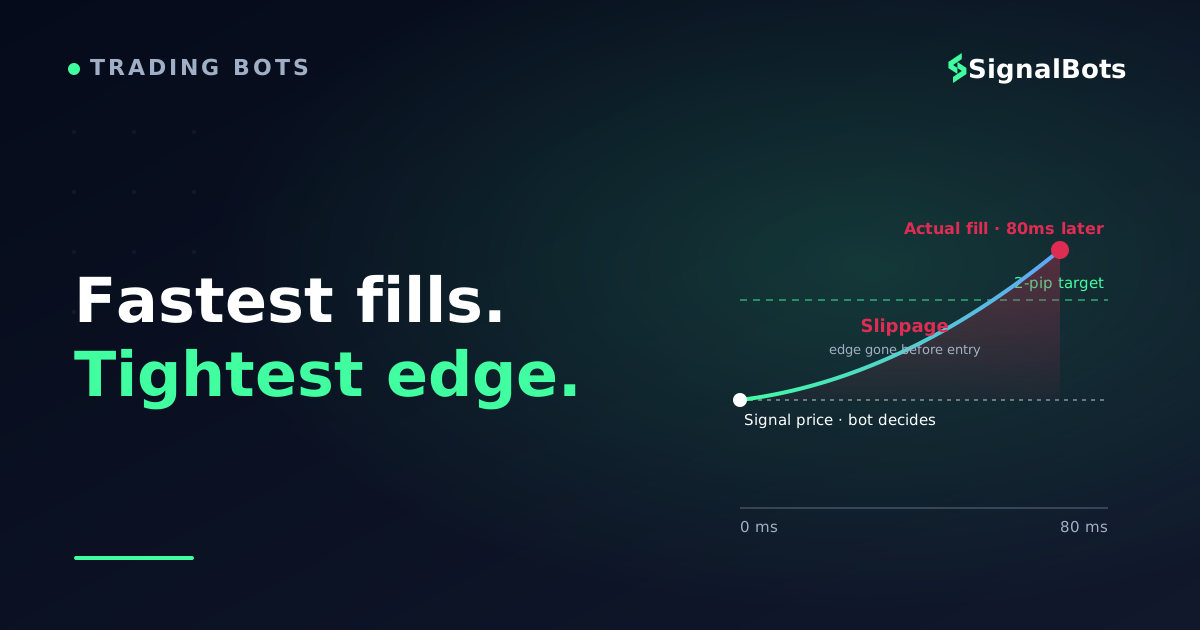
That gap between decision price and fill price has a name — slippage — and on a scalping strategy it is the whole ballgame. When your target is two pips, one pip of slippage per trade is not a rounding error; it is half your edge, gone silently, on every fill. The broker you choose either protects that edge or quietly leases it back to itself.
So the question "what's the best broker for a scalping bot?" is really four narrower questions the marketing pages never answer: how does this broker execute an order, what does a round-turn actually cost all-in, will they even let an EA scalp on the account, and can I get my bot physically close to their servers? Answer those four and the shortlist writes itself.
First filter: how the broker executes an order
Everything starts with the execution model, because it decides whether the broker is on your side of the trade or the other side of it. There are two families, and only one is built for a scalping bot.
An ECN broker (and its close cousin, the STP broker) passes your order straight through to a pool of liquidity providers and takes a fixed commission for the routing. It has no position against you, so a bot that scalps profitably costs the broker nothing — they earn the same commission whether you win or lose. That alignment is exactly what you want automating hundreds of trades.
A market-maker broker, by contrast, is the counterparty to your trade. Your loss can be its revenue. Reputable market-makers hedge their book and execute cleanly, but the structural conflict is real, and it's why market-maker terms are the ones most likely to hide a scalping restriction, a wider spread during news, or a requote — a "price has changed, accept or reject?" prompt that a fast bot experiences as a rejected or delayed fill.
ECN vs market-maker for a bot
What your bot needs
ECN / STP account
Market-maker account
Who's on the other side
Liquidity providers — no conflict
The broker itself — structural conflict
Cost structure
Raw spread ~0 pips + fixed commission
Wider spread, no visible commission
Requotes on fast fills
Rare — order routed, not re-priced
More common, especially in news
Scalping / EA stance
Usually welcomed
Often restricted in the fine print
Fill during volatility
Depends on LP depth, generally deep
Can widen or freeze at the worst moment
The execution model is the first filter — it decides whether the broker profits from your losses.
The practical rule: for an automated scalper, start on a raw-spread ECN or STP account and treat market-maker accounts as guilty until proven innocent. Among forex/CFD brokers that run genuine ECN/raw accounts and don't restrict automation, the names traders reach for repeatedly are IC Markets, Pepperstone, FP Markets and Exness — each offers a raw-spread account, MT4/MT5, and a documented EA-friendly policy. If you connect your signal source or bot through our MT4/MT5 connector for automated trading, any of these execution-first brokers is a natural home for it.
Second filter: what a round-turn actually costs
Here is the trap the "zero-spread" broker pages walk readers into. A near-zero spread looks perfect for scalping — until you notice the commission line. Raw-spread accounts charge a commission per round-turn precisely because the spread is tiny; the true cost is the two added together, not the headline number.
For a scalper this matters more than for anyone else, because you pay that all-in cost on every one of your many trades. A strategy that clears a 2-pip net target on 40 trades a day is a completely different business at 0.6 pips all-in cost than at 1.2 pips — the second version can be a net loser even with an identical win rate. Cost is not a footnote to a scalping bot; it is the strategy's break-even line.
So compute it before you deploy. Add the typical raw spread on your pair, plus the commission expressed in pips, plus a realistic slippage assumption, and multiply by your daily trade count. The widget below lets you feel how fast small per-trade costs compound across a bot's volume.
Try the numbers
All-in cost of a scalping bot's day
See how raw spread, commission and slippage combine per trade — then compound across a bot's daily volume. All figures are illustrative examples, not quoted broker pricing.
Raw spread (pips)
Commission per round-turn (pips)
Typical slippage (pips)
Net profit target (pips)
Trades per day
All-in cost per trade
—
Cost as share of your target
—
Total daily cost drag
—
When the cost bar climbs past half your target, the broker — not the strategy — is deciding whether you're profitable.
Notice what happens as you nudge slippage up: the all-in cost eats a bigger and bigger slice of your target. That's not hypothetical friction — it's the direct consequence of the next filter.
Third filter: slippage, latency and the fill you actually get
Execution speed is where the marketing spread meets reality. Between the instant your bot decides to buy and the instant the broker's engine fills it, the market keeps moving. The longer that round-trip takes — the higher the signal latency plus the broker's own processing time — the further price can drift, and the drift almost always runs against you.
Picture a scalp on a fast pair. Your bot's logic triggers a long the moment price breaks a micro-level. If the fill lands 30–80 milliseconds later, that break may already be a pip higher. Do it forty times a day and the compounding drag is exactly what turned your green backtest red.
Where slippage steals a scalpEUR/USD1m
The bot decided at 1.0844; the fill landed at 1.0850. The 2-pip target vanished into six pips of slippage before the trade even opened.
Two broker-side factors decide how much of this you suffer. The first is liquidity depth: a deep ECN book absorbs your order near the quoted price, while a thin book fills you further away. The second is the broker's own execution infrastructure — how fast their matching engine acknowledges and fills, and whether they ever requote instead. When you compare candidates, the honest questions are: what's your average execution time, do you requote, and how do fills behave during high-impact news? A broker that answers those cleanly is worth more to a bot than one advertising a spread half a pip tighter.
One factor is on your side of the wire, though — and it's the cheapest edge you can buy.
Put the bot next to the servers
The single most effective latency fix costs a few dollars a month: run your bot on a VPS in the broker's data centre rather than on your home connection. Home broadband adds tens of milliseconds of unpredictable jitter; a virtual private server co-located near the broker's matching engine can cut the round trip dramatically and, critically, make it consistent — a bot hates variance in fill time as much as it hates the delay itself.
If you're routing signals into MetaTrader, the pattern is: signal source → VPS-hosted Expert Advisor → broker. Keeping every hop physically short is what turns a <10ms signal into a <10ms trade. Our MT4/MT5 automated-trading connector is built to sit exactly on that VPS-to-broker hop, so the bottleneck is never the software.
Fourth filter: will they even let your bot scalp?
You can nail execution, cost and latency and still get quietly sabotaged by a clause in the terms. This is the filter traders skip and regret. Two account-level settings decide whether your bot can run its logic at all.
First, permission. Not every broker allows automated scalping, and the restrictions hide in phrases like minimum holding time, pip-distance rules, or an outright ban on "latency arbitrage" and high-frequency EAs. A market-maker that profits from your losses has every incentive to bury one of these. Before you deploy, confirm in writing that scalping and Expert Advisors are permitted and that no minimum holding time applies — this is the algo-trading permission your whole strategy depends on.
Second, account type: hedging or netting. This is a mechanical compatibility check, not a preference. On a hedging vs netting account, a hedging account lets you hold a long and a short on the same symbol at once; a netting account collapses them into a single position. If your bot is written to open opposing positions and the account is netting-only, its orders will error out or behave unexpectedly. US-regulated brokers add a further layer — FIFO rules force positions to close in the order opened and disable hedging entirely, which can break an EA built for non-US behaviour.
The go / no-go path
Is this account safe to point a scalping bot at?
Take itProceed with careSkip / stand aside
Three yes/no gates decide whether a broker is bot-ready. One 'no' is enough to disqualify it.
If you're already producing signals and just need somewhere disciplined to run them, our forex trading signals feed and the MT4/MT5 connector let you plug a compliant, EA-friendly ECN broker into an automated pipeline without hand-coding the plumbing.
Putting the four filters together
There is no single "best broker" for every scalping bot, because the right answer depends on your pairs, your jurisdiction, and whether your logic needs hedging. What is universal is the order of the filters. Run any candidate through execution model → true all-in cost → slippage and latency behaviour → permission and account type, in that sequence, and the field narrows fast.
Applied to the current forex/CFD landscape, that process keeps surfacing the same execution-first names — IC Markets, Pepperstone, FP Markets and Exness — precisely because they combine raw-spread ECN accounts, unrestricted EA policies, hedging support outside the US, and VPS options. Treat that as a starting shortlist to verify against each broker's own current terms, never as a ranking to trust blindly. The all-in cost you can only get from live raw-spread quotes; the permission you can only get from the actual T&Cs.
Because performance figures and any "win rate" depend entirely on execution quality you don't control, treat every backtest as a backtested result on your chosen broker's real spreads and slippage — see our risk warning before committing capital to any automated strategy. A strategy that's only profitable on frictionless backtest fills is not a strategy; it's a broker-selection problem in disguise.
Use the checklist below as your pre-deploy gate. If any item is a "no," the broker isn't ready for your bot yet.
Your go-live gate
Pre-deploy broker checklist for a scalping bot
0 / 8
Account is genuine ECN or STP with raw spread plus a transparent commission
Scalping and Expert Advisors are explicitly permitted in the terms
No minimum holding time and no pip-distance restriction on orders
Account type (hedging vs netting) matches your bot's position logic
You've computed all-in cost — spread + commission + slippage — on your actual pairs
Broker discloses average execution time and requote policy
A VPS is available in or near the broker's data centre for co-location
Deep liquidity confirmed on the pairs your bot trades, including around news
★
Checklist complete — you’re cleared to proceed.
Eight yes/no checks. Every one must clear before a bot goes live on real capital.
FAQ
What makes a broker good for a scalping bot specifically?
Four things, in order: an ECN/STP execution model with no dealing-desk conflict, a low all-in cost (raw spread plus commission, not just a tight headline spread), fast and consistent fills with minimal slippage and no requotes, and terms that explicitly permit scalping and Expert Advisors. A human trader can tolerate weakness in any of these; a bot firing dozens of trades a day at a 1–3 pip target cannot.
Is a zero-spread broker the best choice for scalping?
Not on its own. A "zero-spread" or near-zero-spread account almost always carries a per-round-turn commission, so the true cost is spread plus commission. What actually protects a scalping bot is the all-in cost combined with clean, low-latency execution — a raw-spread ECN account with a fair commission and deep liquidity usually beats a headline "zero-spread" market-maker once slippage and requotes are counted.
Do all brokers allow scalping bots and EAs?
No. Many brokers — especially market-makers — restrict or ban automated scalping through clauses like minimum holding times, pip-distance rules, or explicit "no HFT/latency-arbitrage" language. Always confirm in writing that scalping and Expert Advisors are permitted before you deploy. ECN/STP brokers are far more likely to welcome automation because they have no conflict with your trades.
Hedging or netting account — which does my bot need?
Whichever your bot's logic assumes. If it ever opens a long and a short on the same symbol simultaneously, it needs a hedging account; a netting account will merge those into one position and can cause orders to error. Check your EA's design, then match the account. Note that US-regulated brokers enforce FIFO and disable hedging, which can break an EA built for non-US behaviour.
How much does latency really affect a scalping bot?
Enormously, because slippage scales with delay. On a two-pip target, even a fraction of a pip of slippage per trade — the direct product of round-trip latency — can halve your edge, and it compounds across every trade the bot takes. The cheapest fix is co-locating the bot on a VPS in the broker's data centre so the round trip is short and consistent; jitter hurts a bot almost as much as raw delay.
Can I run the same bot on a demo before going live?
Yes, and you should — but a demo won't fully reveal execution quality, because demo servers often fill more generously than live ones. Use the demo to confirm the bot connects, respects the account's hedging/netting mode, and doesn't trip any platform errors. Then validate cost and slippage on a small live balance before scaling, since only live fills show you the broker's real behaviour.
Sources & Further Reading
Want to go deeper? These independent, authoritative sources shaped this guide — each one is worth reading in full:
The Cross-Market Desk is the SignalBots editorial team for topics that span every market — platform connectors, copy trading, partnership and IB programs, and the general mechanics of trading automation. We research and write the guides that apply no matter what you trade.



Discussions 0
Leave a comment