You've seen the leaderboards. A trader with a clean upward curve, hundreds of copiers, a return figure that makes your savings account look broken — and one button that promises to put you in the exact same trades. The pitch is simple: skip the learning curve, ride someone else's skill. So the honest question isn't does copy trading work — it's should you trust your money to it, and how do you tell a real edge from a well-designed trap.
Here's the short version, then the evidence behind it.
The verdict, up front
A clean equity curve and a big copier count prove popularity — not that copying this trader is safe for you.
?
Legit method — the trader is the real risk
Copy trading itself is a real, widely-used model
Safety lives in who you copy, not the button
Their drawdown becomes your drawdown, scaled
Verifiable track record separates real from scam
Verdict
Our take
Reviewed against the risks copiers actually get burned by — not marketing pages.
Copy trading is legitimate. Whether it's safe is a question about the specific trader and your position sizing — not the concept.
Key Takeaways
Copy trading is a legitimate mechanism, but its safety depends entirely on who you copy and how you size the allocation — the model doesn't protect you from a bad trader.
Your account mirrors the leader proportionally, so their worst drawdown becomes your worst drawdown; a headline return tells you nothing until you've seen how deep and how long their losses ran.
The line between a real provider and a scam is verifiability: a long, third-party-verified track record, an honest drawdown figure, and no "risk-free" promises. Missing any of those is a red flag.
Treat a copied trader as one position, not a savings account — small allocation, a drawdown cut-off, and your own automated signals as a cross-check.
Table of Contents (15 min read)Contents
Legitimate and safe are two different questions
Most "is it a scam?" articles answer the wrong question. Copy trading — automatically mirroring another account's trades into your own — is a legitimate, well-established mechanism offered by regulated brokers and platforms across forex, crypto, and stocks. That part is settled. Confirming it is legal does not tell you it is safe for your money.
Think of it like a taxi. Taxis are a legitimate way to travel. That fact says nothing about whether this driver is sober, knows the route, or is about to run a red light. Copy trading is the same: the model is sound, but you are handing the wheel to a specific human whose skill, discipline, and honesty you have to verify yourself.
So we split the question in two, and this article answers both:
Is the mechanism legitimate? Yes — and we'll show exactly how the mirroring works so you understand what you're signing up for.
Is copying this trader safe for you? That's a decision, and it comes down to a handful of checks the flashy leaderboard hides.
Want the plain-English definition first? Our copy trading glossary entry covers the mechanics without the marketing spin. This page is about the risk decision on top of it.
What actually happens when you copy a trader
Before you can judge the risk, you need to see the machine. When you copy someone, you're not buying their tips — you're binding your account to theirs. Every trade the leader opens is mirrored into your account, scaled to your balance and risk setting. If they risk 2% on a position, your copy risks roughly 2% of your money, not theirs.
The mechanism
One leader's trade, mirrored and scaled to each follower
Lead trader accountBUY EUR/USD · risks 2% · 1.00 lot on $100k
Mirrored proportionally to each follower
You — $2,000 account0.02 lot · same 2% risk on $2k
Follower — $10,000 account0.10 lot · same 2% risk on $10k
Follower — $50,000 account0.50 lot · same 2% risk on $50k
The lot size scales to your balance, but the leader's PERCENTAGE risk and their timing are copied exactly — including their mistakes.
You inherit the leader's decisions proportionally. That's the whole appeal — and the whole risk.
That one detail — proportional mirroring — is the root of almost every copy trading risk. You are copying their decisions, not their judgment. When the leader panics, over-leverages, or revenge-trades after a loss, your account does the same thing at the same moment, and you usually find out only when the drawdown shows up in your balance.
The risk the leaderboard hides: their drawdown becomes yours
Here's where "what the data shows" earns its place in the title. The number every copy platform puts front and center is total return — the headline that makes you click. The number that actually decides whether you can survive copying someone is their drawdown: how far their account fell from a peak to a trough, and how long it stayed underwater.
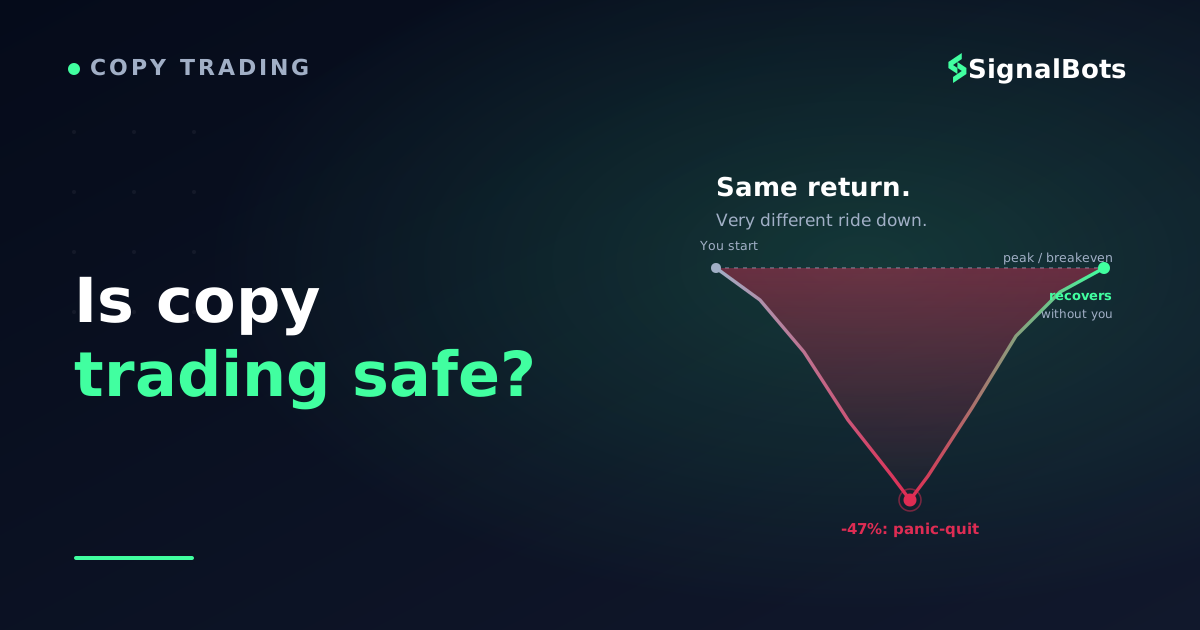
A return figure is a single, flattering snapshot. The drawdown is the movie. Two traders can post the same annual return while one glided up in a smooth line and the other lost half the account along the way and clawed it back. Copy the first and you sleep fine. Copy the second and you'll likely quit — and lock in the loss — at the exact bottom, because the paper says "+40% a year" but your screen says "down 45% this month."
What the return figure hides
An illustrative leader whose curve ended higher — but a copier who joined at Month 1 watched their account fall 47% first. Most people close the copy at the bottom.Two traders can share the same return and the same historical win rate. The one you can actually hold through is the one whose worst drawdown you could stomach.
That gap is why a big historical win rate on its own is a weak safety signal. A trader can win 80% of trades and still ruin an account, if the 20% of losses are large and uncontrolled, or if they use a martingale-style scheme that hides small losses until one catastrophic trade wipes the account. When you copy, you inherit that hidden tail risk in full.
Read a track record backwards: find the worst drawdown first, ask whether your account could survive it, and only then look at the return.
Legit provider or a trap? Read the red flags
Copy trading fraud rarely looks like a stranger asking for your password. It looks like a polished profile with a curve too smooth to be real and a promise no honest trader would make. The tell is almost always verifiability: a real edge can be inspected; a fabricated one relies on you not looking closely.
Be especially wary of any provider whose pitch leans on the exact phrases regulators warn about — "risk-free returns," "guaranteed profit," "you can't lose." No genuine trader promises those, because markets don't offer them. Naming that phrase is the fastest scam filter you have.
The scam filter
✅ A provider worth copying
🚩 A red flag to walk away from
Long track record you can inspect month by month
A short history, or one lucky streak dressed up as skill
Drawdown is shown honestly, even when it's ugly
Only the return is shown; drawdown is hidden or vague
Results verified by the platform or a third party
Screenshots and self-reported P&L you can't verify
Frames results as historical, never promised
Promises "risk-free" or "guaranteed" returns
Has real skin in the game — own capital in the strategy
Pressure to deposit fast, or fees that grow with your losses
Clear, consistent strategy you can understand
Sudden style changes and returns that spike unexplained
Every green cell is something you can verify before depositing. Every red cell asks you to trust and hurry — the two things a fraud needs from you.
The single strongest signal on that list is a verified track record: performance history the platform or an independent party has confirmed, not a self-reported figure the trader typed in. A screenshot proves nothing — anyone can fake one, or run twenty demo accounts and only show you the one that got lucky. If you can't verify how a signal provider actually performed, treat the numbers as marketing, not evidence.
So is it safe? Run the trader through this first
Copy trading is as safe as your vetting is disciplined. "It depends" is the honest answer, but it isn't a useful one — so here is the decision made concrete. Before you copy anyone, tick every box below. If you can't tick one, that's not a small gap; it's the reason people lose money copying strangers.
Make the decision
Before you copy this trader — the safety checklist
0 / 9
I can see a long track record, not a three-month lucky streak
I've read their WORST drawdown — and my account could survive it
Their results are platform-verified, not self-reported screenshots
They frame results as historical, never as promised or no-loss outcomes
Their strategy makes sense to me — I understand roughly how they trade
They have their own money in the strategy (skin in the game)
I'm allocating a small slice of capital, not my whole account
I've set a drawdown cut-off that auto-stops the copy if it's breached
I'm copying more than one style, not betting everything on one trader
★
Checklist complete — you’re cleared to proceed.
Nine checks. Every unchecked box is a known way copiers get burned — fix it before you deposit, not after.
A few of those deserve emphasis, because they're the ones beginners skip:
Size it like a position, not a savings plan. A single copied trader is one bet on one person's continued discipline. Keep any single allocation small enough that their worst month is an annoyance, not a disaster — and spread across a few different styles so one blow-up can't sink you.
Set the cut-off in advance. Decide the maximum drawdown you'll tolerate before you start, and use the platform's stop-copy setting so the connection breaks automatically when it's hit. Emotion in the moment will always argue for "just one more week."
Copying is not a strategy — it's an input. You still have no control over entries, exits, or when the leader changes their mind. That's the trade-off you accept for skipping the learning curve.
Where signals and automation lower the risk
Part of what makes pure copy trading nerve-racking is opacity: you follow decisions you can't see coming and can't second-guess. You can shrink that blind spot by pairing what you copy with a data source you actually control.
Instead of only mirroring one person's calls, use verified trading signals as an independent cross-check — a second, data-driven read on the same market so a copied position that suddenly contradicts everything else raises a flag before it becomes a loss. For forex specifically, our forex signal pages give you that per-pair reference point across the markets you copy. The point isn't to replace copying — it's to stop flying blind on someone else's judgment.
This is also where automation removes the exact human failure the drawdown chart above illustrated: the panic-quit at the bottom. A rule-based system that follows signals with a pre-set drawdown limit doesn't get scared at -47% and doesn't get greedy at +10% — it executes the plan you set when you were calm. That discipline, not a magic win rate, is what actually protects an account.
Compliance
FAQ
Is copy trading a scam?
No — copy trading as a mechanism is legitimate and widely offered by regulated brokers and platforms. Scams exist within it, though: individual profiles with fabricated results, unverifiable screenshots, or "guaranteed profit" promises. The model is real; your job is to filter out the fraudulent traders using it, which the red-flag table and checklist above are built to do.
Can I lose all my money copy trading?
Yes, it's possible. Because your account mirrors the leader's trades proportionally, a leader who over-leverages or hits a catastrophic loss can drag your balance down just as hard — especially with leveraged CFDs. That's exactly why a pre-set drawdown cut-off, a small allocation per trader, and diversifying across styles aren't optional extras; they're the difference between a bad month and a wiped account.
What's the most important thing to check before copying someone?
Their worst drawdown, read alongside a verified track record. A big total return with a hidden or brutal drawdown is a trap you'll close at the bottom. A trader you can hold through — whose worst historical loss your account could survive and whose results are platform-verified rather than self-reported — is far safer than a flashier one you'd panic-quit.
How much of my capital should go into one copied trader?
Treat any single copied trader as one position, not a home for your savings. Keep each allocation small enough that the trader's worst historical drawdown would be an inconvenience rather than a disaster, and spread your capital across more than one trading style so a single blow-up can't sink the whole account. The exact fraction is yours — the principle is: never bet the account on one stranger's discipline.
Does a high win rate mean a trader is safe to copy?
Not on its own. A trader can win the large majority of trades and still ruin an account if the occasional loss is huge or if they use a martingale-style scheme that hides risk until one trade wipes everything. Always pair the win rate with the drawdown and the reward-to-risk profile — a high win rate with a small average win and rare enormous losses is more dangerous than it looks.
Is copy trading better than trading signals?
They solve different problems. Copy trading mirrors another person's decisions automatically — convenient, but opaque and only as good as that one trader. Signals give you a data-driven read you can act on with your own risk rules and control. Many traders use both: copy for hands-off exposure, signals as an independent cross-check so a copied position that contradicts the data gets caught early.
The bottom line
You came in asking
“can I trust my money to a leaderboard trader?”
and the honest answer is
only after you've vetted the drawdown, the verification, and your own sizing.
Copy trading is safe when you make it safe.
SB
SignalBots verified signals
Don't fly blind on one stranger's judgment. Pair what you copy with data-driven signals you control — an independent read on the same market, so a copied position that contradicts the data gets flagged before it costs you.
The Cross-Market Desk is the SignalBots editorial team for topics that span every market — platform connectors, copy trading, partnership and IB programs, and the general mechanics of trading automation. We research and write the guides that apply no matter what you trade.



Discussions 0
Leave a comment