A forex signal is a structured trade instruction — pair, direction, entry, stop-loss, take-profit, and an expiry — not a prediction and never a guarantee.
Signals are generated by analysts, algorithms, or a hybrid of both, but all follow the same five-step pipeline: scan, trigger, compose, deliver, execute.
Whether signals "work" is decided by expectancy (win rate x reward-to-risk), delivery speed, and your risk sizing — never by the advertised accuracy alone.
Judge a provider by its full, verifiable track record of wins and losses; treat any "guaranteed profit" claim as an automatic disqualifier.
Table of Contents (31 min read)Contents
What Is a Forex Signal, Really?
A forex signal is a structured trade instruction: one short message that names a currency pair, tells you whether to buy or sell it, and gives you the exact prices to enter, cap the loss, and bank the profit — plus how long the idea stays valid. It is published by a signal provider — a human analyst, an algorithm, or a hybrid of the two — and sent to you the moment its conditions fire.
Just as important is what a signal is not. It is not a forecast of where EUR/USD will be next quarter, and it is not a promise of profit — it is one trade idea with a defined risk attached. Treat every signal as a probabilistic instruction: a claim that, over many similar setups, this pattern has tended to pay more than it costs.
The most useful mental model is perishable data. A signal is priced off the market at the instant it is generated; from that second on, every tick of price movement and every moment of delivery delay eats into its edge. That perishability — not the analysis itself — is where most signal services quietly fail, and it shapes everything else in this guide: what a signal contains, how it is generated and delivered, and what actually decides whether following one makes money.
The Life of a Signal, in Five Steps
Every forex signal — whether it comes from a veteran analyst or an AI model scanning thirty pairs at once — moves through the same pipeline. Seeing the whole path once makes each later section click into place.
The pipeline
The life of a forex signal — from market scan to managed trade
1
Market scan
An analyst or algorithm watches price, volatility, and news across currency pairs, hunting for conditions that match a tested setup.
2
Trigger fires
Price meets the setup's exact conditions — a breakout, a level retest, a momentum shift — and the trade idea is confirmed.
3
Signal composed
The idea becomes a structured instruction: pair, buy or sell, entry price, stop-loss, take-profit, and how long it stays valid.
4
Delivery
The signal reaches you — Telegram, mobile push, an on-site feed, or straight into MT5. Every second in transit erodes its edge.
5
Execution & management
You (or a bot) place the order, size the position, and let the stop-loss and take-profit manage the exit without emotion.
One pipeline, five hand-offs — a signal can be brilliant at step 3 and worthless by step 5 if delivery or execution is slow.
Notice that only the first two steps are about analysis. The other three are logistics — composing, delivering, and executing the instruction — and they are where speed and discipline matter more than market opinion. That split explains a pattern you will see for the rest of this article: signal quality is a pipeline property, not just an analysis property.
Reading a Signal Line by Line
Here is what a typical forex signal looks like when it lands in a channel or app:
EUR/USD — BUY
Entry: 1.0845 · Stop-loss: 1.0805 · Take-profit: 1.0925
Timeframe: 4H · Valid for the next 12 hours
Six fields, each doing a specific job:
Pair — the market to trade (here, euro against US dollar). A signal for one pair tells you nothing about another; providers usually specialize in a set of majors and crosses, each with its own execution quirks our guide to trading currency pairs with signals covers pair by pair.
Direction — the signal direction: BUY (long) if the analysis expects price to rise, SELL (short) if it expects a fall. This is the core claim the whole signal hangs on.
Entry price — the level at which the setup is valid. Enter far above 1.0845 on a BUY and you own the same risk with a smaller reward — the numbers below assume this entry.
Stop-loss — the exit that caps the damage when the idea is wrong. A stop-loss is what turns an open-ended risk into a defined one; a signal without it is not a complete instruction.
Take-profit — the take-profit level where the trade banks its gain. Entry, stop, and target together define the trade's reward-to-risk ratio before you commit a cent.
Expiry — the signal expiry window. After it lapses, the market context that justified the trade no longer exists, and the instruction should be discarded, not "caught up on."
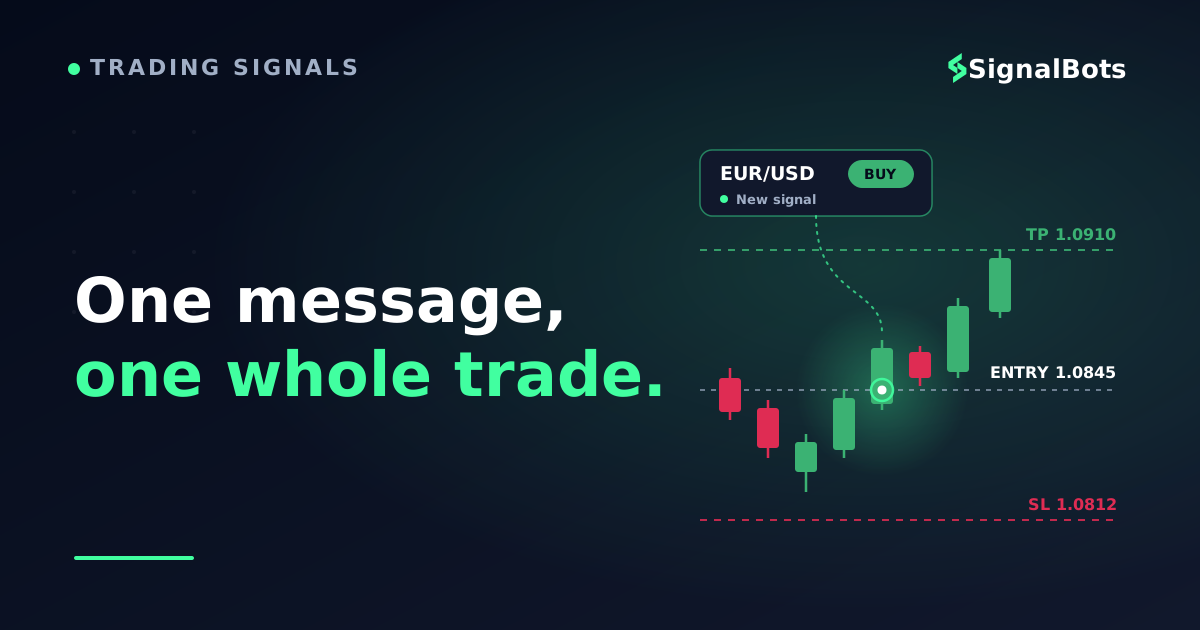
Put those numbers on a chart and the logic becomes visible — the entry sits at a breakout level, the stop hides below the structure that would invalidate the idea, and the target is roughly twice the risk:
Worked example
The example signal, drawn on the chartEUR/USD4H
Illustrative example: 40 pips of defined risk against 80 pips of target — a 2:1 reward-to-risk trade, decided before entry.
A complete signal is a full trade plan: where you're right, where you're wrong, and where you leave.
Some providers add a rationale line ("break of range high with rising momentum") or a confidence tag. Useful, but the six core fields above are the non-negotiables — if any is missing, you are being handed an opinion, not a signal. For a deeper field-by-field reference, see the anatomy of a trading signal; to watch real examples stream in, the live EUR/USD signal feed shows this exact structure updating in real time.
Where Signals Come From: Analysts vs Algorithms
Every signal starts as analysis. Most providers lean on technical analysis — support and resistance levels, momentum, trend structure, often confirmed across multiple timeframes. Some incorporate price action (reading the candles themselves) and a smaller group trades fundamentals: rate decisions, inflation prints, and other scheduled news that moves currencies. The input matters less than you'd think; what separates providers is how consistently the method is applied.
That consistency question is really a question about who — or what — runs the method:
Generation
Two ways a forex signal gets made
Manual — analyst-driven
A human reads charts, levels, and macro context, then publishes the call
Can weigh news nuance and regime shifts an algorithm may miss
Slower from trigger to alert — minutes, not milliseconds
Quality varies with the analyst's workload, mood, and discipline
Strong on context; limited by human speed and consistency
VS
Automated — algorithm-driven
Preset rules or AI models scan dozens of pairs around the clock
Fires the instant conditions are met — latency measured in milliseconds
Perfectly consistent: the same setup always produces the same call
Only as good as the logic and the testing behind it
Strong on speed and discipline; needs a genuinely tested edge
Neither side wins on principle — a disciplined algorithm beats a distracted analyst, and a sharp analyst beats a curve-fit bot.
In practice the strongest services are hybrid: algorithmic scanning surfaces candidate setups at machine speed, and a rules layer (or a human desk) filters what actually goes out. AI models push this further by scoring each candidate against historical outcomes before it is published. But whatever generates the signal, remember the pipeline: generation is steps one to three. A perfectly generated signal can still fail in the two steps that follow.
Delivery and Execution: Where Signals Live or Die
A signal's value decays from the moment it is composed, so how it reaches you is not a convenience feature — it is part of the edge. The common delivery channels, roughly in order of how traders meet them:
Mobile push notifications — a dedicated app pings your phone the second a signal publishes, with no channel scrolling.
Web dashboards and on-site feeds — live signal streams you keep open on a screen, useful when you want history and context beside each call.
Platform-native delivery — signals injected directly into MT4/MT5 or your broker interface, which shortens the gap between reading and acting to almost nothing.
Two clocks are ticking against you here. The first is signal latency — the delay between generation and arrival. The second is your own reaction time between arrival and execution. Add spread and slippage, and a signal that looked clean at 1.0845 can be filled at a meaningfully worse price. Past a point, a delayed signal is a stale signal: the entry has run away, the reward-to-risk has collapsed, and the correct trade is no trade.
That is why execution splits into two schools. Manual execution — you read the alert and place the order yourself — keeps you in control and is the right way to start, but it is bounded by how fast you can reach a trade ticket. Automated execution hands the mechanical part to software: copy trading mirrors a provider's trades into your account, while bots and connectors turn each incoming signal into an order within milliseconds, with position size and stops applied by rule rather than by adrenaline. Automation doesn't make a bad signal good — it makes a good signal arrive intact, and it removes the hesitation and revenge-clicking that emotion injects at exactly the wrong moments; our guide to risk management with AI forex signals covers the sizing rules automation should be enforcing on your behalf.
Do Forex Signals Work?
Honest answer: some do, many don't — and the question as asked is slightly broken. "Do signals work" implies signals are one thing. They are three things stacked together: an edge (does the provider's method win more than it loses over time?), a pipeline (does the signal reach you fast enough to keep that edge?), and your risk sizing (can your account survive the losing streaks on the way to the long-run result?). A failure in any layer looks, from the outside, like "signals don't work."
Start with the layer most beginners get wrong: the difference between accuracy and profitability. Signal accuracy — how often the calls land — is the number every provider advertises, but it is only half of the profit equation. The other half is how much a win pays relative to what a loss costs. A provider hitting 70% of calls that risk 100 pips to make 30 is a slow bleed; one hitting 45% at 2:1 reward-to-risk compounds. Hover the grid below and find where those two examples sit:
Try it — hover any cell
Where win rate × reward-to-risk turns profitable
Hover a cell to see the expected value per $100 risked.
Each cell is the expected result per $100 risked. A high win rate at poor reward-to-risk still loses; a modest win rate at high reward-to-risk still wins.
The single number that combines both halves is expectancy — the average result per trade across wins and losses. Suppose, as a clearly illustrative example, a provider wins 55% of trades at 2:1 reward-to-risk and you risk $100 per trade: over a long run you'd average $200 × 0.55 - $100 × 0.45 = $65 per trade before costs. The same math at 0.5:1 turns negative even with a stellar win rate. When a provider quotes its historical win rate, your first response should always be: at what reward-to-risk?
Two more forces drag real results below the math. The first is false signals: every method — human or algorithmic — sometimes fires on a pattern that immediately reverses. A false signal is not evidence of fraud; it is the statistical cost of trading probabilities, and it is exactly what the stop-loss exists to price in.
The second is oversizing — the fastest way to lose money on profitable signals is to bet so large that a normal five-loss streak forces you out before the edge can express itself. Fix your risk per trade as a small, constant fraction of the account, and translate it into units with a forex lot size calculator before the first live trade — not after the first drawdown.
So: forex signals can work, in the same way a tested strategy can work — when a real edge survives delivery and is traded at survivable size. Which moves the practical question from "do signals work" to "how do I tell whether this provider's signals work." That has a checkable answer.
How to Judge a Signal Provider
Everything in the previous section is measurable, which means a credible provider can show it and a weak one has to hide it. The core evidence is a verified track record: the full sequence of published signals — wins and losses — over a sample large enough that the win rate means something, ideally verifiable against a third-party tracker rather than the provider's own screenshots. A dozen good weeks proves nothing; every method looks brilliant across a lucky stretch.
The pattern-matching below covers most of what you will meet:
Evaluation
Signs of a credible provider
Red flags
Publishes the full signal history — losing trades included
Shows only screenshots of winning trades
Every signal carries an entry, stop-loss, and take-profit
Entry-only calls, or stops added after the fact
States the timeframe and how long each signal stays valid
No expiry — old signals presented as still tradable
Frames results as a historical win rate over a large sample
Promises "guaranteed profit" or "risk-free" returns
Explains the reasoning or logic behind each setup
A black box you are asked to trust blindly
Constant, stated risk per trade through drawdowns
Doubling stakes after losses to "win it back"
None of the red flags is illegal on its own — but each one removes your ability to verify the edge, and unverifiable is unfollowable.
One red flag deserves its own sentence: any service promising "guaranteed profit" or "risk-free signals" is describing something that cannot exist in a leveraged market, and the promise itself tells you the provider's real product is marketing, not trading. Walk away without checking anything else — our full guide to spotting Telegram forex signal scams catalogs the rest of the playbook.
Before committing real money, run any provider through a paper-trading period: follow the signals at zero size for a few weeks, log every call against its stated entry, stop, and target, and compare your logged results with the provider's claims. Divergence between what is advertised and what you can log is the single most reliable disqualifier there is.
See a Signal Arrive: The Anatomy, Live
The reading habit above is easier to trust once you watch it happen. Now that you can parse a signal line by line and know delivery is where the edge lives or dies, the honest next step is to see real forex signals land — which is what our free live forex signal feed is for: an on-site stream where each call publishes the moment its setup fires.
Suppose a EUR/USD BUY prints with an entry, a stop-loss, a take-profit, and a validity window. You already know the drill — confirm all six fields are present, read the direction as the core claim, and measure the reward-to-risk before it is anything more than an idea. Watching the same anatomy update against moving price turns the checklist into instinct, and lets you paper-trade the calls at zero size before real money is involved.
One boundary: the feed shows and delivers signals — it is not auto-execution. It puts the instruction in front of you fast; you still place the order yourself. A trader who wants the mechanical part handled hands-off needs a connector or EA between the signal and the broker, not a feed. Either way, size every position so a normal losing streak cannot end your account — the risk warning explains why.
Free vs Paid: Does Price Signal Quality?
No — price and edge are close to uncorrelated, because the two tiers usually exist for business reasons rather than quality reasons. Free channels are typically an acquisition funnel: fewer signals, delayed posts, or a teaser for a paid tier — which is why our ranked list of the best free forex signal providers filters specifically for funding models that don't depend on selling you an upgrade. Paid tiers sell earlier delivery, more pairs, and fuller trade management. The split is about access and speed, not about a different grade of analysis — the difference between VIP and free signals is worth understanding before you pay for anything.
The evaluation standard therefore never changes: a free provider with a verifiable losing record is expensive, and a paid one that survives the checklist above may be cheap. Judge the track record, not the price tag — and when you weigh whether a paid signal service is worth the money, our full free vs paid forex signals comparison runs the subscription math your expectancy has to clear before you break even.
FAQ
What does a forex signal look like in practice?
A short structured message: pair, direction (BUY or SELL), entry price, stop-loss, take-profit, and a validity window — for example, "EUR/USD BUY, entry 1.0845, SL 1.0805, TP 1.0925, valid 12 hours." Some providers add the timeframe, a rationale line, or a confidence tag. If entry, stop, or target is missing, treat it as an opinion rather than a tradable signal.
How fast do I need to act on a forex signal?
Within the signal's stated validity window, and realistically within minutes on intraday timeframes — the further price drifts from the stated entry, the worse your reward-to-risk becomes. If price has already run well past the entry, the correct action is to skip the trade, not chase it. This decay is the main reason experienced signal traders automate execution or use push delivery instead of scrolling channels.
Are forex signals legal?
Publishing and following trade signals is legal in most jurisdictions; the signal is information, and the trade is executed in your own account with your broker. The legal and regulatory problems cluster around conduct: fake performance claims, unlicensed money management (someone trading your funds directly), and fraud dressed up as signal selling. Stick to providers whose claims you can verify, and be aware that rules differ by country for anyone selling trading advice.
Can a beginner trade with forex signals?
Yes — with two conditions. First, learn to read the full instruction (entry, stop, target, expiry) so you never take a partial trade; this article's anatomy section is the checklist. Second, start on a demo account or minimal size and fix your risk per trade at a small constant fraction of your account — our full beginner's guide to starting forex trading walks through that sequencing step by step. Signals remove the analysis burden, but they never remove risk management — that part is always yours.
Why did a signal lose even though the provider is credible?
Because credible signals are probabilities, not certainties. A provider with a genuine edge still loses a large share of individual trades — and clustered losing streaks are statistically normal, not proof the edge is gone. What matters is whether the full sequence of trades, at the stated reward-to-risk, remains positive over a large sample. Judge providers on the sequence, never on the last trade.
Should I automate signal execution?
Automate once you trust the provider and your sizing rules — automation's job is fidelity, not magic. Software executes the signal as published, at machine speed, with no hesitation, no revenge trading, and no missed alerts at 3 a.m. But it amplifies whatever it is fed: automating an unverified provider just loses money more efficiently. Verify first, size conservatively, then automate.
We started with
“What is a forex signal, and can I trust one to trade with?”
and arrived at
A signal is structured, perishable trade data — it pays when the edge, the delivery, and your risk sizing all hold..
A signal is only as good as its pipeline
You now know the whole path: a tested setup becomes a six-field instruction, races through delivery before it goes stale, and either survives or dies on your execution and position size. That means you can stop asking whether signals work in the abstract and start checking the three things that decide it — a verifiable track record, fast delivery, and constant risk per trade. The natural next step is to watch the pipeline run: follow a live feed, read each signal against the anatomy you learned here, and paper-trade the calls before any real money moves.
The Forex Desk is the SignalBots editorial team responsible for our currency-market coverage. We research and write the guides, explainers and reference articles on how the majors, minors and crosses actually trade — sessions, spreads, swaps and the macro releases that move price.



Discussions 0
Leave a comment