The price tag predicts almost nothing: a signal provider's incentive model and independently verifiable track record tell you nearly everything.
Paying buys structure and accountability - complete trade plans, consistent cadence, support - never accuracy; only a verified track record can speak to that.
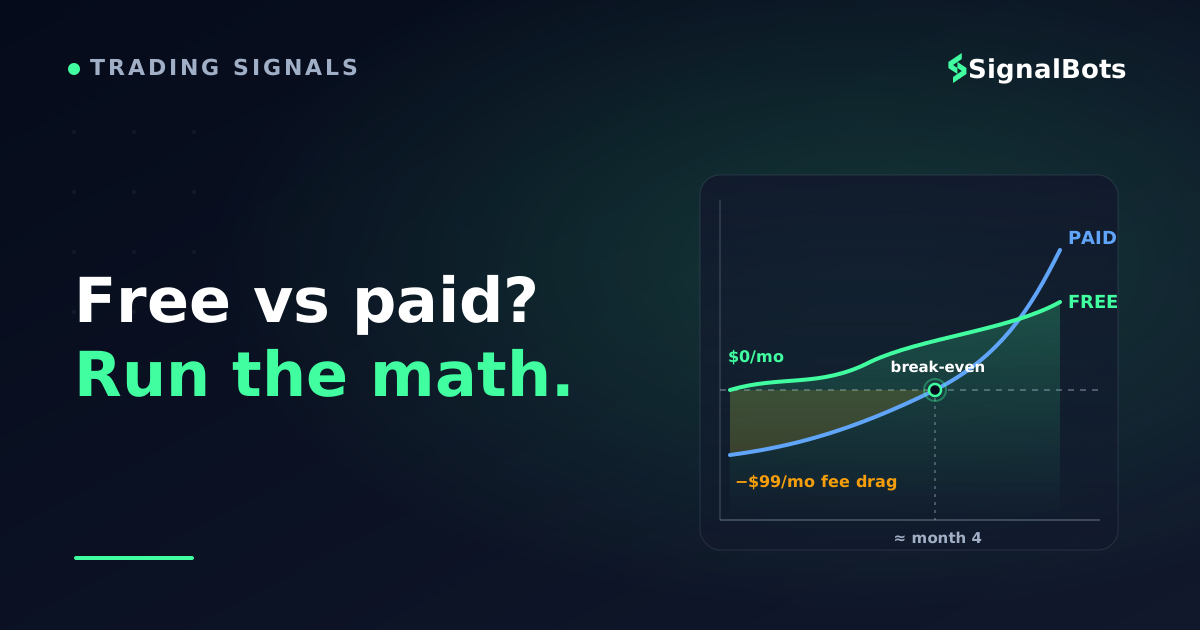
On small accounts the subscription is often the biggest cost: an illustrative $79/month fee on a $1,000 account must earn 7.9% monthly just to break even.
Start with quality free signals, vet them like a paid product, and pay only after a provider survives your own forward test and the fee math.
Table of Contents (21 min read)Contents
The Decision You're Actually Making
Every trader weighing signal services ends up staring at the same two tabs: a free Telegram channel with thousands of members, and a polished paid service promising a professional edge. The instinct is to compare the price. Here is the uncomfortable premise this whole comparison rests on: the price tag is the least informative fact about a signal service.
A forex trading signal is a trade suggestion — an instrument, a direction, and ideally the exact levels to enter and exit. Whether a stream of those suggestions deserves your money depends on three things no pricing page shows:
Incentives — why the signal provider publishes signals at all, and who pays them when you lose.
Verification — whether the performance they claim can be checked anywhere outside their own marketing.
Cost drag — what the fee does to an account your size before a single pip is won.
Because a comparison article owes you a direct answer, here it is up front: free signals are the right starting point for almost everyone, and paid signals are worth it in exactly one situation — a verified track record, a fee your account barely feels, and results that survive your own testing. Everything below shows you how to run that test instead of guessing.
Why Free Signals Exist — Follow the Money
Nothing in trading is given away out of generosity. Free signals are free because they are doing a different job for the provider than they are doing for you. Four models cover almost every free channel you will meet:
The teaser funnel. The free channel is marketing for a paid VIP tier. The free calls are usually real but curated — frequent enough to prove the desk exists, incomplete enough to make the upgrade feel necessary. The actual product being sold is urgency.
The partner-funded model. The provider earns a commission from a broker on the trading volume of the people who follow its signals, so the signals can stay genuinely free and complete. The incentive is roughly aligned — this provider needs you trading, surviving, and staying, not subscribing. Full disclosure: this is how SignalBots funds its own free signals.
The reputation channel. An individual trader or community shares calls to build an audience. Enthusiasm is high; consistency, risk guidance, and accountability are whatever that person feels like this month.
The bait channel. Signals exist purely to funnel you toward a scheme — doctored screenshots, pressure to deposit with an unnamed "trusted broker," promises of "guaranteed profit." That last phrase alone should end the evaluation.
Paid services are not automatically cleaner. Subscription revenue arrives whether the month was good or bad, and retention pressure cuts both ways: quality keeps subscribers, but so do aggressive marketing and a talent for blaming "market conditions." Each pricing model has its own characteristic failure mode — free tends to fail as advertising in disguise, paid tends to fail as complacency behind a paywall. That is why the fee itself settles nothing.
Free vs Paid, Dimension by Dimension
With the incentives on the table, the practical differences line up cleanly. This is what each side of the market typically delivers:
Side by side
What to compare
Typical free channel
Typical paid service
Upfront cost
None
Recurring subscription
What a signal includes
Often direction only - exits missing
Full plan: entry, stop-loss, take-profit
Frequency & consistency
Irregular; can dry up without notice
Scheduled cadence you can plan around
Published track record
Rare; wins cherry-picked for marketing
Expected - but verify it independently
Risk guidance
Usually absent
Position-size and R:R rules included
Support & education
A public chat, if anything
Direct support; reasoning behind trades
Provider's incentive
Upsell you to VIP, or earn on your volume
Keep you subscribed month after month
Delivery speed
Broadcasts can lag the setup
Usually faster - still worth timing yourself
'Typical' is the load-bearing word: the best free channels behave like the paid column, and the weakest paid services behave like the free one.
Two things in that table deserve emphasis. First, the completeness row is not a nice-to-have: a call without a stop-loss is not a signal, it is a mood. The anatomy of a complete signal — pair, direction, entry, stop-loss, take-profit — is the minimum bar for anything you would risk money on, free or paid.
Second, the table describes the middle of each market, and the tails overlap heavily. A disciplined partner-funded free channel can out-deliver a lazy paid service on every row. So use the table to know what to demand — not to assume the fee delivers it.
What Free Signals Do Well — and Where They Quietly Fail
Free signals earn their place in three situations:
Learning to read the market's paperwork. Following a live Telegram signal channel teaches you, at zero cost, how real setups are framed: where stops sit relative to structure, how targets are staged, what a losing week actually looks like.
Auditioning providers before any money moves. Every provider — including every paid one with a free tier — hands you a no-cost sample of its process. Smart traders treat that sample as an audition, not a gift.
Protecting small accounts. When the account is small, any subscription is a structural handicap (the math section below makes this concrete). Free is not the budget option here; it is the correct one.
The quiet failures are just as predictable:
Incomplete calls. Direction without exits shifts all the hard decisions — and all the blame — onto you.
Inconsistent cadence. Channels go silent when the desk's attention (or marketing budget) moves elsewhere, which makes any results streaky and hard to judge.
Curated reality. When the free channel exists to sell a VIP tier, what gets posted is chosen for persuasion, not completeness.
Crowded, late entries. By the time a broadcast reaches thousands of members and you tap through to your platform, the move may already be underway — you are entering a worse version of the trade the provider took.
What Paying Actually Buys — and What It Can't
A good paid service sells you four real things: completeness (every signal a full trade plan), consistency (a cadence you can build a routine around), support (someone answers when a signal confuses you), and often education (the reasoning behind trades, which slowly makes you less dependent on them).
Notice what is missing from that list: accuracy. Signal accuracy does not improve because money changed hands — the market does not know you paid. Payment buys structure and accountability, and accountability only exists where performance is visible.
That matters because the number every sales page shouts — "90% accurate!" — is meaningless on its own. A historical win rate only means something next to the reward-to-risk ratio behind it: a service that wins nine trades in ten, but loses ten times more on the one loser than it makes on each winner, is a slow leak with great marketing.
The dividing line between paid services worth considering and the rest is a verified track record: independently verifiable, complete with losses, and long enough to cover different market conditions. "Trust me" screenshots, however glossy, are not a track record — they are a mood board.
The Subscription Math Most Traders Skip
Here is the part almost every "free vs paid" article dances around, and the part that settles the question for most beginners. Suppose you run a $1,000 account and you are eyeing a service at $79 per month. Before a single trade fires, the fee consumes 7.9% of your account — every month. The service has to generate a 7.9% monthly return just to leave you where you started, a demanding hurdle by any professional standard. Now put the same $79 fee on a $20,000 account: 0.4% — a rounding error.
The identical service is expensive for one trader and cheap for another. That is why "which is better" has no universal answer — it has an account-size-shaped answer:
Run your own numbers
Does a paid signal service pay for itself?
Enter your account size and a subscription fee to see the monthly return the service must generate before it adds anything at all.
Account balance
$
Monthly subscription
$
Expected monthly gain
Fee as share of account
—
Gross gain at your estimate
—
Net after the subscription
—
The featured number is the monthly return the service must earn before it has added a single dollar. If that number makes you wince, the service is priced for a bigger account than yours.
A workable rule of thumb: keep any subscription to a low single-digit share of your account per month — around one percent is comfortable, and past a few percent the fee itself becomes the biggest position you hold. While you are pressure-testing numbers, the free forex trading calculators cover the neighbouring math — position size, pip value, and risk per trade.
How to Vet Any Provider — Free or Paid
The same test applies on both sides of the paywall, which is precisely the point: price stops mattering once you evaluate providers like this — it's the same audit our ranked, vetted shortlist of forex signal groups runs against every name on it.
Demand verifiable history. Third-party-verifiable performance, not screenshots. A provider that refuses has answered your question.
Check completeness. Every published signal should carry entry, stop-loss, and take-profit. No exceptions for "runners" or "management on VIP."
Read win rate and reward-to-risk together. Judge the pair across the whole sample, never the highlight reel.
Insist on sample size. Dozens of signals across different market conditions. One hot week proves nothing except that hot weeks exist.
Forward-test before you commit. Track the provider's live calls for several weeks — on demo or at minimum risk — and compare what you observe with what the sales page claims.
Listen to the language. Any provider promising "guaranteed profit," "risk-free returns," or a win rate that never dips is telling you, in plain words, that they are a marketing operation. Believe them.
So Which Is Better? Run the Decision, Not the Debate
Put verification and cost drag in charge, and the free-vs-paid argument collapses into a short sequence of checks:
The decision path
Should you pay for forex signals?
Take itProceed with careSkip / stand aside
Notice what decides the path: verification and cost drag. The provider's accuracy claim never appears - because until it is verified, it is marketing.
Translated into trader profiles:
You are learning. Free, full stop — ideally alongside a demo account. You are buying an education in signal anatomy, and the tuition is already zero.
Your account is small. Free or nothing — start from our ranked list of the best free forex signal providers. The subscription math above is not motivational advice; it is arithmetic.
Your account is established and a verified candidate exists. Paid can genuinely earn its fee — you are buying process, consistency, and support at a cost your account barely registers. Keep auditing it monthly like the business expense it is.
You are experienced. The common endgame is a hybrid: free channels as idea flow, one verified service as the core process — with every channel, free or paid, held to the same standard.
Free or Paid, Delivery Decides What You Keep
One dimension routinely decides real-world results yet rarely appears in this debate: a signal's value decays from the second it is generated. Signal latency — the gap between the setup being spotted and the alert reaching your screen — quietly rewrites every trade: the entry drifts, the stop sits at the wrong distance, and the reward-to-risk you thought you were taking is no longer on offer. A perfect call delivered late is a different, worse trade.
So when you compare providers, compare when their signals reach you, not just what is in them. Free broadcast channels tend to be the slowest path — a human posts, a queue delivers, a crowd reacts. Paid alerts are usually faster, but "usually" is doing a lot of work in that sentence; measure it during your forward test. This is also why serious signal usage keeps drifting toward automated delivery — push alerts and platform-connected execution instead of copy-typing from a chat window. If you want a benchmark for what fast, complete, and free looks like at once, the live AI forex signals we publish carry entry, stop-loss, and take-profit on every call and are built around sub-10ms delivery.
You came in
“Should I pay for forex signals, or are the free ones enough?”
and ended at
Judge the provider, not the price - verify first, and pay only for an edge that survives the math..
Start free, verify everything, upgrade on evidence
SB
SignalBots Forex Signals
Live AI-generated forex signals with entry, stop-loss, and take-profit on every call - free to follow, because our revenue comes from broker partnerships, not your subscription. Use them as the free benchmark every paid service has to beat.
Prefer signals inside Telegram? Follow the SignalBots forex signal channel and judge the calls in real time before you trust any provider - including us.
FAQ
Are free forex signals any good?
Some are genuinely good — quality follows the provider's incentive and transparency, not the price. Partner-funded and reputation-driven channels can publish complete, consistent signals because their revenue does not depend on withholding anything from you. The reliable way to know is to hold a free channel to the same standard you would demand from a paid one: full trade plans, visible history, and a few weeks of your own forward tracking.
Are paid forex signals more accurate than free ones?
Not automatically. Payment buys structure — complete trade plans, consistent cadence, support — but the market does not check receipts, and accuracy claims are only as good as the verification behind them. A paid service with an independently verified history genuinely offers something most free channels do not; a paid service without one offers a subscription fee and a story.
How much should forex signals cost?
Relative to your account, not in absolute dollars. A fee that is trivial on a large account can be the single biggest monthly cost on a small one, so anchor the decision to the fee's share of your balance — a low single-digit percentage per month is a sensible ceiling, and around one percent is comfortable. The calculator in this guide turns that into your own numbers in seconds.
Why would anyone give away profitable signals for free?
Because you are not always the paying customer — reread how forex signals are generated and delivered and the economics behind "free" make more sense. Free channels are funded by something — a VIP tier they want to sell you, a broker partnership that pays on trading volume, or an audience the author is building. Free does not mean bad; it means the revenue comes from somewhere other than your card, and your job is simply to find out where before you trust the calls.
How do I verify a signal provider's track record?
Ask for independently verifiable performance — a third-party-tracked account or equivalent, showing every trade including the losers, across enough time to cover different market conditions. Screenshots, testimonials, and cherry-picked winning streaks do not count. Then run your own forward test: log the provider's live signals for several weeks and compare your observations against their claims before any money moves.
Can I use free and paid signals together?
Yes, and experienced signal users often do — free channels for idea flow and market coverage, one verified paid service as the core process. Two cautions: hold every channel to the same vetting standard, and never treat two providers calling the same pair as confirmation. Stacking signals on one currency pair is doubled exposure, not doubled conviction.
Sources & Further Reading
Want to go deeper? These independent, authoritative sources shaped this guide — each one is worth reading in full:
The Forex Desk is the SignalBots editorial team responsible for our currency-market coverage. We research and write the guides, explainers and reference articles on how the majors, minors and crosses actually trade — sessions, spreads, swaps and the macro releases that move price.



Discussions 0
Leave a comment