An AI signal's stop loss and take profit are a ready-made risk plan — trade the whole signal, not just its direction.
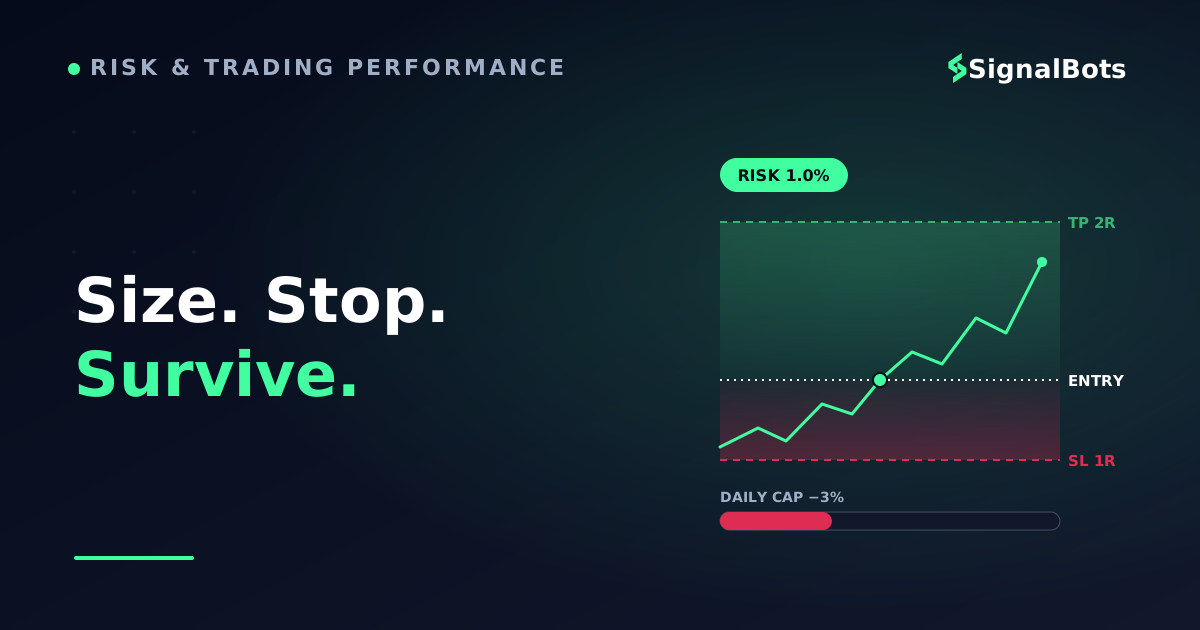
Fix your risk per trade (about 1% of equity) and derive the lot size from each signal's stop distance — never the reverse.
Cap daily losses and correlated exposure, then run the 60-second pre-trade checklist before every entry.
Table of Contents (21 min read)Contents
Why Winning Signals Still Lose Accounts
You followed the signals. More of them won than lost. And the account is still smaller than it was a month ago. If that sounds familiar, the problem usually is not the signals — it is that nothing decided how much each signal was allowed to cost you.
A trading signal answers two questions: what to trade and which way — the full mechanics of how that instruction gets built are in our guide on what forex signals are and how they work. On its own, it says nothing about the third question — the one that decides whether you are still trading in six months: how much of your account rides on this idea? Take ten signals with whatever lot size feels right in the moment, and one oversized loser can erase seven disciplined winners. That is not bad luck; it is arithmetic.
The arithmetic gets worse the deeper you fall. Losses and gains are asymmetric: climbing out of a drawdown always requires a larger percentage gain than the loss that caused it, because you are rebuilding from a smaller base.
Survival math
The hole deepens faster than it refills: a 20% drawdown needs a 25% gain to get back to even, and a 50% drawdown needs a full 100%.
This is why risk management is not a defensive afterthought bolted onto a signal strategy — it is the strategy that keeps every other strategy alive. The good news: an AI signal, read in full, already carries most of the risk plan you need. The rest of this guide shows you how to use it — how to gate signals on their reward-to-risk, size positions from the stop distance, cap what a bad day can take, and compress all of it into a check you can run in under a minute. If you want to feel the recovery asymmetry with your own numbers first, the drawdown recovery calculator makes it uncomfortably concrete.
The Risk Plan Hiding in Every AI Signal
A complete AI signal is never just "EUR/USD BUY". The full anatomy of a trading signal bundles everything a risk decision needs:
Pair and direction — what to trade and which way.
Entry price — the reference point that defines every distance below.
Stop loss — the price at which the idea is proven wrong. The distance from entry to stop is your unit of risk: one R.
Take profit — the target. The distance from entry to target is your reward.
Timestamp — when the setup was valid, which matters more than most traders think.
Each field is a risk input, not decoration. The model that produced the signal placed the stop and target from the structure and volatility it measured — the stop sits where the setup is invalidated, not at a round number of pips that feels comfortable. When you take the direction but discard the levels, you are no longer trading the setup that was signalled; you are trading a hunch with extra steps.
Freshness is the field beginners ignore first. Price drifts away from the signalled entry within minutes, and every pip of drift changes both distances at once — shrinking your reward while widening your effective risk. Acting on a stale signal means the numbers on your ticket no longer match the numbers the model validated.
So the habit this article exists to build is simple: treat the signal as a pre-packaged trade plan, and run the same five moves on every alert.
From alert to sized trade in five moves
1
Read the full signal
Take every field — direction, entry, stop loss, take profit — not just BUY or SELL.
2
Confirm it is still fresh
If price has already run past the entry, your real reward-to-risk is worse than the signal's. Skip stale setups.
3
Check the reward-to-risk
Measure the target distance against the stop distance. Below your floor, the trade simply does not happen.
4
Size from the stop distance
Turn your fixed risk per trade and the stop distance into a lot size. Wider stop, smaller position.
5
Send SL and TP with the order
Attach both exits at entry, so the plan executes even if you walk away or the market moves fast.
The same five moves on every alert — the order never changes, only the numbers do.
Gate Every Signal on Reward-to-Risk
Before you size anything, decide whether the trade pays enough for the risk it asks you to hold. The reward-to-risk ratio is the take-profit distance divided by the stop-loss distance, and it sets the win rate you need just to break even:
At 1:1, you need to win more than half your trades to come out ahead.
At 2:1, one winner pays for two losers — profitable above a one-in-three win rate.
At 3:1, one winner pays for three losers — one win in four keeps you at break even.
That relationship is pure arithmetic, and it is the reason a floor matters. Pick a minimum ratio you will accept — many disciplined signal traders use 1.5:1 — and let it filter your feed. A signal below your floor is not a smaller opportunity; it is a different, worse bet.
Try it live
The risk plan inside one signal
Long setup
Reward zone+0.0060
Risk zone−0.0030
TP 1.0910
Entry 1.0850
SL 1.0820
Reward-to-risk ratioYou aim for 2.00x what you risk
1 : 2.00
Risk (1R)
0.0030
Reward
0.0060
Break-even win rate
33.3%
30 pips of risk against 60 pips of reward is 2:1 — edit the levels and watch the break-even win rate move with them.
Two practical corrections keep this honest. First, costs: the spread widens your effective stop and trims your target, so judge the ratio after costs, not on the raw signal numbers — on a tight 15-pip stop, a 1.5-pip spread already shifts the math. Second, entry drift: chasing a signal 20 pips late can quietly turn a 2:1 setup into 1:1. In both cases the discipline is the same — when the numbers you can actually get no longer clear your floor, skipping the trade is the risk-managed decision.
Size the Position From the Stop, Not From Habit
Here is where most accounts are actually lost. The fixed-lot habit — trading the same 0.50 lots on every alert — means a signal with a 60-pip stop risks four times more money than one with a 15-pip stop, while feeling identical on the ticket. Your risk is random, so your results are random, no matter how good the signals are.
A position sizing rule inverts the habit: fix the dollars first, derive the lots from the stop. Start by choosing your risk per trade — a fixed slice of account equity, and the single most common convention among disciplined traders is 1%. At 1%, a losing streak stings but stays survivable; the account that risks 10% per trade does not get enough tries for its edge to play out.
From there the position size is one division: dollars at risk, divided by the stop distance in pips times the pip value of one lot. Run your own numbers:
Size it yourself
Position size from your signal's stop
Enter your equity, risk cap, and the signal's stop distance. The lot size is the output of the plan — never the starting point.
Account equity
$
Risk per trade
Stop distance
pips
Pip value per standard lot
$
Dollars at risk
—
Position size
—
A $5,000 account risking 1% on a 30-pip stop trades 0.17 lots — double the stop and the correct size halves.
Notice what the rule does to your relationship with stops. A wider stop is no longer a bigger threat — it just means a smaller position carrying the same dollar risk. Every trade becomes worth exactly 1R, which makes wins and losses comparable across pairs, sessions, and volatility regimes. When every loss costs the same, a losing streak is an inconvenience instead of an event. Keep the forex position size calculator open next to your platform until the division becomes reflex.
Cap What One Bad Day Can Take
Per-trade sizing stops any single loser from hurting you. It does not stop six of them in one afternoon. Three caps close that gap:
A daily loss budget. Decide in advance how many R you are willing to lose in a day — three is a common ceiling. Hit it, and you are done until tomorrow. Not "one more to win it back": done.
A correlation cap. Long EUR/USD and long GBP/USD is not two trades; it is one short-dollar bet at double size, because the pairs move together most of the time. Cap yourself at one open trade per currency theme, however many signals fire.
A streak plan. Over enough trades, consecutive losses are a statistical certainty for any win rate — five in a row is not evidence the signals broke. Decide now what a streak changes (nothing, if your sizing is right) so you do not renegotiate your rules mid-tilt.
Together these caps are what push your risk of ruin — the probability your account falls to a level it cannot realistically recover from — toward zero. Ruin is driven far more by oversizing and stacked exposure than by win rate, which is exactly why it is the one variable completely under your control.
Run the 60-Second Pre-Trade Check
Everything above compresses into a single ritual that fits between "signal arrives" and "order sent". Run it on every alert — the check takes less time than a requote.
Your safety net
The 60-second pre-trade risk check
0 / 8
Signal is fresh — price is still at or near the signalled entry, not 20 pips past it
Reward-to-risk still clears your floor (1.5:1 or better) after spread and any entry drift
Position size was calculated from this signal's stop distance — not your usual lot size
Total risk on this trade is 1% of equity or less
Stop loss goes in with the order — not added later once you see how it goes
Take profit is set at the signal's target, not a hopeful round number
Today's loss budget is still intact — if the day is at minus 3R, you are done
No open position already rides the same currency in the same direction
★
Checklist complete — you’re cleared to proceed.
Tick all eight and the trade is allowed to exist. Any unticked box is a no — not a maybe.
The point of a checklist is not information — you already know everything on it. The point is that it runs before the part of your brain that wants the trade gets a vote. Traders who print this list and run it mechanically stop making the expensive mistakes long before they get better at anything else.
Let Automation Hold the Line
Now the honest part. Rules like these are easy to write and brutally hard to obey at the exact moments they matter — after two losers, when the revenge trade whispers, or when a "sure thing" tempts you to triple size just this once. Discipline is perishable, and it perishes fastest under drawdown.
That is the real case for automating signal execution — not speed for its own sake, but consistency: the stop loss and take profit go in exactly as signalled every time, the sizing math is identical at 9 a.m. and after a four-loss streak, and a kill switch halts trading the moment the daily budget is hit — enforced by code, not remembered under stress. The machine does not negotiate with itself.
If you prefer to stay hands-on, keep the plan visible at minimum: a forex Telegram signal channel that publishes entry, stop, and target on every alert hands you the complete risk plan in one message — leaving the checklist as the only thing between you and a disciplined entry.
We started with
“One bad week kept erasing a month of winning signals”
and arrived at
Every signal now enters sized, capped, and pre-checked.
Make survival the strategy
You did not need better predictions — you needed each trade to cost the same small, survivable amount when it failed. The signal already carries the plan: entry, stop, target. Gate it on reward-to-risk, size it from the stop, cap the day, and run the checklist. Do that on every alert and no single trade, streak, or session can take you out of the game.
Do AI forex signals include stop loss and take profit levels?
A complete signal does — entry, stop loss, and take profit are the minimum fields that make a signal actionable as a risk plan rather than a directional opinion. If a provider sends direction-only alerts, you are being handed the least valuable half of the trade. Treat the presence of full levels on every alert as a basic quality bar when judging any signal source.
How much should I risk per trade when following AI signals?
The most widely used convention is 1% of account equity per trade, with 2% as an aggressive ceiling. The exact number matters less than two properties: it is fixed in advance, and it is small enough that a normal losing streak cannot do lasting damage. Signals do not change this rule — they only tell you where the stop is, which is what converts your fixed risk into a lot size.
Can I move the stop loss that comes with a signal?
Widening it after entry is the single most expensive habit in retail trading — it converts a planned 1R loss into an unplanned multiple of it. The signal's stop marks where the setup is invalidated; if price gets there, the trade idea failed and the position should die at its budgeted cost. Tightening a stop to lock in profit on a runner is a different, defensible move — but the direction only ever goes one way: toward less risk, never more.
Should I still take a signal if price has moved past the entry?
Recheck the numbers before deciding. Entry drift shrinks your reward and widens your effective risk at the same time, so a setup that was 2:1 at the signalled entry can be 1:1 by the time you click. If the ratio you can actually get still clears your floor, the trade can be legitimate; if not, let it go — the next signal costs you nothing.
Does auto-trading remove the need for risk management?
No — it removes the need to remember risk management in the moment, which is different and arguably more valuable. The rules still have to be set by you: risk per trade, reward-to-risk floor, daily loss cap, correlation limits. What automation adds is enforcement — the stop always goes in, the size is always derived from it, and the kill switch fires whether or not you feel like stopping.
Sources & Further Reading
Want to go deeper? These independent, authoritative sources shaped this guide — each one is worth reading in full:
The Forex Desk is the SignalBots editorial team responsible for our currency-market coverage. We research and write the guides, explainers and reference articles on how the majors, minors and crosses actually trade — sessions, spreads, swaps and the macro releases that move price.



Discussions 0
Leave a comment