Starting forex is mostly a sequencing problem. Everything you need to know is public — what a pip is, how brokers work, why stop-losses matter — but almost nobody tells you the order to do things in. So most beginners do it backwards: they fund an account first and learn risk management afterwards, one losing trade at a time. That's an expensive curriculum, and it's avoidable.
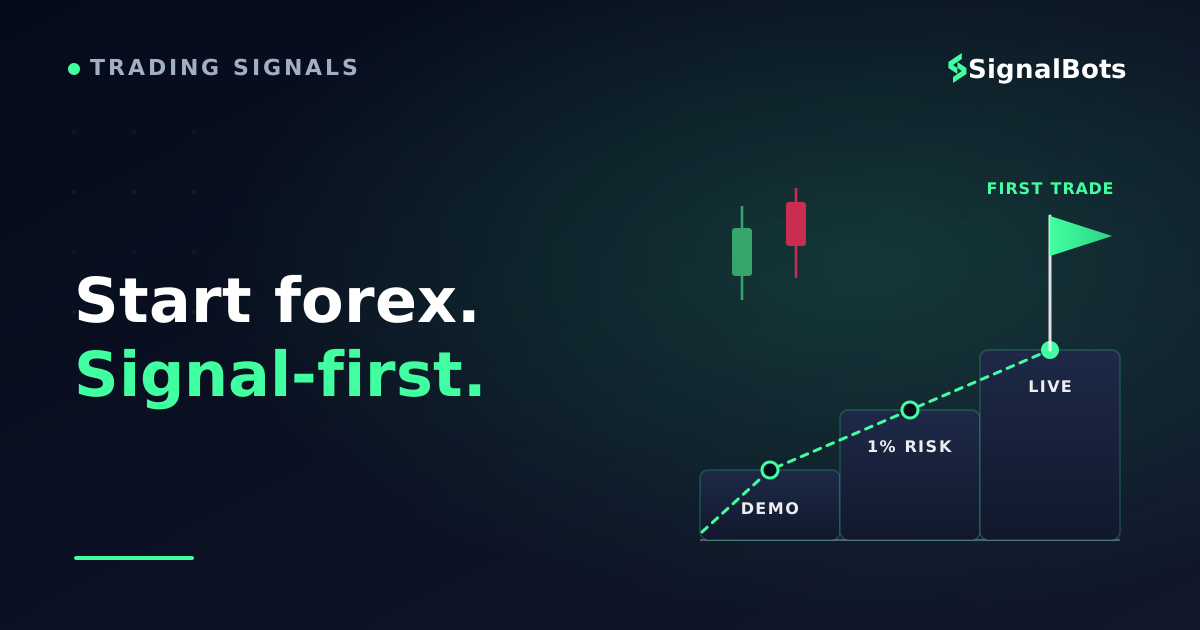
This guide fixes the order. You'll set up the boring structural pieces first — a regulated account, a demo rehearsal, a fixed risk rule — and only then take your first live trade, using a trading signal as a structured template instead of a hunch. Along the way you'll see where automation genuinely helps a beginner (enforcing discipline) and where it doesn't (replacing judgment you haven't built yet). Here's the whole roadmap at a glance:
Your roadmap
The six-step roadmap this guide walks through
1
Learn to read the quote
Bid, ask, spread, pips — the four words every forex price and every signal is written in.
2
Open the right account
A regulated broker, MetaTrader 5, a free demo account and micro lots. Nothing else matters yet.
3
Rehearse on demo
Trade your written plan for a few weeks as if the money were real — same size, same rules.
4
Set risk rules first
Fix your risk per trade and attach a stop-loss to every position before you obsess over entries.
5
Take a structured first trade
Follow a complete trading signal — entry, stop, target — instead of an impulse.
6
Automate the discipline
Let alerts and automation enforce the plan while you keep control of the decisions.
The order is the edge: structure first, live money last.
Key Takeaways
Do things in the right order: regulated account, demo rehearsal, fixed risk rules — live money comes last, not first.
Cap risk per trade at 1% or less and size every position from your stop distance; the in-guide calculator does the math.
Make your first live trade a complete trading signal — pair, direction, entry, stop, target — instead of a hunch.
Automate alerts first and execution later: a bot magnifies whatever process you hand it, good or broken.
Table of Contents (38 min read)Contents
First, learn to read the quote
Forex prices come in currency pairs: EUR/USD is the price of one euro measured in US dollars. Buy the pair and you're betting the first currency (the base) strengthens against the second (the quote); sell it and you're betting the opposite. That's the entire product — there are no shares, no dividends, just one currency's value expressed in another.
Every pair is quoted as two prices at once — the bid and ask price. The bid is what you can sell at, the ask is what you can buy at, and the ask is always slightly higher. That gap is the spread, and it's the first cost you pay on every trade: the moment you enter, you're down by the spread.
Price movement itself is measured in pips — for most pairs, a change in the fourth decimal place (1.0850 to 1.0851 is one pip). How much one pip is worth in dollars depends on your position size, a concept called pip value that we'll use for position sizing in step four.
Why start here rather than with charts and strategies? Because these four words — bid, ask, spread, pip — are the alphabet that every broker ticket and every signal you'll ever receive is written in. A signal that says "Buy EUR/USD at 1.0865, stop 1.0840, target 1.0915" is meaningless until you can read it fluently, and misread instructions cost real money.
The spread is also not the only cost. A typical trade carries up to three:
Know the bill
What one trade actually costs (illustrative mini-lot round turn)
Spread
Commission
Overnight swap
0All-in cost
Spread0.9 USD
Commission0.7 USD
Overnight swap0.3 USD
Total cost per trade— USD
Illustrative example for one mini lot of EUR/USD held overnight on a raw-spread account. Your broker's mix will differ — the point is that the headline spread is not the whole bill.
Three costs stack on every position: the spread you cross, any commission, and a swap fee if you hold overnight.
You don't need to memorize fee tables. You just need the habit of asking, before any trade: what does this cost me in dollars if price never moves? Our pip value calculator turns any pair and position size into that dollar figure in a few seconds.
Step 1 — open the right account, not the flashiest one
Your broker choice matters more as a beginner than it ever will again, because you can't yet recognize bad execution when you see it. Filter on these five things, in this order:
Regulation. The broker should be licensed by a recognized financial authority (FCA, ASIC, CySEC, or your local regulator), and you should verify the license number on the regulator's own register — not just trust the broker's footer.
Platform. Choose a broker that supports MetaTrader 5 (or MT4). It's the industry-standard platform, it's free, and everything in the signal-and-automation world — expert advisors, connectors, copiers — is built around it. Most regulated retail brokers offer it; IC Markets, XM, Exness and FP Markets are common examples beginners run into.
A real demo account. Same prices, same platform, virtual money. Non-negotiable — it's where you'll spend your first weeks.
Micro or cent accounts. These let you trade 0.01 lots, so a full position risks single-digit dollars. Small sizing is what makes the learning phase survivable.
Execution quality. How fast and how faithfully orders fill — execution speed and slippage — matters more than a marginally tighter advertised spread, especially once signals enter the picture: a signal acted on slowly is a different (worse) trade than the one that was sent.
Notice what's not on the list: deposit bonuses, prize contests, and maximum leverage. High leverage isn't a feature for a beginner — it's a loaded setting you'll deliberately leave turned down.
Step 2 — know when the market is actually worth trading
Forex trades 24 hours a day, five days a week — but those hours are not equal. The market follows the sun through four sessions, and liquidity (how easily you can trade at a fair price) rises and falls with them:
Sessions
When each FX session is open (UTC)24-hour clock · times in UTC
UTC timeline
SydneyTokyoLondonNew York
22:00–24:0022:0000:00–7:00–7:00
0:00–9:000:00
8:00–17:008:00
13:00–22:0013:00
000306091215182124
Tokyo + London8:00–9:00 UTC · Liquidity hand-off
London + New York13:00–17:00 UTC · Peak liquidity & volatility
Sydney
Tokyo
London
New York
Overlap (peak liquidity)
The London–New York overlap is when spreads are usually tightest and moves are largest — the busiest hours of the trading day. The stretch after New York closes is the quietest, with wider spreads.
Forex is open 24/5, but the London–New York overlap is where the action concentrates.
The practical takeaway: you do not need to watch charts all day, and you shouldn't try. Pick one window that fits your timezone and daily life — the London–New York overlap if you can manage it — and make that your trading session. Consistency of conditions is underrated: trading the same pair in the same session every day means you're learning one market's personality instead of four. The forex market hours tool converts every session into your local clock.
Step 3 — rehearse on demo like the money is real
A demo account gives you live prices with virtual money, and most beginners waste it. They oversize wildly, skip stop-losses, click buttons to see what happens — then wonder why none of it transfers to a live account. The problem isn't demo trading; it's aimless demo trading.
Rehearse instead. Write a one-page plan — which pair (start with one major; EUR/USD is the standard choice), which session, what risk per trade, and what has to be true before you enter — then trade the demo exactly as you intend to trade live, at the same small size. The goal of the demo phase is not profit. It's fluency: placing, modifying and closing orders without hesitation, attaching stops as a reflex, and logging every trade with a one-line reason.
Give it a few weeks of consistent repetitions, not a weekend. You're done with demo when the mechanics are boring — when nothing about the platform surprises you anymore. What demo can't teach is how losses feel with real money on the line, which is exactly why your first live trades stay tiny.
Step 4 — set your risk rules before your entry rules
Here's the counterintuitive part of learning to trade: your survival through the first year depends far more on position sizing than on entries. A beginner with mediocre entries and strict risk control outlasts a beginner with great entries and no rules — because the second one eventually meets a losing streak they're sized too big to survive, exactly the failure mode our deeper guide to risk management with AI forex signals is built to prevent.
Three rules, fixed before your first live trade:
Cap your risk per trade at a fixed fraction of your balance. The widely used guideline is 1–2%; as a beginner, start at 1% or below.
Every position gets a stop-loss — a pre-set exit that caps the loss if the trade goes against you. Placed before entry, never "when I get around to it".
Know your reward before you enter. A take-profit target meaningfully larger than your stop distance gives the trade a favorable reward-to-risk ratio — which is what lets a strategy survive losing more often than feels comfortable.
Those three rules collapse into one number: how big your position should be. The formula is simple — cash you're willing to risk, divided by the stop distance — and you should run it before every trade. Try it with your own numbers:
Try your numbers
Your first-trade position size
Set your balance, risk percentage and stop distance. The result is the largest position that keeps a losing trade inside your risk cap. A pip value of $10 per standard lot fits USD-quoted majors like EUR/USD.
Account balance
$
Risk per trade
Stop-loss distance
pips
Pip value per standard lot
$
Cash at risk if the stop hits
—
Max position size
—
Same size in micro lots
—
A $500 account risking 1% with a 25-pip stop trades 0.02 lots — about $5 on the line. Small feels slow; small is the point.
Run the default example: a $500 account risking 1% with a 25-pip stop puts $5 at risk on a 0.02-lot position. If that feels frustratingly small, good — that reaction is exactly the emotion the rule exists to contain. When you want the full version with margin and leverage handling, the forex position size calculator goes deeper.
Step 5 — your first live trade: follow a signal, not a hunch
Most first trades are impulses — a chart that "looks like it's going up", a tip from a video. The alternative is to make your first trade a structured one, and this is where signals earn their place in a beginner's process.
A trading signal is a complete trade instruction produced by analysis you don't have to perform yourself — ours are generated by AI models scanning price data around the clock. The key word is complete: a legitimate signal specifies the pair, the direction, the entry price, the stop-loss and the take-profit. All five fields, every time — the full anatomy of a signal. A message that just says "buy EUR/USD now!!" is not a signal; it's noise with confidence.
Here's what one looks like plotted on a chart, so you can see how the fields map to actual price:
Anatomy of a signal
A complete signal on the chart: EUR/USD breakout longEUR/USD1H
Entry above the range high, a 25-pip stop below it, a 50-pip target — a 2:1 reward-to-risk trade you can size with the calculator above before clicking anything.
Every field of the signal maps to a line on the chart. If a signal can't be drawn like this, don't trade it.
Why is this better for a beginner than trading your own ideas immediately? Three reasons:
It removes the blank-page problem. You're executing a defined plan, which trains exactly the skills — sizing, order entry, patience — that any strategy you build later will need.
It pre-packages the risk math. Entry, stop and target arrive together, so the position-size calculation from step four plugs straight in.
It takes emotion out of the entry. The decision was made by a system before you saw the chart — which is the whole discipline battle for most new traders.
One warning, because it matters: following signals is not a substitute for understanding them. Trace every signal you take — where did the stop sit relative to structure? did price reach the target? — and treat your first months as paid tuition, win or lose. Judge any signal provider by transparency: an inspectable track record that shows losses as well as wins, and full five-field signals every time — the same checklist our guide to spotting Telegram forex signal scams applies in more depth. You can watch our live AI-generated calls on the forex signals dashboard without paying anything, which makes it a low-stakes place to practice reading them.
Step 6 — automate the discipline, not the decisions (yet)
Automation in forex is a spectrum, and beginners should walk it left to right:
Alerts and notifications. Signals delivered to your phone the moment they fire, so you're not glued to charts. Nothing is traded for you — this is purely a convenience layer, and it's where you should start. Our forex signals app does exactly this.
Semi-automation. Tools that pre-fill the trade ticket from a signal — entry, stop, target, size — while you still click the final button. Discipline enforced, judgment retained.
Full automation. A trading bot or expert advisor executes signals end-to-end; copy trading, where your account mirrors another account's trades automatically, sits here too.
The honest advice: stay at levels one and two until you've been through at least one losing streak with real (small) money without breaking your rules. Full automation magnifies whatever process you hand it — a solid process compounds, a broken one breaks faster. The reason to move toward it eventually is the same reason it's dangerous early: a bot never widens a stop out of hope, never revenge-trades, and reacts to a signal in milliseconds rather than minutes. It already has the discipline you're still building. Earn the process first; then hand it to the machine.
How much money do you actually need?
Less than you think to learn, more than you think to earn — and confusing those two goals is what funds most blown accounts.
To learn, a few hundred dollars on a micro-lot account is genuinely enough. Suppose you start with $300 at 1% risk: each trade risks $3, which is large enough to make losses sting (the tuition demo can't charge) and small enough that a ten-trade losing streak costs $30, not your account. What a small account cannot do is replace an income — and it doesn't need to. Its job is to buy you a year of real repetitions cheaply.
So fund the account with an amount whose total loss you could absorb without flinching, treat any growth as evidence your process works, and scale only when the process — not one lucky month — has proven itself.
The five mistakes that actually end beginner accounts
Oversizing. The account-killer. Not bad analysis — size. If a position makes you check the chart every five minutes, it's too big.
Trading without a stop. One "it'll come back" trade can undo fifty disciplined ones. It usually doesn't come back.
Revenge trading. Doubling size after a loss to win it back turns one planned loss into an unplanned disaster. A fixed risk rule plus a daily stop — two or three losses and you're done for the day — blocks it.
Acting on expired signals. Entering long after a signal fired — a stale signal — means the price and reward-to-risk that justified the trade no longer exist. If you missed it, you missed it; there is always another.
Strategy-hopping. Switching methods every losing week guarantees you never collect enough trades to know whether anything works. Pick one process and give it a fair sample.
Notice that all five are behavior, not knowledge. That's the honest reality of starting forex: the market doesn't beat most beginners — their own unstructured process does. It's also why every step in this guide has been about installing structure.
Your pre-live checklist
Before your first live trade, tick every box — literally:
Final gate
Ready to go live? Confirm every item
0 / 10
My broker is regulated and I verified the license on the regulator's register
MetaTrader is installed and I can place, modify and close a demo trade without hesitating
I have a written plan: one pair, one session, one signal source
My risk per trade is fixed at 1% or less of my balance
I know my position size before every trade — formula or calculator
Every trade gets a stop-loss and take-profit attached at entry
I've logged a few weeks of demo trades with a one-line reason for each
I can state, in dollars, what one trade costs me in spread and fees
The account holds only money I can afford to lose
I understand every field of the signals I plan to follow
★
Checklist complete — you’re cleared to proceed.
If any box stays unticked, that's your next task — not a technicality to skip.
FAQ
How much money do I need to start forex trading?
Enough to trade micro lots under a 1% risk rule and absorb a total loss without stress — for most people that's a few hundred dollars. Your first account's purpose is education, not income; fund it accordingly and scale only after your process has survived several months, including losing streaks.
Can I skip learning and just follow signals?
You can execute signals from day one, but you can't skip the foundations: you still need to size positions, place stops, and recognize when a signal has expired — mistakes in any of those lose money even when the signal itself was good. Treat signals as structured training wheels: follow them, trace why each one was issued, and let them accelerate your learning rather than replace it.
How long should I stay on a demo account?
Until the mechanics are boring — typically a few weeks of consistent, plan-driven trading. You're ready to go live (small) when you place stops as a reflex, never fumble an order ticket, and have a log of demo trades that followed your written rules. Staying on demo for many extra months adds little, because demo can't teach the emotional side; tiny live positions do.
Do I need to watch charts all day?
No — and trying to is counterproductive. Forex runs around the clock on weekdays, but liquidity concentrates in specific windows, especially the London–New York overlap. Pick one session that fits your life, trade only that window, and let signal notifications cover the rest of the clock so you're alerted instead of glued to a screen.
Is forex trading profitable for beginners?
Not automatically — and be wary of anyone promising otherwise. Most beginners lose money in their first months, usually to oversizing and skipped stops rather than bad market calls. Profitability comes, if it comes, from surviving the learning phase cheaply: strict risk per trade, favorable reward-to-risk ratios, and one process given a fair sample. Structure improves your odds; nothing guarantees them.
What's the difference between a forex signal and a forex bot?
A signal is information — a complete trade instruction (pair, direction, entry, stop, target) that you execute yourself. A bot is execution — software that places those trades on your account automatically. Signals keep you in the decision loop, which is where a beginner belongs; bots enforce speed and discipline once you have a proven process to hand them.
You came in asking
“I want to trade forex but I don't know where to start”
and you now have
a six-step roadmap: read the quote, open the right account, rehearse, fix your risk, follow a structured signal, automate the discipline.
Start small, start structured — and let the process compound
None of the six steps requires talent; every one of them requires order. Do the boring parts first — regulation, demo reps, a 1% risk rule — and your first live trade becomes a controlled experiment instead of a gamble. From here, the fastest way to build fluency is to read real signals daily and price out your own trades before taking them.
The Forex Desk is the SignalBots editorial team responsible for our currency-market coverage. We research and write the guides, explainers and reference articles on how the majors, minors and crosses actually trade — sessions, spreads, swaps and the macro releases that move price.



Discussions 0
Leave a comment