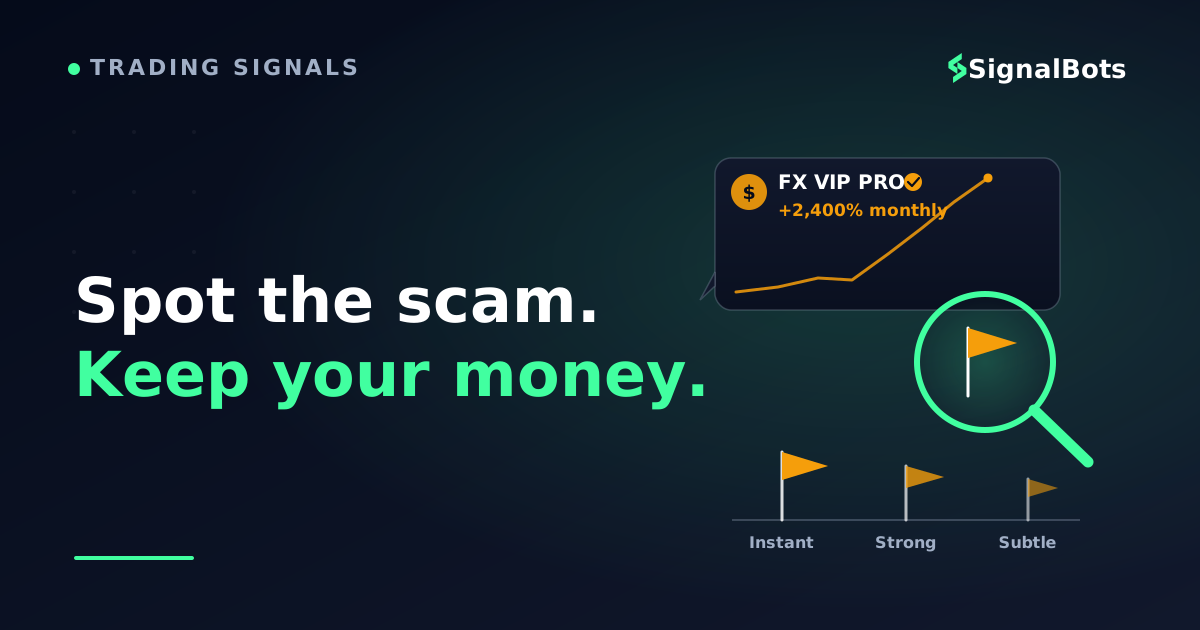
The channel looks profitable and the VIP window 'closes tonight' — but scam channels are paid on your deposits and losses, not your wins.
SB
SignalBots Forex Signals— free channel, public record
Full history public — losing trades included
Entry, stop-loss and take-profit on every signal
AI-generated, delivered in under 10ms
Judge the free record before anything else
Built to be audited
Our take
#2SignalBots Live SignalsOn-site, no Telegram
#3SignalBots Forex AppPush notifications
Every claim here is checkable with the audit steps belowStart the scam audit →
Somewhere in your Telegram feed there is a forex channel posting a wall of green: pinned wins, celebration emojis, and an admin insisting the VIP group closes tonight. The question you need answered is narrow and urgent — is this specific group real, and how do you find out before any of your money moves?
This review gives you a working method, not a scare story. First you will see how a scam Telegram signal channel actually earns — because once you understand the incentives, red flags stop being a list to memorize and become obvious on sight. Then you will run the same audit we would apply to any signal provider: a ten-point checklist, a ten-minute verification routine, and a side-by-side picture of what a legitimate operation looks like instead.
Key Takeaways
A scam signal channel earns from your deposits and losses, not your wins — read the incentives and most red flags become obvious on sight.
Screenshots prove nothing; only a full, timestamped history with visible losing trades (or a third-party verified record) counts as evidence.
Signals without a stop-loss, deposit-to-unlock broker demands, and "guaranteed profit" language are instant disqualifiers — leave on the first one.
Forward-test any provider on a demo account for several weeks before paying; a legitimate provider will never rush that step.
Table of Contents (19 min read)Contents
Follow the money: how scam channels get paid
Here is the single most useful fact in this article: a scam signal channel does not need its signals to work. Its revenue comes from everywhere except your trading success, through four engines that often run in parallel:
Broker kickbacks on your activity — and often your losses. The channel funnels you to one specific offshore, unregulated broker through its own referral link. Many of these brokers take the other side of your trades, so your loss is their revenue — and a slice of that flows back to the channel that delivered you. When the admin is paid per deposit, the trade ideas are set dressing; the deposit link is the product.
VIP subscriptions. The free channel is a shop window. Its job is to make a paid "VIP tier" look like the obvious next step — usually priced low enough that hundreds of people say yes before anyone can score the signals properly.
"Account management." The admin offers to trade your account or "invest" your funds directly for a profit split. This is not a signal service at all — it is custody of your money in a stranger's hands, and it rarely comes back.
The second bite: recovery scams. After the collapse, "fund recovery agents" appear in your DMs offering to get your money back for an upfront fee. It is frequently the same operator, monetizing the victim list twice.
Notice what is missing: not one of these engines requires a single winning trade. That is the core difference from a legitimate provider, whose income depends on subscribers staying — which only happens when the record holds up under scrutiny. One honest nuance: broker partnerships by themselves are not proof of a scam. Introducing-broker relationships are a normal, disclosed business model across the industry (it is how SignalBots keeps its tools free). The scam version has three tells: the broker is unregulated, the relationship is hidden, and the signals are held hostage until you deposit through their link.
The playbook, from first post to exit
Scam channels are franchises, not one-offs. The same six-stage script repeats because it works — and once you can see the stages, you can place any suspicious channel on this timeline and predict its next move.
The playbook
1Seed the audience Members are bought in bulk, the channel is back-dated with reposted screenshots, and the early 'results' are lifted from other channels. Day one already looks like a two-year track record.
2Cherry-pick the free wins The free channel posts signals frequently. Winners get pinned with celebration posts; losers are quietly deleted or edited. What survives looks like an unbroken streak.
3Manufacture urgency The VIP upsell arrives with a countdown: 'only 20 slots left', 'price doubles at midnight'. The scarcity is fake — the product is a Telegram invite link with infinite supply.
4Reframe the losses Inside VIP, losing trades get excuses — broker slippage, 'market manipulation' — plus 'recovery' signals that double the stake after every loss, a spiral that empties small accounts fast.
5Move the money Now the real ask: deposit through their link at a broker you have never heard of, or hand your account over for 'professional management'.
6Vanish and rebrand When complaints outweigh new deposits, the channel is deleted. The same operator reopens weeks later under a new name, running the same template. Nothing is left to report.
The lifecycle almost every scam signal channel follows — each stage exists to move you one step closer to the deposit.
Two stages deserve a closer look. In stage two, the channel is manufacturing what looks like a flawless record by deleting its losers. Every provider on earth produces a false signal sooner or later — a setup that looked valid and failed. A channel where none are visible is not showing you skill; it is showing you an editing habit. In stage four, the "recovery" signals that double your stake after each loss are a martingale progression — a structure that converts a losing streak into a wiped account while keeping the channel's claimed win rate technically alive.
Red flags, ranked by how fast they disqualify
Not all red flags carry the same weight. Rank them, and you stop wasting evenings investigating channels that a thirty-second glance should have killed.
Instant disqualifiers — one strike and you leave
Promises of certainty. Any channel advertising "guaranteed profit", "risk-free signals", or "100% accuracy" is lying about how markets work. No forecasting method removes risk; a legitimate provider talks in historical win rates and reward-to-risk ratios, never certainties.
Signals without a stop-loss. A real signal is a complete, falsifiable instruction — the full anatomy of a signal includes an entry, a stop-loss, and a take-profit. An entry-only call can be retroactively claimed as a win almost regardless of what price did.
Deposit-to-unlock. If the signals only start after you fund an account at one specific broker you have never heard of, you are not buying signals — you are the commission event.
Requests for your money or your account. "Send funds, we trade for you", profit-split "management", or any ask for your account's master password ends the conversation immediately.
Strong warnings — two or more means walk
An anonymous operator. No real name, no company, no website, no regulator record — nothing that exists outside Telegram. Accountability is impossible by design.
Screenshot-only proof. Platform screenshots are trivially fabricated, and demo accounts produce real-looking wins with zero risk. Screenshots are marketing assets, not evidence.
A record with no losses. See stage two above — this is editing, not trading.
Lifestyle marketing. Rented supercars and cash fans answer a question nobody asked. Actual track records make lifestyle props unnecessary.
Countdown pressure. "Last 5 VIP slots" on a product with infinite supply exists for one reason: to make you decide before you can verify.
Subtle tells — the ones sharp traders still miss
A win rate with no sample size. "92% accuracy" over how many signals, across what period, at what reward-to-risk? A historical win rate only means something attached to a sample and a risk profile; a naked percentage is a slogan.
Drawdown is never mentioned. Every genuine strategy has losing streaks. A provider who has never discussed one either hasn't traded through one or won't tell you about it — both disqualifying.
Broadcast-only silence. Comments disabled, no member chat, no questions answered in public. Scrutiny is the one thing the channel cannot survive.
Template overlap. The same bio, the same win-rate claim, the same pinned message across a dozen channels means you found a franchise, not a trader.
That is the theory. Here is the same content as something you can actually run against the channel sitting in your feed right now:
Run the audit
The 10-point Telegram signal scam audit
0 / 10
Find the operator's identity outside Telegram — a registered company, a real website, or a regulator record. No external footprint, no deal.
Scroll the entire channel history and confirm losing trades are visible. A record with no losses has been edited, not earned.
Check that every signal posts entry, stop-loss, and take-profit together. Entries-only 'signals' are unfalsifiable marketing.
Search the channel's exact win-rate claim in quotes. The same '90% accuracy' template pasted across many channels is a franchise scam.
Reverse-image-search the admin's photos and lifestyle shots. Stolen images disqualify a channel instantly.
Ask for a third-party verified track record or read-only account access. Screenshots and forwarded messages prove nothing.
Refuse any channel that unlocks signals only after you deposit with one specific broker it controls the link to.
Treat 'send us funds' or 'we trade your account for you' as an automatic exit, whatever the promised split.
Check any promoted broker against the FCA Warning List and your local regulator's register before opening an account.
Forward-test the free signals on a demo account for several weeks and score them yourself before paying a cent.
★
Checklist complete — you’re cleared to proceed.
Tick each item against the channel you are evaluating. A single failed instant-disqualifier item ends the audit early.
The ten-minute verification routine
The checklist tells you what to check. This is how, in three passes — none of which needs special tools.
Pass one: the operator (3 minutes). Take the admin's name and photos out of Telegram. Reverse-image-search the profile picture and any lifestyle shots. Search the exact channel name plus the word "scam". Look for a company registration or a regulator record. A legitimate provider wants to be found outside Telegram, because an external footprint is what lets them charge for trust. Finding nothing at all is itself a result.
Pass two: the record (4 minutes). Scroll to the channel's oldest messages and check the creation date against the length of the claimed track record. Look for edit marks and date gaps where losing days should be. Then ask one question in the channel or by DM: "Can I see the full history including losing trades, or a third-party verified track record?" Verification can be a live read-only view of the account — for example via an investor password, MetaTrader's view-only login — or an independently tracked feed. How they respond to that single question is often the whole audit: a real provider answers it routinely; a scammer deflects, blocks, or floods you with screenshots.
Pass three: the economics (3 minutes). Run the claim through a sanity check. Suppose a channel really produced a 90% win rate at 2:1 reward-to-risk, as so many advertise. Compounding even a small account at that edge would build serious wealth within a few years — quietly, with no need to sell $40 VIP slots to strangers or chase broker referral fees. The louder the claimed edge, the less sense the business model makes. When the math says "this person would not need you", believe the math.
If a channel survives all three passes, there is still one gate left: forward-test it on a demo account for several weeks. Score every signal yourself — wins, losses, and the ones that never triggered — before real money is involved. A provider confident in their record will never object to being tested; only a provider whose revenue depends on speed will push you to skip this step.
What a legitimate provider looks like instead
Spotting scams is only half of your intent — the other half is knowing how a legitimate signal service actually works, so you are not paralyzed into treating every signal service as fraud. The medium is not the problem: Telegram is simply where signal delivery happens, for honest providers and scammers alike. The difference shows up in seven places you can check from your chair:
Side by side
What to check
Legitimate provider
Scam channel
Track record
Full, timestamped history you can audit — often third-party verified
Screenshots and forwarded wins; history starts last month
Losing trades
Visible and discussed; drawdowns acknowledged
Deleted, edited, or blamed on the broker
Signal format
Entry, stop-loss and take-profit on every signal
Entry-only calls that can be claimed as wins either way
Performance language
Historical win rate with sample size; reward-to-risk framing
'Guaranteed profit', '100% accuracy', 'risk-free'
Broker relationship
Disclosed partnerships with regulated brokers; your broker choice stays yours
One unregulated broker; signals locked behind their deposit link
Sales pressure
Free tier stands on its own; upgrade whenever you are ready
Countdowns, 'last 5 slots', DMs pushing you to decide tonight
Your money
Never asks for custody of funds or trading credentials
Pushes 'account management' or asks for your master password
Seven checks that separate a provider you can verify from a channel built to be abandoned.
The through-line of the left column is auditability. A legitimate provider structures everything — public history, complete signal format, framed statistics, disclosed partnerships — so that a skeptical stranger can verify the operation without trusting anyone's word. A scam structures everything so that verification is impossible and speed is essential.
If you already paid or deposited
If you recognize the playbook above because you are inside it, act in this order:
Stop the bleeding. Make no further deposits, decline all "recovery trades", and revoke any account access you granted — change passwords and disable any granted API keys or authorized sessions.
Document everything now. Screenshot the channel, the DMs, payment receipts, and the broker's registration details before the channel is deleted — evidence disappears at the rebrand stage.
Report it. File with your local financial regulator (in the US, the CFTC and the FTC take these complaints; in the UK, the FCA), and report the channel to Telegram. Reports rarely bring money back directly, but they attach the operator's payment rails to a paper trail.
Try the payment path. If you paid by card, ask your bank about a chargeback immediately — time limits apply. Crypto payments are usually unrecoverable; know that before anyone charges you a fee to "trace" them.
Expect the second scam. Anyone who contacts you offering fund recovery for an upfront fee found you on a victim list. Legitimate recovery does not start with a payment from you.
Choosing a safer route to forex signals
You do not have to abandon signals to avoid scams — you have to change what you are willing to accept. Demand the left column of the table above from any provider, starting with ours: run the ten-point audit against the SignalBots channel before you trust it, exactly as you would with a stranger's.
Prefer a public, uncut record. Our free forex Telegram channel keeps its full history visible — losing signals included — because a record you cannot audit is a record you cannot trust.
Or skip Telegram entirely. The live forex signal feed publishes every active and closed signal on-site with timestamps, so there is no chat layer between you and the record.
Take delivery on your terms. If push alerts fit your day better than a chat app, the forex signal app delivers the same signals as notifications.
Whatever source you choose, keep the risk on your side of the table: a signal is an input to your decision, not a replacement for it. Size every position deliberately — the forex position size calculator turns your stop distance and risk budget into a lot size in seconds — and read our risk warning before trading live. Trading foreign exchange carries a substantial risk of loss, with signals or without them.
You came in
“A green-screenshot channel pushing you to join VIP tonight”
and ended at
Audit the incentives and the record before a cent moves.
The record decides — never the screenshots
SB
SignalBots Forex Signals
Our free forex channel keeps its full signal history public — entries, stop-losses, take-profits, and the losing trades — precisely so you can run this article's ten-point audit against it before you trust anything.
Not ready to join another Telegram channel? Watch signals on-site instead — the live forex signal feed shows every active and closed signal with timestamps, no membership required.
FAQ
Are all Telegram forex signal groups scams?
No. Telegram is a delivery channel, not a business model — legitimate providers and scammers use the same app. What separates them is auditability: a full public history with visible losses, complete signals with stop-losses, framed statistics instead of certainties, and disclosed broker relationships. Judge the record, not the platform.
Can MT4 or MT5 screenshots prove a channel's results?
No. Platform screenshots can be fabricated in minutes, taken from demo accounts, or cherry-picked from dozens of accounts trading opposite directions. Treat screenshots as marketing. The only acceptable evidence is a record verified outside the channel's control — a third-party tracked feed, read-only account access, or your own forward test on demo.
Why would a scam channel give away free signals?
Because the free channel is the funnel, not the product. Free signals build an audience cheaply; cherry-picking and deleting losers makes the record look strong; then the audience is monetized through VIP upsells, referral deposits at a partnered broker, and "account management" offers. Free is not the red flag — what the free channel is steering you toward is.
Is it a scam if a channel asks me to join a specific broker?
Not automatically. Disclosed introducing-broker partnerships with regulated brokers are a standard industry model — it is how many legitimate services, including SignalBots, stay free for traders. The scam signature is different: an unregulated broker you cannot verify, a hidden relationship, signals locked until you deposit through their link, and resistance if you propose using your own broker instead.
Can I get my money back after a signal scam?
Sometimes, partially — and speed matters. Card payments may qualify for a chargeback through your bank; deposits at a broker sometimes can be withdrawn if you act before accounts are frozen or the entity disappears. Crypto transfers are usually gone. Report the scam to your regulator regardless, and never pay an upfront fee to a "recovery agent" — that is the same scam's second act.
Do legitimate providers ever advertise a win rate?
Yes — but framed as a historical, sample-based figure, not a promise. A trustworthy provider states the period, the number of signals, and the reward-to-risk profile behind the number, and will show you the losing trades inside it. The moment a win rate is presented as guaranteed, permanent, or too clean to include drawdowns, it stops being a statistic and becomes bait.
Sources & Further Reading
Want to go deeper? These independent, authoritative sources shaped this guide — each one is worth reading in full:
The Forex Desk is the SignalBots editorial team responsible for our currency-market coverage. We research and write the guides, explainers and reference articles on how the majors, minors and crosses actually trade — sessions, spreads, swaps and the macro releases that move price.



Discussions 0
Leave a comment