You saw Quotex in a YouTube walkthrough or a Telegram channel, the interface looked clean, and you went to sign up — only to hit a country block, or a nagging doubt about whether you're even allowed to. You already know roughly what binary options are. What you don't know is how US law treats an offshore platform like this one, and whether a workaround is worth the risk. This page answers that directly, in plain English, the way a regulator-literate editor would — not the way a page that earns a commission on your signup would.
The verdict
Essential answer
Can a US resident legally open and trade on Quotex?
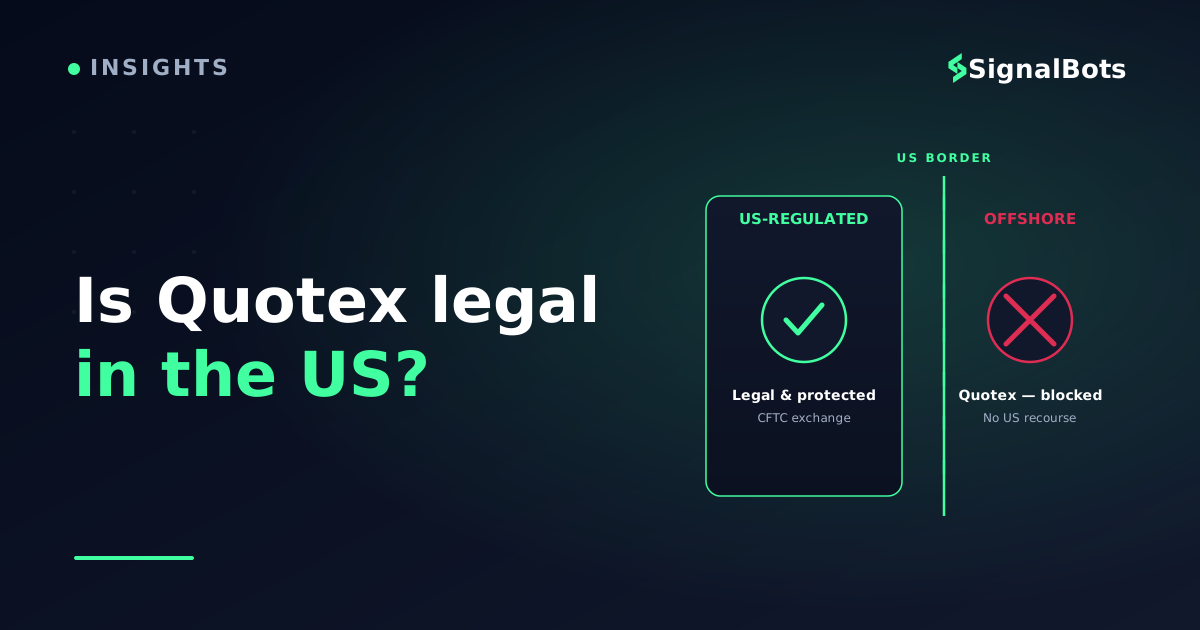
No. Quotex does not accept US residents and is not registered with the CFTC or SEC — so it cannot legally offer you binary options in the US.
US regulatory statusNot registered
Registered with CFTCNo
Registered with SECNo
Accepts US residentsBlocked at signup
Platform typeOffshore
US-law recourse if funds lostNone
Based on the CFTC/SEC investor alert on binary options and Quotex's own country restrictions
The short answer, before you read another word.
If that's all you needed, you can stop here. But most readers want the why — because without it, our "no" reads exactly like the hedged "no, but here's a deposit button" you'll find on affiliate reviews. So here is the actual rule, the reason it lands on Quotex specifically, what really happens if you bypass the block, and what you can legally do instead.
Key Takeaways
Quotex does not accept US residents and is not registered with the CFTC or SEC. Under US law, binary options offered to US residents must trade on a designated contract market — Quotex is an offshore platform, so it cannot legally solicit you.
A VPN does not make it legal. It only strips away your protections: you trade against Quotex's own terms, gain no US regulatory recourse, and put your deposit and ID data at risk on a platform US regulators cannot reach.
There are legal US paths. A small set of CFTC-regulated exchanges list binary-style and event contracts to US residents — verify the current list yourself before depositing anywhere.
Learn to verify any platform in two minutes using NFA BASIC, FINRA BrokerCheck, and the CFTC RED List, so the next platform ad you see answers its own legality question.
Table of Contents (15 min read)Contents
Is Quotex legal in the US? The short answer
No — Quotex is not legal for US residents, and it is not available to them either. Two separate facts stack here, and it helps to keep them apart.
The first is availability: Quotex's own terms restrict US residents, so you'll typically be blocked at signup or when you try to verify. The second is legality: even if the block didn't exist, Quotex is an offshore platform that is not registered with the two US regulators that govern this product — the Commodity Futures Trading Commission (CFTC) and the Securities and Exchange Commission (SEC). Under US law, a foreign platform generally must be registered to solicit US residents for this kind of trading. Quotex isn't. So the answer to is Quotex legal in the US is a clean no, and the answer to is Quotex available in the USA is also no.
That's the verdict. The rest of this page is why, and what to do with that.
Why Quotex isn't available to US traders
The reason isn't that Quotex singled out Americans, or that the US "banned" binary options. It's narrower and more specific than that — and once you see the rule, every offshore binary platform's US block makes sense at once.
The US rule for binary options, in plain English
Here is the rule without the legalese. In the US, when a platform offers binary options — the all-or-nothing contracts where you predict whether a price finishes above or below a level — to ordinary residents, those transactions must take place on a designated contract market (DCM): a US exchange the CFTC has formally approved and oversees. It is not enough to be a real, functioning company somewhere in the world. The venue itself has to be a US-regulated exchange.
A platform based offshore that hasn't registered with the CFTC and isn't operating as (or on) a designated contract market cannot legally solicit US residents to trade these contracts. That's the entire mechanism. The US didn't outlaw the product — it fenced where the product can be offered to you, and offshore platforms sit outside that fence.
This is why the "is it legal" question and the "is it regulated" question are really the same question wearing two hats. When you ask is Quotex regulated in the US sense, you're asking whether it's registered with the CFTC/SEC and operating on an approved market. It isn't — which is exactly why it isn't legal for you, and why it blocks you.
Where Quotex is registered — and what that means for you
Quotex is an offshore platform. It is incorporated in a small overseas jurisdiction, outside the reach of US financial regulators, and it holds no CFTC or SEC registration. From a US trader's seat, that single fact drives everything that follows.
An offshore registration is not automatically a fraud badge — plenty of legitimate businesses incorporate offshore. But for you, a US resident, it means the platform operates in a place where no US agency can compel it to return your money, honor a withdrawal, or answer a complaint. There is no US supervisor watching the payout percentage it advertises, no US body auditing whether the platform is the counterparty to your own trades, and no US court that can practically reach it if things go wrong. "Offshore" is not a marketing detail here. It is the reason your protections evaporate the moment you deposit.
Side by side
What you're comparing
US-regulated exchange (DCM)
Offshore platform (e.g. Quotex for a US resident)
Regulatory oversight
CFTC-registered and supervised
No US oversight of any kind
Legal recourse if funds are withheld
US complaint and enforcement path
None you can practically use
Who your counterparty is
Exchange with cleared, rule-bound contracts
Often the platform itself
Fund custody
Held under exchange/clearing rules
Held by the platform, on its terms
Payout & pricing integrity
Set by transparent exchange rules
Set and adjustable by the platform
Legal for a US resident
Yes
No
The gap isn't the interface — it's every protection that sits behind the trade.
What happens if you trade on Quotex from the US anyway
Let's answer the question everyone actually has and no affiliate page says out loud: can I just do it anyway? We won't teach you how to bypass a block — that's not the point, and it's a compliance line we don't cross. But you deserve an honest account of what you'd be walking into, because the consequences are the real answer.
The VPN question, answered honestly
A VPN hides your location from the platform; it does nothing to your legal status or your protection. That's the whole answer, and it's worth sitting with, because the ranking pages bury it in an FAQ and hedge.
Masking your country doesn't make the trade legal, and it doesn't summon a regulator to your side. What it does do is put you in direct conflict with the platform's own terms of service, which almost always prohibit access from restricted countries. Platforms enforce those terms most reliably at the worst possible moment — withdrawal. It is entirely common for an offshore platform to run a full identity check when you try to take money out, discover a restricted-country mismatch, and freeze or confiscate the account and its balance on that basis. You'd have deposited real money, possibly won real trades, and handed the platform a clean, terms-based reason to keep all of it — with no US authority you can appeal to. A VPN doesn't reduce your risk. It concentrates it at the exit.
The risks the CFTC has documented on unregistered platforms
The VPN trap isn't hypothetical hand-wringing. US regulators have documented, repeatedly, the specific ways unregistered offshore binary platforms harm the people who use them. Three patterns come up again and again.
Withdrawal refusal. The platform happily accepts deposits, then cancels withdrawal requests, refuses to credit accounts, or simply stops answering emails and calls when you try to cash out.
Software manipulation. Because the platform controls the software and is often the counterparty to your trade, it can distort the prices and payouts you see — for example, arbitrarily stretching an expiry-time countdown so a winning position expires as a loss.
Identity-data misuse. The onboarding process collects sensitive documents — credit-card details, a driver's license, proof of address — and an unregistered platform faces no US supervisor over what it does with that data afterward.
Notice the through-line: every one of these is only possible because no regulator is watching. On a US-regulated exchange, refusing legitimate withdrawals or rigging payouts is a supervised, punishable act. On an offshore platform you reached through a workaround, it's just Tuesday — and you're the one with no recourse.
Legal ways to trade binary-style contracts in the US
Here's the part the pure "no" pages skip, and the part that actually solves your problem: you are not out of options. Binary options themselves are not illegal for US residents — only offering them off an approved exchange is. So the legal path is simply to trade binary-style contracts on a US-regulated exchange.
A small set of CFTC-designated contract markets list binary-style and event contracts to US residents — the yes/no, above-or-below, event-outcome contracts that scratch the same itch as an offshore binary. This corner of the market moves faster than most: exchanges get added, retired, and migrated, and the roster in 2026 is not the roster from a few years ago. So the durable advice isn't a name to memorize — it's a habit: check the current designated-contract-market list on CFTC.gov before you fund anything. The one non-negotiable is that your money sits on a CFTC-regulated US exchange, not an offshore platform you reached around a block.
That single filter — regulated US exchange, verified today — is what separates a legal trade with real recourse from the exact trap this whole page is about.
How to verify any platform in 2 minutes before you deposit
The most useful thing you can take from this page isn't the verdict on one platform — it's the skill to answer the legality question yourself the next time a slick platform shows up in your feed. US regulators publish free lookup tools for exactly this, and none of them takes longer than a coffee to run. Here's the order to run them in and what you're looking for.
The 2-minute check
Verify any trading platform before you fund it
1
Check NFA BASIC
Search the company name at nfa.futures.org. A registered firm shows a record and disciplinary history; a blank result means it isn't registered.
2
Check FINRA BrokerCheck
Search the name at brokercheck.finra.org. It confirms whether a firm is a registered broker-dealer, and surfaces any disclosures against it.
3
Check the CFTC RED List
Look up the name on the CFTC's RED List of foreign firms flagged for soliciting US residents without registration. A hit is a hard stop.
4
Confirm it's a designated market
For binary-style contracts, verify the venue is on the CFTC's current designated-contract-market list. If it isn't, it can't legally take your trade.
Run these four lookups on any platform and its legality answers itself.
Run those four checks on Quotex and the picture is consistent with everything above: no US registration record, and an offshore profile that doesn't meet the designated-market bar. Run them on the next platform an influencer promotes, and you'll have your answer before you ever reach the deposit screen.
Use this as your pre-deposit gate every single time — tick every box before any money leaves your account.
Tick before you deposit
Your pre-deposit checklist for any binary-options platform
0 / 7
I searched the company name on NFA BASIC and found a registration record
I checked FINRA BrokerCheck and reviewed any disclosures
I confirmed the name is NOT on the CFTC RED List
For binary-style contracts, I confirmed the venue is a CFTC-designated contract market
I confirmed the platform actually accepts US residents in its own terms — not via a workaround
I read how withdrawals work and who holds my funds
I understand this is high-risk and I'm only risking money I can afford to lose
★
Checklist complete — you’re cleared to proceed.
If you can't honestly tick every box, don't fund the account.
FAQ
Are binary options legal in the US at all?
Yes — the product itself is legal for US residents. What's restricted is where it can be offered to you: binary options for US residents must trade on a CFTC-designated contract market (a US-regulated exchange). Offshore platforms that solicit US residents without that registration are the illegal part, not the contract type.
I already have money stuck on an offshore platform. Can I get it back?
Be realistic: recovery is hard and never guaranteed, precisely because no US regulator can compel an offshore, unregistered platform to pay you. Document everything — deposits, trades, communications, withdrawal attempts — and you can still report the firm to US authorities (the CFTC and SEC accept tips and complaints), but treat any funds on such a platform as at serious risk. Be especially wary of anyone who contacts you promising to "recover" the money for a fee; regulators warn that recovery-scam operators specifically target people who've already been burned.
Will Quotex ever accept US traders? What would have to change?
Not without a fundamental change on Quotex's side. To legally serve US residents these contracts, a platform would have to register with US regulators and operate as (or on) a CFTC-designated contract market — a heavy, ongoing regulatory commitment, not a settings toggle. Until a platform does that, its US block is a feature of the law, not a temporary inconvenience.
Does using a Quotex demo account change anything legally?
A demo account uses no real money, so there's no deposit at risk in a practice session itself. But it changes nothing about legality or availability: the platform still isn't US-registered, still restricts US residents in its terms, and the demo is designed to move you toward a funded real account you legally can't hold. For the full story on why bypassing the block backfires, see the VPN section above.
Is Quotex regulated by the CFTC or SEC?
No. That's the core of the whole answer — we cover it in detail above. Quotex holds no CFTC or SEC registration and operates offshore, which is exactly why it isn't legal for, or available to, US residents.
You came in asking
“Is Quotex legal in the US — and can I use it anyway?”
and you leave with
A clear no, the reason why, and a way to check any platform yourself..
Quotex is a no for US residents — but you're not out of options
Quotex isn't legal or available to US residents because it's an offshore platform with no CFTC or SEC registration, and a VPN only strips away the protections that matter most — it never makes the trade legal. The durable win here isn't a single verdict; it's the two-minute verification habit that answers the legality question for the next platform you see, before a cent leaves your account. If you want to keep sharpening on binary-options mechanics and where legitimate signals fit, the pages below go deeper.
The Binary Options Desk is the SignalBots editorial team for fixed-time and OTC trading coverage. We research and write the guides that explain expiry timing, payout structure and disciplined entry across the major brokers.


Discussions 0
Leave a comment