In the US your broker shortlist is already fixed by law — the real question is which of the five lets your bot run under FIFO.
FX
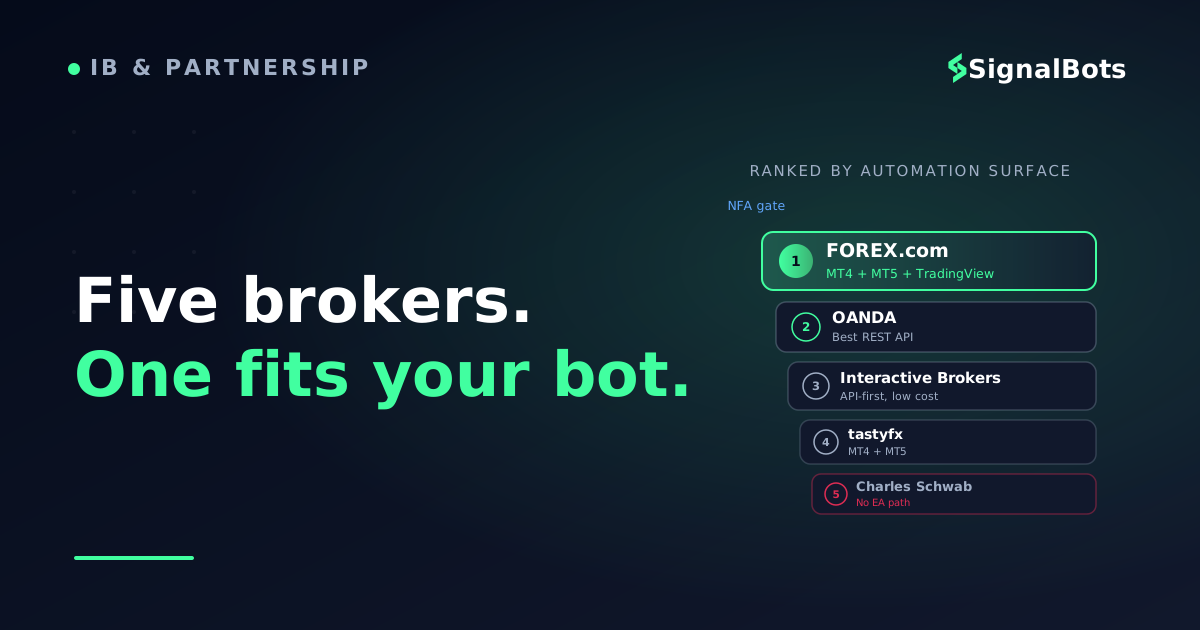
FOREX.com— widest US automation surface
Only US broker with full MT4 + MT5 EA support
TradingView and NinjaTrader both wired in
CFTC-registered, NFA member, StoneX-backed
Top US pick
Best for
#2OANDABest REST API
#3Interactive BrokersAPI-first, low cost
#4tastyfxMT4 + MT5
Ranked by automation surface, not by app polish · US-resident accounts, 2026See the full comparison →
For a bot, the broker that wins is the one whose platform and rules your strategy can actually run on.
Key Takeaways
Only five brokers are CFTC-registered and NFA-member to take US retail forex clients in 2026: OANDA, FOREX.com, tastyfx, Interactive Brokers, and Charles Schwab. Anyone off that list cannot legally onboard you.
For an automated trader, "best broker" means "which one gives me the platform and API my bot runs on" — OANDA has a REST API but no MT5, Schwab is thinkorswim-only, and only FOREX.com ships the full MT4 + MT5 stack.
The silent breaker is NFA rule 2-43b: FIFO ordering and no hedging (netting only). A hedging EA built for an offshore broker will get its orders rejected or its positions force-closed on any US account.
Table of Contents (14 min read)Contents
Why "best US broker" Means Something Different for a Bot
When you automate, the broker stops being an app you look at and becomes an execution venue your code has to negotiate with. That shift quietly rewrites the whole ranking. Tight spreads and a slick mobile chart matter far less than three things a manual trader never thinks about: whether your platform is even offered, whether there is an broker API your bot can talk to, and whether the broker's regulator will let your strategy place the orders it wants to.
Here is the constraint that sits above everything else and that most roundups bury: in the United States, only a handful of firms are legally allowed to onboard you at all. To take US retail forex clients, a broker must be registered with the CFTC as a Retail Foreign Exchange Dealer and be a member of the NFA (the National Futures Association, the industry's self-regulatory body). That short list is the real starting universe — not the hundred offshore names that fill a global "top brokers" page.
So we are not ranking "the best forex brokers on Earth." We are answering a sharper question: of the brokers that can legally serve a US trader, which one gives your bot the platform, the API access, and the rule-set it needs to run? That is the question this page answers, and it is the one that actually determines whether your automation works on Monday morning.
The Five Brokers That Can Legally Take US Clients
Start with the fence, because it eliminates most of the noise. If a broker is not on this list, it is not a candidate for a US resident — no matter how good its spreads look in a review. As of 2026, the CFTC-registered, NFA-member firms actively accepting new US retail forex accounts are OANDA, FOREX.com, tastyfx, Interactive Brokers, and Charles Schwab.
That scarcity is the whole story. In most of the world an automated trader shops across dozens of brokers on execution model, leverage, and platform. In the US you are choosing among five, and the differences between them are almost entirely about how you are allowed to connect a bot — not about who has the prettiest dashboard. Below is the automation-relevant view of each, built from what each firm documents on its own official site.
US-legal brokers, by automation surface
Broker
Platforms for bots
API access
Automation notes
FOREX.com
MT4, MT5, TradingView, NinjaTrader
Via MT4/MT5 + TradingView webhooks
Widest EA surface of any US broker; StoneX-backed
OANDA
MT4, TradingView, OANDA Trade
Documented REST (v20) API
No MT5; fractional lots; strong for code-first traders
Interactive Brokers
TWS, IBKR Desktop
Full REST / FIX / native APIs
No MetaTrader; commission-priced; API-first
tastyfx
MT4, MT5, ProRealTime
Via MT4/MT5 EAs
Built on IG infrastructure; MetaTrader route only
Charles Schwab
thinkorswim only
thinkScript / limited API
No MetaTrader; large min trade size; not EA-friendly
The same five brokers a manual trader sees — re-scored on the one axis that matters when a bot places the orders.
Three patterns fall out of that table. FOREX.com is the only US broker that hands you the complete MetaTrader stack — both MT4 and MT5 — plus TradingView and NinjaTrader, which is why it leads for anyone whose strategy already lives in an expert advisor. OANDA and Interactive Brokers are the two API-first choices: if your bot is Python or FIX rather than MQL, they are the natural homes, with OANDA's documented REST endpoints and IBKR's institutional-grade API. And Charles Schwab, despite being a giant, is effectively closed to conventional EA automation — thinkorswim's scripting is powerful but it is not MetaTrader, and there is no drop-in EA path.
Read also: if your automation lives in TradingView alerts rather than an EA, the TradingView alert webhook is the piece that carries your signal from chart to broker — and both FOREX.com and OANDA support that route.
The Silent Breaker: NFA Rules That Reject Your Bot's Orders
Here is the part every offshore-trained automated trader learns the hard way. Even after you pick a legal broker with the right platform, US regulation changes how your bot is allowed to behave — and a strategy that ran fine on an offshore account can have its orders silently rejected on a US one. This is not the broker being difficult; it is NFA Compliance Rule 2-43b, and it binds every US forex dealer equally.
Two pieces of that rule matter for automation. First, FIFO — first in, first out. If you hold several open positions on the same pair, you must close the oldest one first. Many EAs are written to close a specific ticket by its ID, which is exactly what FIFO forbids; those close orders get rejected. Second, no hedging — US accounts are FIFO-constrained and forbid opposing positions, so you cannot hold a long and a short on the same symbol at once. A grid or hedging EA that opens an opposing position will either be rejected or will force-close the position it was trying to hedge against.
The practical upshot: on a US broker your automation must be FIFO-compliant and single-direction — no hedging — by design. A trading bot built around ticket-specific closes or simultaneous hedged legs needs to be re-engineered before it will run — test it on a demo account with a US broker first and watch how it behaves, because the rejections do not always announce themselves loudly.
What Actually Makes a Broker "Automation-Ready"
Strip away the marketing and an automation-ready US broker comes down to a handful of verifiable facts. Execution quality is first — an EA fires orders far faster than a human, so execution speed and slippage compound across thousands of trades in a way they never do for a discretionary trader. A broker that is fine for a swing trader can quietly bleed an intraday bot through re-quotes and fills a few tenths of a pip worse each time.
Second is cost structure. The headline spread is only half the picture: an ECN broker style raw-spread-plus-commission account often beats a wider all-in spread once your bot is turning over volume, while a market-maker (dealing desk) broker model can be simpler but carries a different conflict profile. For US forex, the practical read is to compare the effective round-turn cost at your typical trade size, not the advertised number.
Third is infrastructure for always-on running: VPS availability so your EA stays live 24/5 without your laptop, and stable API rate limits so a busy strategy is not throttled. None of these are exotic — they are just the things a manual-trader review never scores, because a human closing the app at night never feels their absence.
Pre-flight before you automate
Verify a US forex broker before you point a bot at it
0 / 7
Confirm the broker is CFTC-registered and an NFA member — check the NFA BASIC database by name, not the broker’s own badge.
Confirm your platform is actually offered (MT4? MT5? a documented REST API?) — do not assume MetaTrader is available.
Confirm your EA is FIFO-compliant and closes oldest-first, not by specific ticket ID.
Confirm your strategy is hedging-free — no simultaneous long + short on the same pair (hedging is blocked on US accounts).
Run the bot on a demo account with THIS broker and watch for silently rejected orders before going live.
Confirm VPS hosting is available so the EA runs 24/5 without your machine.
Compare effective round-turn cost at your real trade size — spread plus commission, not the headline spread.
★
Checklist complete — you’re cleared to proceed.
Seven yes/no checks. If any answer is ‘no,’ fix it before a single dollar of real capital is automated.
A Note on Offshore "Automation-Friendly" Brokers
You will see global roundups crown names like FxPro, Pepperstone, or IC Markets as the best brokers for automation — praised for MT4, MT5, cTrader, sub-8ms execution, and FIX API access. Factually, those are genuinely strong automation platforms. But they are not registered to take US retail forex clients, so for a US resident they are off the table regardless of how good the feature list reads. Naming them is useful only as a benchmark for what a rich automation surface looks like; it is not a recommendation you can act on from the US. If you are outside the US, that wider field opens up — but that is a different article and a different regulatory world.
From Broker to Signals: Closing the Loop
Picking the broker is step one; the account still needs something to trade. Once you are on a US-legal, automation-ready broker, the next decision is what drives the orders — your own EA, a trading signal feed your bot consumes, or a webhook route from TradingView. If you want a live picture of what an automated forex feed looks like before you wire anything up, our forex signal channel shows the format and cadence, and the MT4/MT5 connectors are the bridge that turns a signal into a placed order on your broker account.
For Introducing Brokers: Why the US Picture Matters
If you refer traders to a broker as an introducing broker (IB), the US jurisdiction decides what you can actually offer. Only CFTC/NFA-registered firms can legally onboard US clients, so routing a US-based automated trader means matching them to one of the same five brokers above — never an offshore high-leverage entity, however attractive its terms look. Get the jurisdiction wrong and the referral simply cannot convert: the broker rejects the signup and the attribution never registers. The upside is that the US shortlist is small and the automation-ready differences are clear, so an IB who understands FIFO and the MetaTrader picture can route each trader to the right desk with confidence.
FAQ
Which US forex brokers are actually regulated in 2026?
A US retail forex broker must be registered with the CFTC and be a member of the NFA. As of 2026 the firms actively accepting new US retail forex accounts under that framework are OANDA, FOREX.com, tastyfx, Interactive Brokers, and Charles Schwab. You can verify any broker's standing yourself by searching its name in the NFA's BASIC database rather than trusting a badge on its homepage.
Which US broker is best for MetaTrader EAs?
FOREX.com is the strongest single choice for MetaTrader automation because it is the only US broker offering both MT4 and MT5, alongside TradingView and NinjaTrader. If MT4 is enough for your EA, OANDA and tastyfx also run MT4, and OANDA adds a documented REST API as a second automation route.
Can I run any forex EA on a US broker?
Not without checking it first. US accounts are governed by NFA rule 2-43b, which enforces FIFO (close oldest positions first) and prohibits hedging (no simultaneous long and short on the same pair). An EA built for an offshore broker — especially a grid or hedging strategy — may have its orders rejected or positions force-closed until it is re-engineered to be FIFO-compliant and hedging-free. Always demo-test on the actual US broker before going live.
Is automated forex trading legal in the US?
Yes. Automated trading and expert advisors are fully permitted and supported by NFA-regulated US brokers. What is restricted is not automation itself but certain strategies — hedging is blocked and FIFO is enforced — so your bot must respect those rules. Automation is legal; hedging-style automation is what needs re-work.
What if I want an API instead of MetaTrader?
For a code-first, API-driven approach, OANDA offers a well-documented forex REST (v20) API, and Interactive Brokers offers full REST and FIX APIs across asset classes with commission-based pricing. Neither requires MetaTrader; both let your own Python, Node, or FIX engine talk to the broker directly. OANDA is the more forex-native of the two; IBKR is the multi-asset, lower-cost option.
You came in asking
“which is the best US forex broker”
and the real answer is
the one your bot can legally run on.
The “best” broker is the one that fits your automation
FX
FOREX.com
For most automated US forex traders it is the widest legal surface: MT4 and MT5 EAs, TradingView, and NinjaTrader under CFTC/NFA regulation. Pair it with a signal feed or your own EA and you have a complete, compliant automation stack.
The Forex Desk is the SignalBots editorial team responsible for our currency-market coverage. We research and write the guides, explainers and reference articles on how the majors, minors and crosses actually trade — sessions, spreads, swaps and the macro releases that move price.



Discussions 0
Leave a comment