Assessed on protocol coverage, execution model, docs, and automation permissions — not headline spreads.See the full API matrix →
No single broker wins for every bot — the right one depends on your strategy's protocol and speed needs.
Key Takeaways
Pick the API protocol first: a REST plus WebSocket stack is enough for most retail bots, while FIX only earns its higher cost and setup burden for sub-second, order-book-hungry strategies.
The execution model behind the API matters more than the endpoint list — an ECN/STP feed with named liquidity beats a market-maker desk that can re-quote or reject your bot's orders.
Documentation quality, sandbox/paper access, and explicit automation permissions separate a broker you can build on from one that fights you at every deploy.
Latency lives in the whole path, not the API alone — signal generation, network hops, and broker matching all add up, so budget it end-to-end before blaming the endpoint.
Table of Contents (23 min read)Contents
Why a Broker's API Page Never Answers Your Real Question
You are not shopping for a trading account. You are shopping for an execution surface that a piece of software can talk to, reliably, without a human in the loop. That is a completely different purchase, and almost no broker's marketing page frames it that way. They advertise "API access" as a feature bullet, next to the mobile app and the economic calendar, as if the three were interchangeable.
They are not. A bot does not care about a slick chart. It cares whether it can authenticate, stream a price it can trust, place an order, and get back a fill confirmation fast enough that the market has not moved out from under it. When any link in that chain is flaky, undocumented, or quietly rate-limited, your carefully backtested edge evaporates in live conditions — and you find out the expensive way.
This guide is written for that job. If you build or run algorithmic trading systems and you need a broker whose broker API can actually carry them, the sections below give you the decision framework, the named candidates, and the traps that a comparison chart of "REST: yes" will never surface.
The First Decision Is Protocol, Not Broker
Before you compare a single broker, decide what kind of connection your strategy actually needs. Get this wrong and every other criterion is noise — you will either overpay for institutional plumbing you never use, or bolt a retail REST endpoint onto a strategy that needs the order book and watch it choke.
There are three protocol families you will meet, and they sort cleanly by what your bot does:
REST — request/response over HTTP. You ask, the server answers, the connection closes. Perfect for placing orders, reading account state, and pulling history. It is the easiest to build against and the most widely documented. Its weakness is that it is pull-based: to know a price changed, you have to keep asking.
WebSocket streaming — a persistent connection the broker pushes updates down. This is how a REST-based bot gets live quotes and order-status changes without hammering the server. Treat REST and WebSocket as a pair, not rivals: REST to act, WebSocket to listen.
FIX API — the Financial Information eXchange protocol, the same messaging standard banks and prime brokers run between each other. It offers the lowest latency, full market depth, and granular order control. It also demands more engineering, often a co-located or VPS setup, and frequently a higher minimum deposit or monthly volume commitment.
The honest rule: most retail algo strategies never need FIX. A REST + WebSocket stack comfortably runs swing bots, most intraday systems, signal-following auto-trading, and copy-execution. FIX earns its complexity only when you are genuinely fighting for milliseconds — high-frequency, latency-arbitrage, or depth-of-book market making. If you cannot name the specific millisecond you are saving, you do not need it yet.
Decide before you compare
Which API protocol does your strategy actually need?
Take itProceed with careSkip / stand aside
If you can't name the specific millisecond FIX saves you, a REST + WebSocket stack is the right answer.
Protocol is the fork that decides which brokers even belong on your shortlist.
The Execution Model Behind the API Matters More Than the Endpoints
Here is the mistake that sinks more automated accounts than any missing endpoint: judging a broker by the shape of its API and ignoring who is on the other side of your fills. Two brokers can expose an identical-looking REST interface while one routes your orders to a genuine liquidity pool and the other fills them off its own book — and takes the opposite side of your trade.
An ECN broker (or a true STP setup) passes your order to an external network of banks and liquidity providers. Pricing is aggregated from real counterparties, so your bot competes on the same book as everyone else. A market-maker broker is itself the counterparty. That is not automatically sinister — many are well-regulated and fine for manual traders — but for an automated system it introduces two hazards that a REST spec will never warn you about:
Re-quotes and rejections. When your bot fires an order and the desk does not like the price, it can send back a requote or an order rejection instead of a fill. A human shrugs and clicks again; a bot either stalls or, worse, retries into a moving market.
Automation-hostile terms. Some market-maker desks restrict, throttle, or outright ban certain automated behaviours — scalping, latency-sensitive entries, news trading — in the fine print. Your code can be flawless and still get your account flagged.
So the execution-model question comes before the endpoint question. Prefer an ECN/STP broker with explicit, written permission to automate. Then, and only then, evaluate the API surface.
Read the execution-model column before the protocol columns — an ECN feed beats a longer endpoint list for an automated account. Verify every detail against each broker's official docs before you commit.
A note on that table: it is a map of what to check, not a leaderboard. API offerings, account tiers, and automation terms change, and each broker exposes its access differently — some route you through the cTrader or MetaTrader ecosystem rather than a first-party REST endpoint. Confirm the current specifics on the broker's own documentation before you write a line of code against it.
What Separates an API You Can Build On from One That Fights You
Protocol and execution model get you a shortlist. These next criteria decide which broker you will still be happy with six months into a live deployment — the difference between a platform that disappears into the background and one you are perpetually working around.
Documentation you can actually follow. Complete, current, example-rich docs are not a nice-to-have; they are the single biggest predictor of how long your first integration takes. A broker with a well-organized reference and real code samples will cost you days; one with a stale PDF will cost you weeks.
A real sandbox or paper environment. You must be able to run your bot against a non-live endpoint before risking capital. Paper trading that shares the real API's shape lets you catch auth quirks, rate limits, and order-rejection handling with zero downside.
Explicit automation and algo-trading permission. Look for written confirmation that automated and EA-style trading is allowed on your account type. This is the clause that silently voids more strategies than any technical limit.
Sane rate limits and clear error semantics. Your bot will hit limits; the question is whether the API tells you clearly (a specific error you can back off on) or just starts dropping requests. Predictable errors are worth more than a slightly higher ceiling.
Order types your strategy needs. If your logic depends on OCO orders, stop-limit orders, or trailing stops, confirm the API exposes them natively — emulating a bracket in your own code is a bug factory.
Among the named candidates, this is where they separate. Interactive Brokers wins on breadth — the widest order-type and asset coverage, a mature paper account, and API options spanning REST to FIX — at the cost of a steeper learning curve. OANDA is the developer's comfort pick: its v20 REST API is famously clean and well-documented, ideal if you want to be placing orders the same afternoon. IC Markets and Pepperstone lead when your priority is raw ECN execution feeding an automated system, typically through the cTrader or MetaTrader automation layer rather than a bespoke REST endpoint.
The Signal-to-Fill Path: Where a Bot's Order Actually Goes
It helps to picture what happens the instant your strategy decides to trade, because the broker API is only one hop in a chain — and understanding the whole chain is how you stop blaming the wrong link when live results drift from backtest.
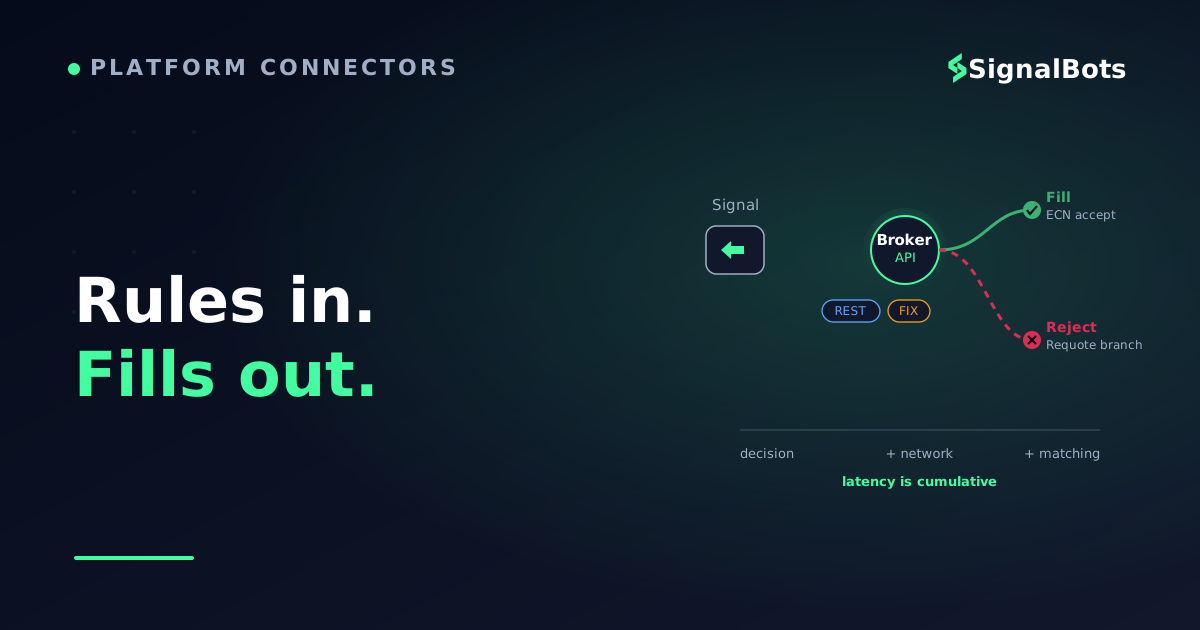
Whether your entry comes from a self-hosted model, a TradingView alert webhook, or a signal feed, the automated path looks the same: something generates a decision, your bot translates it into a broker-specific order message, the broker's API accepts it, the matching engine (or the market-maker desk) executes, and a fill confirmation travels back for your bot to reconcile against its own state.
From signal to fill
sequenceDiagram
    autonumber
    participant Strategy
    participant Bot
    participant Broker API
    participant Market
    Strategy->>Bot: Signal fires (entry decision)
    Bot->>Broker API: Place order (REST or FIX)
    Broker API->>Market: Route to matching engine
    alt Order accepted
        Market-->>Broker API: Fill at market price
        Broker API-->>Bot: Fill confirmation
        Bot->>Bot: Reconcile position state
    else Requote or rejection
        Broker API-->>Bot: Reject or requote
        Bot->>Bot: Retry logic or stand down
    end
Every hop adds latency and a failure mode — the API is one link, not the whole chain.An ECN accept-path is clean; a market-maker desk introduces the reject/requote branch your bot must handle.
Two things fall out of that picture. First, the reject/requote branch is not optional — your bot has to handle it, and how often it fires depends heavily on the execution model you chose earlier. Second, latency is cumulative. People obsess over the broker's execution speed and ignore the hops on either side of it. Your total signal latency is the sum of decision time, network round-trips, and broker matching — optimizing one to zero while the others stay slow buys you nothing.
That cumulative math is easy to underestimate, so it is worth making it concrete rather than abstract.
Try the numbers
Round-trip latency budget for your bot
Latency is not one number — it's a chain. Add up each hop to see your realistic order round-trip, and how it compares to a co-located FIX setup.
Strategy decision time
Network round-trip to broker
Broker matching / processing
Connection type
Estimated round-trip latency
—
Share you control (decision + protocol)
—
Drag the sliders: often the network hop dominates, which is why co-location — not just FIX — is what actually cuts institutional latency. Figures are illustrative, not broker-quoted.
The lesson the calculator makes obvious: for most retail setups the network hop dwarfs everything else, so the biggest latency win is usually a well-placed VPS near the broker's servers — not swapping REST for FIX. Chasing the protocol before the plumbing is a classic case of optimizing the wrong link.
How SignalBots Fits This Picture
One clarification worth making, because it is where readers often get confused: SignalBots is not a broker, and you do not need us to choose a broker. We sit on the signal and execution side of the chain you saw above — the part that turns a decision into an order your broker's API accepts.
If your strategy leans on MetaTrader-style execution rather than a first-party REST endpoint, our MT4/MT5 connector and the wider connectors surface bridge the gap, letting a signal drive orders on the broker account you already picked using this guide. If you trade off webhooks, the same principle applies through a webhook bot. The broker decision in this article and the execution layer are complementary: you choose the venue on execution model and API quality, and the automation layer carries your signals into it. For the forex and CFD context most of these brokers serve, our forex signals surface is the same-market starting point.
FAQ
Do I need a FIX API for algorithmic trading?
Usually not. A REST plus WebSocket stack runs the overwhelming majority of retail algo strategies — swing, most intraday, signal-following, and copy execution. FIX earns its extra cost and engineering only for genuinely latency-critical work like high-frequency or depth-of-book strategies. If you cannot name the specific milliseconds FIX would save you, stay on REST + WebSocket.
What is the difference between a REST and a streaming API for a bot?
REST is request/response: your bot asks and the server answers, which is ideal for placing orders and reading account state. A streaming (WebSocket) API pushes live updates — quotes and order status — down a persistent connection so your bot does not have to keep polling. They are partners, not rivals: use REST to act and WebSocket to listen.
Why does the broker's execution model matter for automated trading?
Because it decides who is on the other side of your fills. An ECN or STP broker routes your orders to an external liquidity network; a market-maker broker is itself the counterparty and can re-quote or reject orders in ways that stall or mislead a bot. For an automated account, prefer an ECN/STP venue with written permission to automate before you even look at the endpoint list.
Are these brokers safe to run bots on 24/7?
Only if the broker explicitly permits automated and EA-style trading on your account type — check that clause in writing, because it silently voids more strategies than any technical limit. Beyond permission, look for a real paper/sandbox environment, clear rate-limit error handling, and the native order types your strategy needs. Automation does not remove market risk; it executes your logic, including its mistakes, faster.
Can I use SignalBots with any of these brokers?
SignalBots is an execution and signal layer, not a broker. Where a broker supports MetaTrader-style execution, our connectors can carry signals into the account you chose using this guide, so the two decisions are complementary: pick the venue on execution model and API quality, then route your signals through the automation layer.
The one decision that matters
You came in asking
“which broker has an API a bot can actually rely on”
and the honest answer is
the one whose protocol and execution model fit your specific strategy.
Choose the venue, then carry your signals into it
There is no universal best API broker — there is the right one for your strategy's speed and depth needs. Decide the protocol first (REST + WebSocket for most bots, FIX only when you can name the milliseconds), insist on an ECN/STP execution model with written automation permission, then judge the API on docs, sandbox, and order-type coverage. Once the venue is chosen, the execution layer is a separate, complementary decision.
The Cross-Market Desk is the SignalBots editorial team for topics that span every market — platform connectors, copy trading, partnership and IB programs, and the general mechanics of trading automation. We research and write the guides that apply no matter what you trade.



Discussions 0
Leave a comment