There is no single "best" algo strategy — trend-following, mean reversion, breakout, news, and arbitrage each win only in the market regime they were built for, so the skill is matching the rule to the current condition.
A bot's edge is discipline, not a secret formula. An algorithm executes its exit rule identically every time, delivering the reward-to-risk ratio you designed — the consistency humans lose under stress.
Start with trend-following, add mean reversion (with a trend filter) as the complement, and treat news, breakout, and arbitrage as advanced regimes that depend heavily on execution quality.
The broker is part of the strategy. ECN/raw-spread execution and EA/API permission decide whether a backtested edge survives live — a thin edge dies to wide spreads and slippage.
Table of Contents (28 min read)Contents
The Strategy Isn't the Edge — the Rule Is
You already know the names. Trend-following, mean reversion, breakout, news, arbitrage — every roundup lists the same six and calls them "the best algorithmic forex strategies." What almost none of them tell you is the part that actually decides whether your bot makes money: which market condition each family is built for, and what happens when you run it in the wrong one.
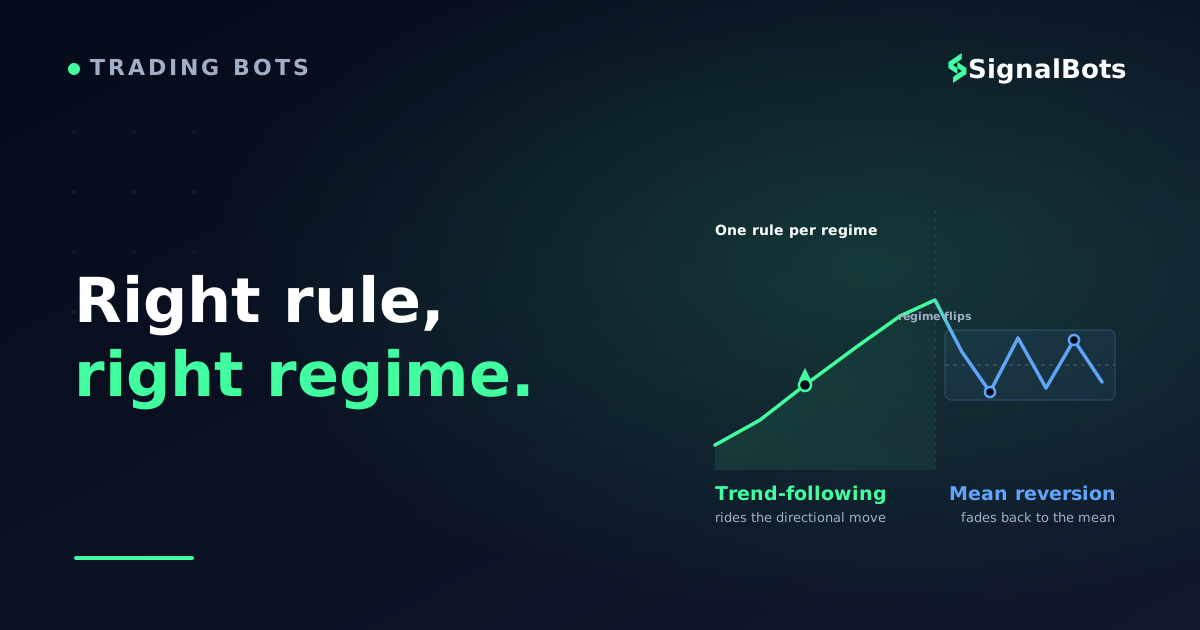
A trend-following algorithm is not "good" or "bad." It is correct in a trending market and wrong in a range — the same code, the same rules, printing profit one week and bleeding the next, entirely because the regime flipped underneath it. That is the real question behind "which algo strategy is best," and it is the question this page answers.
Here is the reframe that makes the rest of it click. An algorithm has no opinion. It executes a rule — if price closes above the 20-period high, buy — the same way every single time, without the hesitation, the revenge trade, or the "just this once" override that quietly destroys manual accounts. The algorithmic trading edge is not a secret formula. It is discipline made mechanical, applied to a rule that fits the market you're actually in.
So the useful way to read the sections below is not "which strategy wins" but "which rule fits which regime, and how do I tell which regime I'm in right now." Watch the idea before you read it:
Press play
One rule, run over and over
EUR/USD · M5Ready
Buy entrySell entryExit
Trades
0
Win rate
—
Avg win
0
Avg loss
0
Net P&L (pips)
0
Same bot, same fixed rule, a fresh random price walk each run. The win rate and net P&L land differently every time — a strategy's real edge only shows up over many runs, never in one.
A rule-based bot enters and exits mechanically. The label on the strategy matters far less than whether its rule matches the market and whether the math survives a run of losers.
Press Play a few times. The bot never changes its mind — but the outcome does, because price is different each run. That is exactly why "which strategy is best" is the wrong first question. A strategy is a rule plus the regime it belongs to plus enough of a reward-to-risk ratio that a normal run of losing trades doesn't sink it. Get those three aligned and almost any of the families below works. Get them misaligned and the fanciest algorithm on earth loses.
The Five Strategy Families Worth Automating
Strip away the marketing and every automatable forex strategy collapses into a handful of families, each defined by the market behaviour it exploits. You are not choosing between fifty tactics — you are choosing which of these behaviours you expect the market to show, then letting a bot trade it without flinching.
Below is the whole catalog at a glance — the family, the regime it needs, the tools its rules are usually built from, and the one-line trigger logic. Read it as a matching table, not a ranking: there is no "best" row, only the row that fits what the market is doing.
The catalog
Strategy family
Market regime it needs
Typical rule inputs
Entry → exit logic
Trend-following
Strong directional move
Moving-average cross, ADX, Donchian channel
Enter with the trend on confirmation; exit on reversal / trailing stop
Mean reversion
Range-bound / sideways
Bollinger Bands, RSI, standard deviation from a mean
Fade the stretch back toward the average; exit at the mean
Breakout
Coiled range about to expand
Support/resistance, ATR, session high/low
Enter as price clears the level with force; exit on failure or target
News / event
Scheduled high-impact release
Economic calendar, volatility filter, straddle logic
Trigger on the release move; exit fast once impact fades
Arbitrage / statistical
Any — exploits mispricing
Cross-venue feeds, correlation, spread models
Enter when two related prices diverge; exit when they reconverge
Match, don't rank. Each family is built for one market behaviour — the skill is running the right one at the right time, which is what a bot lets you do without emotion.
Now the detail on each — what the rule actually does, and the trap that catches people who run it in the wrong regime.
Trend-Following: Ride the Move, Never Predict It
Trend-following is the most-automated family in forex, and for a good reason: its rule is simple, its logic is mechanical, and it needs no forecast. The bot doesn't guess the top or bottom. It waits for a directional move to establish itself, joins it, and stays in until the move breaks.
The rules are built from tools that measure direction and momentum. A classic setup buys when a faster moving average crosses above a slower one and the Average Directional Index (ADX) confirms the trend has strength, then trails a stop and exits when the fast average crosses back or a trailing stop-loss is hit. Donchian-channel breakouts of a rolling N-period high or low are another common trend entry.
Regime it needs: a market that is actually going somewhere — a sustained directional push, not chop.
The trap: run it in a range and it buys every fake high and sells every fake low, dying by a thousand small losses. This is the single most common way an automated forex strategy quietly loses money — a perfectly coded trend bot left running through a sideways week.
Trend-following pairs naturally with the discipline argument for automation: the hardest part of trend trading by hand is letting winners run while your instinct screams to take profit. A bot has no instinct. It holds until its rule says exit, which is exactly the behaviour manual traders can't sustain.
Mean Reversion: Fade the Stretch Back to Normal
Mean reversion is trend-following's mirror image. Instead of betting a move continues, it bets a move has gone too far and will snap back toward its average. When price stretches well above its recent mean, the bot sells; when it sags well below, it buys — and it closes as price returns to the middle.
The rule inputs measure "how far is far." Bollinger Bands flag when price touches or pierces a band two standard deviations from a moving average; RSI flags overbought and oversold extremes. The exit is the mean itself — this family takes small, frequent profits rather than one big runner.
Regime it needs: a range-bound, sideways market where price genuinely oscillates around a stable centre.
The trap: the exact opposite of trend-following. In a strong trend, mean reversion sells into a rocket and buys into a collapse — "the stretch" never snaps back, it just keeps stretching. A mean-reversion bot without a trend filter is a slow-motion account killer in a trending market.
The two families are complementary on purpose. Many automated forex operations run a trend bot on the pairs that are trending and a mean-reversion bot on the pairs that are ranging — a regime filter decides which one is allowed to trade.
Breakout: Enter When the Range Snaps
Breakout strategies live at the seam between the two families above. They wait for a market that has been coiled in a tight range and enter the instant price escapes it with force, on the theory that a genuine breakout is the birth of a new trend.
Rules are built around clearly defined levels — prior session high or low, a consolidation range, a support/resistance zone — plus a volatility gauge like Average True Range (ATR) to size the stop and separate a real break from a twitch. The bot enters as price clears the level on expanding range, sets a stop back inside the range, and either trails the new move or exits on a target.
Regime it needs: a compressed, low-volatility range that is likely to expand — often just before a major session open.
The trap: the false breakout. Price pokes above resistance, triggers the entry, then collapses back inside the range. Automation helps here precisely because the defence is mechanical — a stop back inside the range and a volatility filter that ignores weak breaks are rules a bot follows perfectly and a human abandons after two fakeouts.
News / Event: Trade the Scheduled Shock
News-based algorithms don't read the news — they trade the volatility around a scheduled, high-impact release. The bot knows from an economic calendar that a rate decision or jobs number lands at a fixed time, and it has a rule for the burst of movement that follows.
Some implementations use a straddle — orders staged on both sides so the bot catches the move whichever way it breaks — with tight time-based exits, because news edges evaporate in minutes. A volatility filter keeps the bot flat when nothing is scheduled.
Regime it needs: a specific, calendar-driven event with enough impact to move price hard and fast.
The trap:slippage and spread blowout. In the first seconds after a release, spreads widen violently and fills come in far from where you intended — the move can be real and you can still lose because execution was terrible. This is the family where broker execution quality matters most, and where a demo-tested edge most often fails to survive contact with live conditions.
News trading is also the family most sensitive to where it runs. The same rule at a market-maker desk with wide event-time spreads behaves nothing like it does at an ECN broker built for automation — which is why the broker section below matters more here than anywhere else.
Arbitrage & Statistical: Profit From Mispricing
Arbitrage is the odd one out: it doesn't need any particular regime because it doesn't bet on direction at all. It exploits a temporary price difference — the same pair quoted differently across venues (simple arbitrage), a chain of three pairs whose cross rates don't line up (triangular arbitrage), or two historically correlated pairs that have drifted apart (statistical arbitrage / pairs trading).
The rule is: enter when the divergence exceeds a threshold, exit when the prices reconverge. Because the mispricing is tiny and fleeting, this family lives or dies on execution speed — it is the most latency-sensitive strategy of all, and largely the preserve of bots for exactly that reason. No human clicks fast enough.
Regime it needs: none in particular — it needs speed and clean, low-cost execution.
The trap: the edge is real but thin, and transaction costs eat it alive. A spread, a commission, or a few milliseconds of latency can turn a theoretically profitable arbitrage into a net loser. For retail traders this family is the hardest to run profitably, and the one where "it worked in backtest" most often means "the backtest ignored real costs."
Which Family Fits the Market You're In Right Now
Every family above is "the best strategy" in the regime it was built for and a liability everywhere else. So the practical skill is not picking a favourite — it's reading the current market and switching the rule to match. That decision is mechanical enough to draw as a tree:
Which algo family fits right now?
Take itProceed with careSkip / stand aside
Read the regime first, pick the rule second. The most profitable setting on any algo is often 'do nothing right now.'
The lesson buried in that "do not trade" branch is the one competitors skip: a bot's willingness to sit flat is a feature, not a failure. A human gets bored and forces trades in dead markets. A well-built algorithm simply doesn't fire until its regime condition is met — which is a large part of why automating a strategy tends to beat running the same rules by hand.
Why the Reward-to-Risk Ratio Decides More Than the Family
Here's the part that separates a strategy that survives from one that blows up, and it's the same math regardless of which family you picked. No rule wins every trade. Every family above will hand you a string of losers — a trend bot through a chop, a breakout bot through a run of fakeouts. Whether that string is a survivable drawdown or an account-ender is decided almost entirely by your reward-to-risk ratio, not by the cleverness of the entry.
The logic is simple: the more your average winner pays relative to your average loser, the lower a win rate you can survive on. A rule that risks 30 pips to make 60 (2:1) stays profitable at a far lower hit rate than one risking 30 to make 20. Drag the stop and target below and watch the break-even win rate move:
Move the levels
How R:R sets the win rate you need
Long setup
Reward zone+0.0060
Risk zone−0.0030
TP 1.0910
Entry 1.0850
SL 1.0820
Reward-to-risk ratioYou aim for 2.00x what you risk
1 : 2.00
Risk (1R)
0.0030
Reward
0.0060
Break-even win rate
33.3%
Risking 30 pips to make 60 is 2:1 — you only need to be right on a minority of trades to come out ahead. Widen the stop or shrink the target and the required win rate climbs fast.
This is why the strategy family matters less than the exit rule. A modest edge with an honest R:R survives a losing streak; a high win rate with a bad R:R does not.
This is where automation earns its keep a second time. The single most destructive manual habit is cutting winners early and letting losers run — precisely the behaviour that wrecks your realised R:R even when your strategy's rules are sound. A bot exits at the level its rule specifies, every time, so the R:R you designed is the R:R you actually get. That consistency, more than any indicator, is what makes an automated strategy outperform the same idea traded by hand.
Which Family Should You Automate First?
If you're choosing where to start, ignore whatever a leaderboard calls "the best" and pick by which regime you can already read and which one your broker's conditions support.
New to automation: start with trend-following. Its rule is the most intuitive, its edge is the most robust, and its main failure mode (running it in a range) is easy to filter out. It's the family with the shortest distance between "makes sense" and "works."
Comfortable reading ranges: add mean reversion as the complement, gated by a trend filter so the two never fight each other. Together they cover most of what a major pair does in a normal month.
Chasing volatility around events:breakout and news rules can work, but only on infrastructure that survives event-time spreads — this is not the family to learn automation on.
Arbitrage: genuinely powerful, genuinely hard for retail. Treat it as advanced — our forex arbitrage build guide walks the execution architecture — since its edge is mostly a latency-and-cost game, not a strategy-design game.
Whichever you start with, the make-or-break variable isn't in the strategy file — it's in where the strategy runs.
The Broker Is Part of the Strategy
An algorithm's edge is measured in pips, and pips are exactly what a bad broker takes back through wide spreads, slippage, requotes, and — the dealbreaker — a platform that doesn't permit automated execution. Two things decide whether a sound strategy actually earns its backtested edge live: execution quality and automation permission.
For automated forex, that means favouring brokers built for it: an ECN or STP account with raw spreads (so your cost per trade is predictable), explicit Expert Advisor or API permission on MetaTrader or cTrader, and ideally VPS support so your bot runs uninterrupted. Brokers commonly used for automated forex — verify the current terms yourself before committing — include IC Markets, Exness, FP Markets, HFM, Tickmill, XM, and Eightcap; each offers MT4/MT5 with EA support and account models suited to rule-based trading. A pure market-maker with wide, variable spreads and no EA permission can neutralise a genuinely profitable strategy no matter how well it's coded.
The point isn't which name you pick — it's that the broker is a component of the strategy, not a neutral pipe. Test any rule on the exact account you'll run it on, because a mean-reversion or news bot's thin edge lives entirely inside the execution costs your venue charges.
Once your rule and your venue are aligned, the last piece is getting the signal to fire and execute without you babysitting a screen. You can watch live rule-based forex signals run on real pairs, route them into MT4/MT5 through our MT5 connectors, or follow them hands-free through a forex Telegram channel. The strategy is the rule; we handle the plumbing that turns it into a filled trade.
We opened with
“there is no single "best" algo forex strategy”
and landed on
match the rule's family to the market regime you're in.
The best algo strategy is the one that fits the market you're actually in
Trend-following rides directional moves, mean reversion fades ranges, breakout and news trade expansion, and arbitrage harvests mispricing — each unbeatable in its own regime and a liability outside it. Automating the right rule removes the emotion that wrecks the reward-to-risk you designed. Next, line up the execution: run the signals live, wire them into MT5, or let a channel deliver them hands-free.
What is the single best algorithmic forex strategy?
There isn't one, and any page that names a single "best" is selling you a regime that happened to be true recently. Each family — trend-following, mean reversion, breakout, news, arbitrage — is the best strategy in the market condition it was built for and a losing one everywhere else. The real skill is matching the rule to the current regime, which is exactly what a bot lets you do without hesitation. For most people starting out, trend-following is the most robust place to begin.
Which algo strategy is easiest to automate?
Trend-following. Its rule is the most mechanical (join a confirmed move, exit on reversal), its inputs are simple (a moving-average cross plus a trend-strength filter), and its main failure mode — running it in a range — is easy to guard against with a filter. Mean reversion is a close second but demands a trend filter so it doesn't fade a runaway move. Arbitrage is the hardest: the logic is simple but it lives or dies on execution speed and cost.
Do algorithmic forex strategies actually beat manual trading?
A sound strategy tends to perform better automated than by hand, for one specific reason: consistency. The rules that make a strategy work — cut losers here, let winners run to there, don't trade this regime — are exactly the ones humans abandon under stress. A bot follows them identically every time, so the reward-to-risk you designed is the one you actually realise. Automation doesn't invent an edge; it stops you destroying the edge you already have.
How many trades does it take to know if my algo strategy works?
More than you'd think, and far more than one good week. As the simulator at the top shows, the same rule produces wildly different results run to run — a single sequence tells you almost nothing. A strategy's true edge only emerges over a large sample of trades, which is why proper backtesting and forward-testing on a demo account matter before you risk real capital. Judge the rule by its long-run expectancy, never by its last ten trades.
Does the broker affect whether an algo strategy is profitable?
Enormously. An algorithm's edge is counted in pips, and spreads, slippage, requotes, and commissions subtract directly from that edge — a thin-margin strategy like arbitrage or news trading can be profitable on an ECN account and a net loser on a wide-spread market-maker. The broker must also permit automated execution (EA/API access). Always test a strategy on the exact account you'll run it on; the venue is part of the strategy, not a neutral pipe.
Sources & Further Reading
Want to go deeper? These independent, authoritative sources shaped this guide — each one is worth reading in full:
The Forex Desk is the SignalBots editorial team responsible for our currency-market coverage. We research and write the guides, explainers and reference articles on how the majors, minors and crosses actually trade — sessions, spreads, swaps and the macro releases that move price.



Discussions 0
Leave a comment