You spot the setup. It's clean — the exact entry you've traded a hundred times. But by the time your hand reaches the mouse, price has already moved twenty pips without you. Or worse: you do get in, then panic-close at the first red candle, and watch it run straight to your original target.
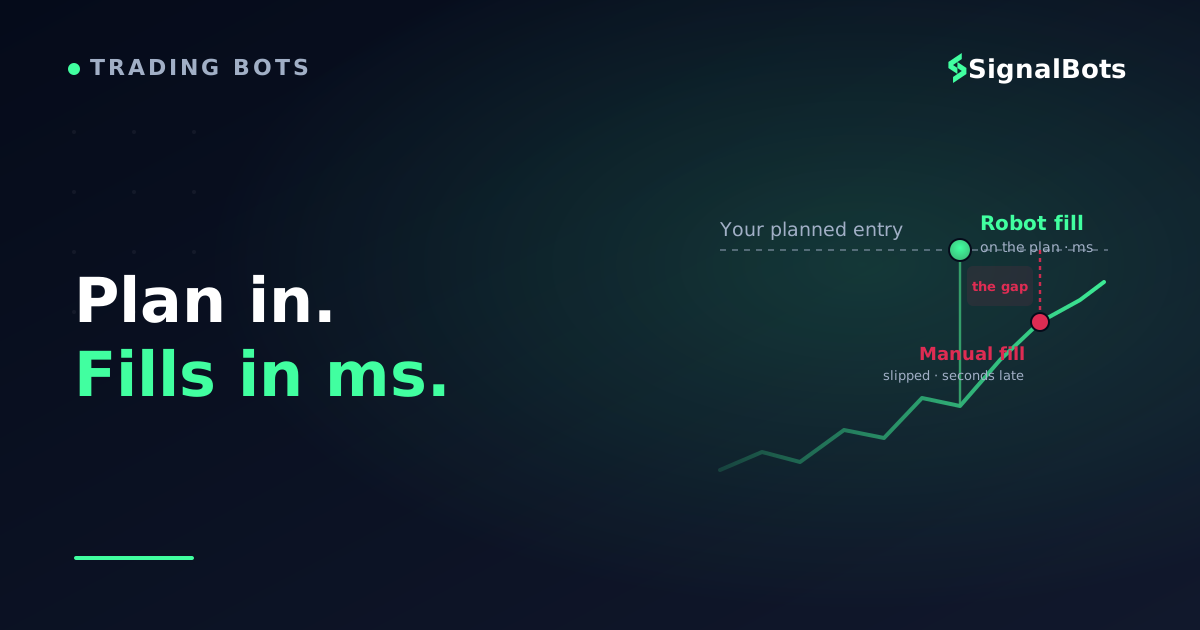
That gap — between the trade you planned and the trade you actually executed — is where most manual traders quietly bleed. And it's exactly the gap a forex robot is built to close. The question isn't whether a bot is smarter than you (it isn't). It's whether it executes your plan better than you can by hand. On three specific fronts, the evidence says yes.
The short answer
The core advantage
What does a forex robot actually beat you at?
Execution
Not analysis — execution
SpeedFires in milliseconds, every time
EmotionZero fear, greed or hesitation
CoverageEvery hour of the 24/5 week
What stays humanJudgment on the unexpected
The advantage is discipline made automatic, not a guaranteed win
A forex robot's edge is a smaller gap between your plan and your fills — not a crystal ball.
Key Takeaways
A forex robot's real edge is not "smarter" analysis — it is flawless execution: it fires the same rule in milliseconds, at 3 a.m., without fear, greed, or fatigue.
The gap shows up in three concrete places: execution speed on fast moves, emotional discipline that never breaks, and round-the-clock coverage across all 24/5 forex hours.
Manual trading keeps one advantage a robot can't copy — contextual judgment when the market does something its rules never anticipated.
The strongest setup is not one or the other: a rules-based strategy you designed, executed by a bot, with you supervising the edge cases.
Table of Contents (23 min read)Contents
The real question: execution, not intelligence
Most "robots vs humans" debates get framed wrong — as if the bot is a genius analyst and you're the slow amateur. That's not the advantage. A forex robot is simply a program that executes a predefined set of rules automatically, and its rules are only as good as the strategy you (or its author) gave it. It doesn't invent edge. It removes the friction between having a rule and following it.
Think about your own trading honestly. You already know your strategy. You know you shouldn't move your stop, shouldn't chase, shouldn't revenge-trade after a loss. The problem was never knowing — it was doing it every single time, without exception, when you're tired or on tilt or asleep. That's the job a robot does perfectly and you do imperfectly. The evidence for robots "winning" is really evidence that automated discipline beats human discipline — because human discipline has bad days and a robot never does.
So the rest of this article isn't about analysis. It's about the three places where flawless execution measurably out-trades the manual version of the same plan.
Advantage 1: execution speed you physically cannot match
Markets don't wait for your reflexes. When a fast move triggers your entry condition, the difference between reacting in a few milliseconds and reacting in a few seconds is the difference between your intended price and a worse one — the cost traders call slippage.
A robot removes the human relay entirely. There's no see the signal → recognize it → decide → move the mouse → click chain. The moment its trigger condition is true, the order is placed. For any strategy that lives on small, fast price movements — breakouts, news reactions, scalps — that execution speed is not a nice-to-have; it's the whole edge. A discretionary trader who's even a second late is trading a different, worse setup than the one that fired.
This is also why serious automation cares so much about signal latency — the delay between a signal being generated and reaching the point of execution. Shaving that delay is exactly what a well-built automation stack, from the signal source to the broker, is engineered to do. If you want the mechanics of what "fast" actually means here, our note on what execution speed measures in automated trading breaks it down.
Watch the gap for yourself. Below, a simple rules-based bot executes the same entry, stop, and target over and over, tick by tick — no hesitation, no skipped setups, no moved stops:
Press play
Watch a rules-based bot execute — tirelessly
EUR/USD · M5Ready
Buy entrySell entryExit
Trades
0
Win rate
—
Avg win
0
Avg loss
0
Net P&L (pips)
0
Same bot, same rules. Random price walk — win rate and P&L converge to the strategy's expected value only over many runs.
The bot takes every valid setup the same way — identical stop, identical target. Notice the win rate and net P&L only settle toward the strategy's expected value over many trades, not in any single run.
Press it a few times. Two things stand out. First, it never skips a setup and never freezes — something a manual trader can't promise on hour six of a session. Second, the result swings run to run: this is why a single good or bad day tells you almost nothing, and why a robot's value is consistency across hundreds of trades, not a magic outcome on any one of them.
Advantage 2: it has no emotions to override the plan
Here's the advantage manual traders underrate the most, because it's invisible until it costs you. Fear, greed, hope, and revenge don't just feel bad — they actively rewrite your strategy in real time. You widen a stop "just this once." You close a winner early because you can't stand giving back profit. You double your size to win back a loss. Every one of those is a deviation from the plan, made by a stressed human brain.
A robot has no such brain. It executes the rule when the rule is met and does nothing when it isn't. This is the core of auto-trading: the decision to enter or exit is already made in the strategy, so the moment of execution carries no emotional weight at all. It can't feel the fear that makes you skip a valid entry after two losses, and it can't feel the greed that makes you hold past your target. If you want the precise definition, we cover what hands-off auto-trading actually removes from the equation in the glossary.
See the two failure modes side by side:
Same strategy, two operators
You, trading by hand
Skips a valid entry after a losing streak dents your confidence
Closes winners early to 'lock it in' — cutting the trades that pay for the losers
Moves or widens the stop when a trade goes against you
Revenge-trades or over-sizes to claw back a loss
Misses setups while asleep, at work, or off the screen
Great judgment — undermined by inconsistent execution.
VS
A robot running your rules
Takes every valid setup identically, streak or no streak
Holds to the target and stop you defined — no early exit
Never moves a stop out of hope or fear
Sizes exactly as programmed on every trade
Covers the hours you can't watch
Flawless execution — only as good as the rules you gave it.
Neither side is 'the winner' outright — the point is that they fail differently. The robot fixes the execution leaks; you still own the strategy behind it.
Notice the framing: the robot isn't better at deciding. It's better at not un-deciding under pressure. That's the emotional advantage in one line — it protects your good decisions from your worst moments.
Advantage 3: it trades the hours you can't
The forex market runs roughly 24 hours a day, five days a week, rolling across the Sydney, Tokyo, London, and New York sessions. Your best setup might trigger during the London–New York overlap while you're asleep in another timezone, or at the Tokyo open while you're at your day job. A manual trader simply cannot be present for most of the week — and the trades you're not present for are trades you don't take.
A robot doesn't have this problem. As long as it has power and a connection, it watches every session and takes every valid signal, whether that's 3 a.m. your time or during a meeting you can't leave. Here's why that coverage matters — the sessions and their high-liquidity overlaps are exactly when many intraday setups fire:
The hours a robot covers — and you can't24-hour clock · times in UTC
UTC timeline
SydneyAESTTokyoJSTLondonGMT/BSTNew YorkEST
21:00–24:0021:0000:00–6:00–6:00
0:00–9:000:00
7:00–16:007:00
12:00–21:0012:00
000306091215182124
London + New York12:00–16:00 UTC · Peak liquidity & volatility
Sydney + Tokyo0:00–6:00 UTC · Asian-session activity
Sydney
Tokyo
London
New York
Overlap (peak liquidity)
The London–New York overlap (12:00–16:00 UTC) is when liquidity and volatility peak — prime time for intraday setups. If that window lands while you're asleep, a robot is the only way you're at the desk for it.
This is coverage, not magic: the bot doesn't find better trades at 3 a.m., it simply takes the ones your strategy already defines when you can't be there. Multiply that across every session, every day, and the manual trader's "I only trade when I'm watching" ceiling becomes obvious.
How the speed advantage actually reaches your broker
It's worth seeing the chain that turns "a signal fired" into "a trade is live," because every human step you remove is latency and emotion you remove with it. On most retail setups a robot runs as an Expert Advisor (EA) — a program that plugs into a MetaTrader platform and places orders directly through your broker:
From condition met to order filled — no human in the loop
1
Rule is evaluated
The bot checks live price against your predefined entry condition on every tick — continuously, never distracted.
2
Trigger fires
The instant the condition is true, the decision is already made — there is no 'should I?' pause to lose pips in.
3
Order sent to broker
The EA places the entry, stop-loss and take-profit together, in milliseconds, straight to your broker's server.
4
Position managed to the rule
It holds to your exact target and stop — no early exit, no widened stop, no second-guessing.
Each removed human step is a source of slippage and emotion that a manual trader can't fully eliminate.
If the robot wins on speed, emotion, and coverage, why does anyone trade by hand at all? Because a robot's greatest strength — doing exactly what it's told, always — is also its ceiling. It has zero judgment about anything outside its rules.
When a central bank surprises the market, when liquidity vanishes into a holiday, when price does something its logic never anticipated, a robot keeps executing its rule as if nothing changed — sometimes straight into a wall. A human sees the context and chooses not to trade. That contextual judgment — knowing when the map no longer matches the territory — is the manual trader's real, durable edge. A trading bot is a discipline machine, not a wisdom machine.
Dimension
Forex robot
You, by hand
Execution speed
Milliseconds, every time
Human reaction time
Emotional discipline
None to break
Fear / greed / tilt
Coverage of 24/5 hours
Every session
Only when watching
Consistency across trades
Identical every time
Varies with mood
Judgment on the unexpected
None — obeys its rules blindly
Reads context, can stand aside
Quality of the strategy itself
Inherited from its author
Yours to design and improve
The robot wins the execution rows outright. You win judgment and own the strategy — which is why the best answer is usually 'both'.
The honest takeaway: a robot beats you at executing a plan and loses to you at knowing when the plan doesn't apply. That's not a reason to pick one — it's a reason to combine them.
So do forex robots beat manual trading?
On the things that quietly cost manual traders money — slow fills, broken discipline, missed hours — yes, decisively. A robot closes the gap between the trade you planned and the trade you actually made, and it does it on every trade, in every session, without a single emotional lapse.
But it "beats" you only at execution. It inherits whatever strategy it's given and has no judgment when reality steps outside those rules. So the real winner isn't robot-or-human — it's a rules-based strategy you designed and stress-tested, executed by a bot that never deviates, with you supervising the edge cases a machine can't read. That's how you keep your judgment and stop leaking pips to your own reflexes and emotions.
If you're ready to see automated execution on real setups, our live forex trading signals are the natural next step — the signal layer that a bot or connector turns into disciplined, hands-off trades.
We opened with
“the trade you planned, ruined by a slow fill or a panic exit”
and landed on
automating the execution while you keep the judgment.
A robot doesn't out-think you — it out-executes you
The forex robot's advantage is real but narrow: millisecond speed, zero emotion, and round-the-clock coverage on the plan you already have. Its ceiling is just as real — no judgment when the market breaks its own rules. Pair the two: your strategy and oversight, its flawless execution. That's the combination that actually beats trading fully by hand.
The verdict in one line: automate the execution, keep the judgment.
FAQ
Are forex robots actually profitable, or just faster?
Speed and profitability are two different things. A robot executes faster and more consistently than you can by hand, but it can only trade the strategy it was given — if that strategy has no edge, the bot will lose money efficiently. Automation removes execution leaks (slippage, emotion, missed hours); it does not create an edge that isn't in the rules. Judge any robot by the quality of its underlying strategy and its reward-to-risk profile, not by the fact that it's automated.
Do I need to know how to code to use a forex robot?
Not necessarily. Many traders use a ready-made Expert Advisor (EA) or connect a signal source to their platform without writing a line of code. Coding helps if you want to build or heavily customize a strategy from scratch, but plenty of automation runs on existing bots and signal feeds. The skill that matters most isn't programming — it's defining clear, tested rules for the bot to follow.
Can a robot completely replace me as a trader?
No — and treating it that way is the classic mistake. A robot has no judgment outside its rules: it will keep executing straight through a news shock or a broken market that a human would sit out. The strongest setup is supervised automation — the bot handles disciplined execution, you handle strategy design and the edge cases it can't read. It replaces your reflexes and your emotions, not your judgment.
What's the difference between a signal and a robot?
A signal tells you what to trade — a direction, an entry, a stop, a target. A robot acts on that instruction automatically. You can receive signals and place trades manually, or you can let a bot or connector execute them for you with no clicking involved. The advantage discussed throughout this article — speed, no emotion, full coverage — comes from the execution half, which is why automating the signal is where the manual-trading gap actually closes.
Does a robot need to run 24/7, and what happens if my computer sleeps?
To capture the round-the-clock advantage, the robot needs continuous power and connectivity — if your machine sleeps or loses internet, the bot stops watching and can miss or mismanage trades. That's why many automated traders run their bot on an always-on setup rather than a personal laptop. The coverage advantage only exists while the robot is actually awake and connected.
Sources & Further Reading
Want to go deeper? These independent, authoritative sources shaped this guide — each one is worth reading in full:
The Forex Desk is the SignalBots editorial team responsible for our currency-market coverage. We research and write the guides, explainers and reference articles on how the majors, minors and crosses actually trade — sessions, spreads, swaps and the macro releases that move price.



Discussions 0
Leave a comment