How do you build an automated forex system from scratch?
6 stages
Rules → Live
Starts withUnambiguous, testable rules
Proven byOut-of-sample + demo testing
Survives onRisk controls, not the entry
Deploys asTiny live size, then scale
A build sequence, not a strategy — the same six stages fit any edge
Every automated forex system moves through the same six stages, in this order. Skip one and you find out in production.
You have a forex idea that works when you watch the screen — a clean breakout at the London open, a pullback into a moving average, a fade at a round number. But you sleep, you travel, you hesitate, and you second-guess a good setup right before it pays. The pull toward automation is simple: you want the rules to fire the same way every time, whether or not you are watching, and whether or not you feel like it.
That is what an automated forex system is — your judgment, frozen into rules a machine can execute without you. The hard part is not the coding. It is that a machine cannot read "buy when the trend is strong"; it needs a number. This guide walks the entire lifecycle: turning your edge into testable rules, coding it, proving it on data it has never seen, rehearsing it on a demo account, and finally letting it trade real money — without blowing up on the way.
Key Takeaways
An automated forex system is a set of testable, unambiguous rules for entry, exit, and position size — the machine only executes what you have already decided, so vague ideas like "buy when momentum is strong" have to become math first.
The build order is not negotiable: write the rules, code them, backtest on out-of-sample data, forward test on demo, then deploy live at tiny size and scale up only on live evidence.
Your risk controls (fixed fractional sizing, a hard stop, a daily loss cap, a kill switch) matter more to survival than your entry signal — a mediocre entry with strong risk management outlasts a brilliant entry without it.
The two silent killers are over-optimization (a system tuned to fit the past that fails on the future) and execution gaps (slippage, downtime, latency) — both are mitigated by design, not by hope.
Table of Contents (25 min read)Contents
What "automated" actually demands of your rules
Before any code, understand the wall every new system-builder hits: automation is unforgiving of ambiguity. When you trade by hand, you fill a thousand tiny gaps in your plan unconsciously — you skip a setup because "it doesn't feel right," you hold a winner because "there's room to run." A machine has none of that intuition. Every one of those judgments has to become an explicit, numeric rule, or the system simply cannot make the decision.
The practical test is whether a rule is backtestable. "Buy when price is above the 20-period EMA and the last candle closed higher" can be checked against history, bar by bar, with no interpretation. "Buy when the market looks bullish" cannot — there is nothing to measure. If you cannot write a rule as a condition that is unambiguously true or false on any given bar, it is not ready to automate; it is still an opinion.
A complete system is more than an entry. You need four rule families, and most beginners obsess over the first while neglecting the three that actually keep them solvent:
Entry — the exact condition(s) that open a trade, and on which pair and timeframe.
Exit — where the stop-loss sits, where you take profit, and any time-based or signal-based exit.
Position sizing — how many lots, derived from your account and stop distance, never a fixed "1 lot forever."
Risk governance — the account-level guards: max open trades, a daily loss cap, and a kill switch that halts everything when something is clearly wrong.
This whole guide is about designing your own logic, so we will not hand you a canned recipe — how to automate a scalping strategy and how to set up a DCA bot are each their own topic. What matters here is that whatever your edge is, it has to survive being written down this precisely.
The six-stage build, in order
The single most common way to lose money automating forex is to skip stages — to code a bright idea and put it straight on a live account because the backtest "looked amazing." The order below exists to catch a broken system at the cheapest possible point: on paper, then on data, then on a demo, and only then with real capital at a size that cannot hurt you.
The lifecycle
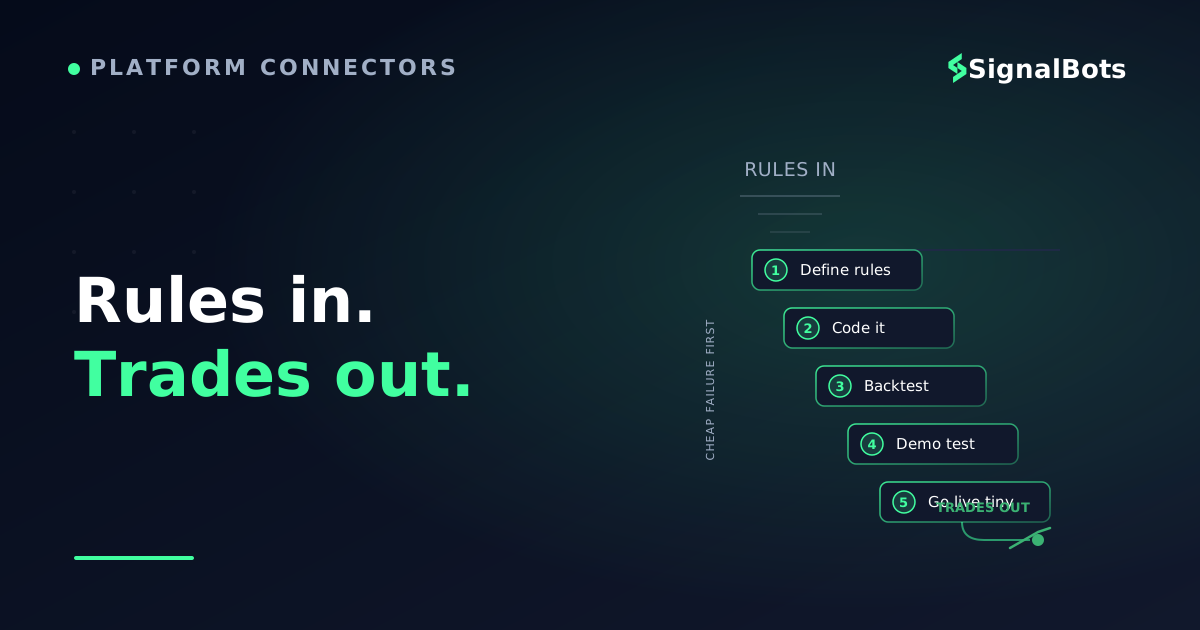
1Define the rules Write entry, exit, sizing, and risk governance as unambiguous, testable conditions. If a rule can't be true-or-false on a single bar, it isn't ready. This stage happens in plain language before any code.
2Code the logic Translate the rules into an executable form — an MT4/MT5 Expert Advisor in MQL, a cTrader cBot, or a TradingView alert that fires a webhook. Match the code exactly to the written rules; do not 'improve' it while coding.
3Backtest (out-of-sample) Run the system over historical data, but reserve a slice it never sees during tuning. Judge it on drawdown, expectancy, and profit factor — not just the equity curve's final number.
4Forward test on demo Let it trade a demo account in live market conditions for weeks. This is where clock drift, spread widening, and weekend gaps show up — things a backtest silently smooths over.
5Deploy live, tiny Go live at the smallest size your broker allows, on a stable connection (usually a VPS). The goal is not profit yet; it is to confirm live fills match your demo behavior.
6Monitor and maintain Compare live results to the backtest continuously. A widening gap between them is your signal to investigate — markets change, and no system runs untouched forever.
Each stage is a checkpoint. A system that fails stage 3 never reaches your live account — which is the entire point of doing them in order.
Notice that live deployment is stage five of six, not stage one. Everything before it is designed to be cheap failure: a bad idea caught in backtest costs you an afternoon; the same idea caught by your live account costs you real money and confidence. Let's walk each stage in the depth it deserves.
Stage 1: turn your edge into rules
Start in plain language, on paper, with no platform in mind. Write the literal sentence a machine would have to obey. "When the 50-period EMA is above the 200-period EMA (uptrend), and price pulls back to touch the 20-period EMA, and the current candle closes back above it, buy one position." Every clause there is measurable. Now do the same for the exit and the stop.
The discipline that separates a durable system from a fragile one is deciding your auto-trading logic before you see any results. If you invent rules while staring at a chart of what already happened, you are not designing a strategy — you are drawing a line through past prices that, by definition, fits them. That is the over-fitting trap, and it is the number-one reason backtests lie. Commit the rules first; let the test judge them second.
Keep the rule set small. A system with three conditions and a clear stop is far more likely to survive contact with the future than one with eleven filters, each added to "fix" a losing trade in the backtest. Complexity is not sophistication here; it is usually just over-optimization wearing a suit.
Stage 2: code it — platform and language choices
Once the rules are unambiguous, coding is mostly transcription. Your platform choice decides the language and the ceiling on what you can build:
MetaTrader 4 and MetaTrader 5 are the default home for forex automation. You write an Expert Advisor (EA) — a program that runs inside the terminal and places trades — in MQL4 or MQL5, the platforms' native C-like languages, both heavily optimized for backtesting.
cTrader uses cBots written in C#, favored by developers who want a modern language and cleaner API.
TradingView lets you write the signal in Pine Script and fire a webhook to an external executor — useful when you want charting-grade indicators but your broker isn't on MT4/MT5.
The cardinal rule of this stage: code the rules you wrote, not the rules you wish you'd written. It is tempting to "improve" logic mid-code — add a filter, loosen a stop — but every un-tested change invalidates the rules you were about to test. Below is a minimal MQL5 fragment showing how an entry condition becomes code; the point is not to teach MQL5, but to show how concrete a rule must become.
An entry rule is only 'real' once it looks like this: every clause is a value the machine can compare. Note that lot size comes from a risk function, not a hard-coded number.
The line that matters most there isn't the entry — it's RiskLots(sl). Position size is derived from the stop distance and your risk budget, never hard-coded. That single habit is what stage 3 will reward and what an amateur system almost always gets wrong.
Stage 3: backtest without fooling yourself
A backtest runs your coded rules over historical price data and reports how they would have performed. It is the cheapest, fastest way to reject a bad idea — and the easiest place to lie to yourself. The lie has a name: over-optimization (curve-fitting). You tweak parameters until the equity curve looks glorious, but all you've done is memorize the past. That system then meets a future that doesn't match, and collapses.
The defense is an out-of-sample split. Tune your system on one slice of history (the in-sample period), then run it — untouched — on a separate slice it has never seen (the out-of-sample period). If it holds up out-of-sample, you have evidence of a real edge, not a memorized one. If performance falls off a cliff on unseen data, you curve-fit; go back to stage 1 and simplify.
Equally important is which numbers you trust. Beginners fixate on total profit and win rate. A high win rate can still lose money if the losses are huge, and total profit tells you nothing about the pain you'd have endured to earn it. Read a backtest like this instead:
Judge the report, not the profit line
How to read a backtest report cardIllustrative example — not a live or promised result
Profit Factor
> 1.3
Expectancy (per trade)
Positive
Max Drawdown
Can you stomach it?
Out-of-sample holds up
Required
Sample size (trades)
Large enough
Win rate alone
Misleading
The values here are illustrative, not a track record. What matters is the hierarchy: expectancy and drawdown outrank the headline profit and win-rate numbers every time.
Expectancy — the average outcome per trade — is the metric that actually tells you whether an edge exists, because it folds win rate and average win/loss into one number. A system can win 40% of the time and still be strongly positive if its winners dwarf its losers. Pair expectancy with maximum drawdown (the deepest peak-to-trough fall in the equity curve), because that is the number that decides whether you'll still be running the system when it finally pays. A curve you can't emotionally survive is a curve you'll switch off at the worst moment.
Stage 4: risk controls — the part that keeps you alive
Here is the truth most automation guides bury: your entry signal is the least important part of your system. You can pair a mediocre entry with disciplined risk management and survive for years; pair a brilliant entry with reckless sizing and you're one bad streak from zero. Automation makes this sharper, because the machine will happily execute a catastrophic sequence of trades at full size while you sleep.
The backbone is fixed-fractional position sizing: risk the same small percentage of your current account on every trade, sized from your stop distance. Because the risk is a percentage, your position shrinks after losses and grows after wins automatically — no martingale, no "making it back." Use the risk-to-reward relationship below to see why a favorable reward-to-risk ratio lets a lower win rate stay profitable, and how your stop placement drives the break-even win rate.
Where your stop sits decides everything downstream
Long setup
Reward zone+0.0090
Risk zone−0.0030
TP 1.0940
Entry 1.0850
SL 1.0820
Reward-to-risk ratioYou aim for 3.00x what you risk
1 : 3.00
Risk (1R)
0.0030
Reward
0.0090
Break-even win rate
25.0%
Drag the stop and target: a wider reward-to-risk ratio lowers the win rate you need just to break even. This is why 'where's the stop?' is the first question a system answers, not the last.
Around that core sizing rule, an automated system needs account-level governors that a manual trader enforces by willpower and a machine enforces by code:
A hard stop-loss on every trade, submitted with the order — never a mental stop, because there is no human watching to honor it.
A daily loss cap that halts new trades once the account is down a set amount for the day, so a bad session can't become a bad month.
A max-open-trades limit, so a signal that fires repeatedly in a choppy market can't stack ten correlated positions into one giant bet.
A kill switch — one condition (or one button) that flattens everything and stops the system when reality clearly diverges from expectation.
You don't have to compute sizing by hand while you design this. Our forex position size calculator turns an account balance, a risk percentage, and a stop distance into a lot size directly — the same arithmetic your RiskLots() function should encode. And when you want to understand how deep a hole your sizing lets you dig, the drawdown recovery calculator shows the brutal math of climbing back from a loss.
Stage 5: forward test, then deploy live small
A backtest, however clean, is a simulation. It assumes perfect fills at the historical price, ignores your broker's real spread behavior around news, and never once drops your internet connection. Forward testing — running the finished system on a demo account in live market conditions — is where those gaps surface. Let it run for weeks, not days, so it meets a range of conditions: quiet Asian sessions, volatile London opens, news spikes, weekend gaps.
Watch specifically for the difference between your backtest's assumptions and live reality. Slippage — the gap between the price you expected and the price you got — is invisible in most backtests but very real live, especially on stops during fast moves. Execution speed and connection stability matter too: a signal is worthless if your order reaches the broker seconds late. This is why serious automated forex runs on a VPS, a hosted server that keeps the system online 24/5 with a fast, stable link to the broker — no home power cut or Wi-Fi drop can flatten your account.
Only when the demo behavior matches your expectations do you go live — and you go live tiny. Trade the smallest size your broker permits. At this stage you are not trying to make money; you are confirming that live fills, spreads, and execution match what the demo showed. Scale up only on accumulating live evidence, in steps, never in a leap. A system that behaves identically at small size and can survive its own worst backtested drawdown has earned a larger allocation — nothing else has.
If you'd rather not build, code, host, and babysit all of this yourself, that is a legitimate choice: our MT5 connectors and ready-made forex automation deliver the execution layer without the DIY infrastructure, and our live forex signals give you a rules-based feed you can trade or automate against. Building your own teaches you the most; using proven tools gets you to market faster.
Stage 6: monitor, and know when to stop
Automated does not mean abandoned — keeping an EA consistent is an ongoing job, not a launch-day one. The market you backtested is not fixed — volatility regimes shift, spreads change, a pair that trended for a year starts ranging. Your job after launch is to watch the gap between live results and the backtest that justified going live. A small, noisy gap is normal. A persistent, widening gap is the system telling you its edge has decayed or that live conditions never matched your assumptions.
Set a rule in advance for what forces a review — a drawdown beyond your worst backtested level, a losing streak longer than any in testing, or live expectancy drifting negative over a meaningful sample. Deciding those limits before you're in the pain removes the emotion from the shutdown decision, which is the whole reason you automated in the first place. Resist the opposite temptation too: do not re-optimize after every losing week. That is just curve-fitting the future in slow motion.
Before you promote any system from demo to real money, run it against this gate. If you can't tick every box, it isn't ready — no matter how good the backtest looked.
Don't skip a single line
Pre-live gate: tick every box before real money
0 / 8
Every rule is written as an unambiguous, true-or-false condition — no 'looks bullish'.
The system was tuned on in-sample data and still held up on out-of-sample data it never saw.
Position size is derived from risk and stop distance, never a fixed lot count.
Every trade carries a hard stop-loss submitted with the order, plus a daily loss cap.
A kill switch can flatten all positions and halt the system in one action.
It forward-tested on a demo account for weeks and live behavior matched the backtest.
It runs on a stable, always-on connection (VPS) so downtime can't leave a trade unmanaged.
You've pre-decided the drawdown and losing-streak limits that force a review or shutdown.
★
Checklist complete — you’re cleared to proceed.
Every unchecked box is a way live money can leak out that your backtest never warned you about.
Trading forex — automated or manual — carries real risk of loss, and no backtest or system removes it. Size every stage of this build around survival first. See our risk warning for the full picture before you commit real capital.
FAQ
Do I need to know how to code to build an automated forex system?
Not necessarily. If you can express your rules unambiguously, you can build in MT4/MT5 with an Expert Advisor (some of which are configured rather than coded), use a visual strategy builder, or fire TradingView alerts to an executor. But you do need to think like a programmer — every rule must be exact and testable. The coding is transcription; the hard, non-optional skill is defining logic precisely enough that a machine can obey it without guessing.
How long should I backtest and forward test before going live?
Backtest over enough history to include different market conditions — trending, ranging, high and low volatility — and always reserve an out-of-sample slice the system never sees while you tune it. Forward test on a demo account for weeks, not days, so the system meets real spreads, news events, and weekend gaps. There's no magic number; the goal is a large enough sample that the results aren't luck, and enough live-condition exposure that slippage and execution surprises have shown up before real money is at stake.
What's the difference between a backtest and forward testing?
A backtest runs your rules over historical data — fast, cheap, and useful for rejecting bad ideas, but it assumes perfect fills and ignores live frictions. Forward testing runs the finished system on a demo account in live market conditions, so it exposes the gaps a backtest smooths over: real spread widening, slippage, latency, and connection drops. You backtest to prove the edge might exist; you forward test to prove it survives contact with a live broker.
Why does my system need a VPS?
A VPS (virtual private server) keeps your system online 24/5 with a fast, stable connection to your broker. Running on your home PC exposes you to power cuts, Wi-Fi drops, and restarts — any of which can leave a live trade unmanaged, with no stop honored and no exit fired. Automation only removes emotion if the machine is actually running; a VPS is what guarantees it is. It also reduces the latency between your signal and the broker, which matters most for faster strategies.
What's the single biggest mistake when building an automated forex system?
Over-optimization — tuning parameters until the backtest looks spectacular, which just memorizes the past instead of capturing a real edge. The system then fails the moment the future stops matching. The close runner-up is neglecting risk governance: obsessing over the entry signal while under-building the position sizing, stops, daily loss cap, and kill switch that actually keep the account alive. A durable system is simple, tested out-of-sample, and defended by risk controls — not clever.
You came in wanting
“an edge that fires the same way every time, whether or not you're watching”
and the path there is
six disciplined stages: rules, code, backtest, demo, tiny live, maintain.
Your judgment, frozen into rules a machine executes without you
The system that survives isn't the one with the cleverest entry — it's the one whose rules are exact, whose backtest held up on data it never saw, and whose risk controls keep it alive through the drawdown that always comes. Build in that order, deploy small, and let live evidence — not a shiny backtest — decide when to scale. If DIY infrastructure isn't your fight, the same execution layer is available ready-made.
The Forex Desk is the SignalBots editorial team responsible for our currency-market coverage. We research and write the guides, explainers and reference articles on how the majors, minors and crosses actually trade — sessions, spreads, swaps and the macro releases that move price.



Discussions 0
Leave a comment