You already know the feeling: you nailed the direction on EUR/USD, but your single entry landed twenty pips early, price dug against you, and you bailed at the worst possible spot — right before it turned. The trade thesis was fine. The one entry point was the problem.
A dollar-cost-averaging bot exists to remove that single point of failure. Instead of betting the whole position on one perfectly-timed click, it scales into the position across a planned sequence of orders, so your average entry — not one lucky candle — decides how the trade goes. This guide is the hands-on setup: what to configure, in what order, and where the settings quietly turn a disciplined ladder into a margin call.
This is a configuration walkthrough, not a bot-building tutorial. If you want the architecture, coding, and backtesting side of automating a strategy from scratch, that is its own subject; here we assume you have a DCA bot in front of you and need to know which knobs to turn.
Key Takeaways
A forex DCA bot doesn't buy the dip blindly — it splits one intended position into a planned ladder of orders, each fired on a time interval or a price/indicator trigger, so a single mistimed entry no longer decides the trade.
The four settings that make or break it are capital allocation (how much the whole ladder may ever hold), per-order size, the entry-trigger type, and a basket-level exit (a shared take-profit on average price plus a hard stop) — get the exit wrong and averaging-in becomes averaging-into-ruin.
Flat sizing keeps every safety order the same and behaves predictably; martingale sizing scales each order up to pull the average closer fast, but it consumes capital geometrically and is the setting most likely to margin-call a leveraged forex account.
DCA fits ranging, mean-reverting pairs far better than strongly trending ones — averaging into a runaway trend just funds a losing bet, so pair selection is part of the strategy, not an afterthought.
Table of Contents (22 min read)Contents
What a Forex DCA Bot Actually Does
Strip away the branding and a DCA bot is a rule that says: take the position I want, cut it into pieces, and add the pieces on a schedule or on adverse price movement instead of all at once. Each added order shifts your average entry price toward current price. Fill three orders as EUR/USD drops, and your break-even is no longer the first (too-early) entry — it's the blended average of all three, which sits much closer to where price actually is.
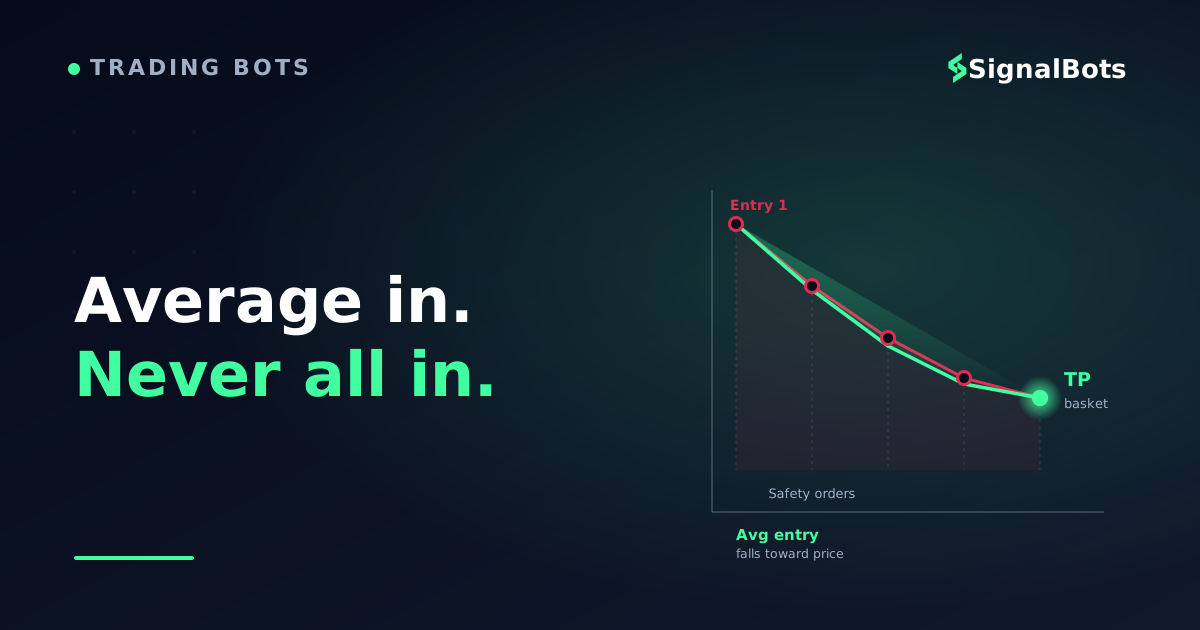
That blending is the entire point. It is a form of mean-reversion thinking applied to execution: you are betting that price will swing back through your average, at which point the whole basket closes in profit together. The visual below shows how the average entry line falls toward price as each safety order fills — that gap between your first entry and your final average is exactly the room a single mistimed click used to cost you.
The core mechanic
As price falls, each new order drags the blended average down with it — a far smaller reversal is now enough to close the whole basket in profit. Illustrative levels, not a forecast.
Critically, a forex DCA bot is not the crypto "buy $50 of Bitcoin every Monday forever" version. In FX you are adding to a leveraged, two-sided position with a finite margin budget and a 24/5 clock. Averaging down on a long means holding — and financing — a growing losing position while you wait for the reversal. That is powerful when price ranges and brutal when it trends. Everything in the setup below exists to keep the powerful case in and the brutal case out.
The Four Settings That Decide Everything
Most DCA bots expose dozens of fields, but four of them carry the strategy. Get these right and the rest are refinements; get these wrong and no amount of fine-tuning saves you. Here is the order to configure them in.
Configure top to bottom
The setup sequence, in order
1
Cap the total capital allocation
Decide the maximum the entire ladder may ever hold. This is your hard ceiling — the bot may fire every safety order and never exceed it.
2
Set the base and per-order size
Choose the first order's size and how each safety order is sized (flat or multiplied). Together with the cap, this fixes how many orders you can fit.
3
Pick the entry-trigger type
Time interval, an indicator/signal condition, or a buy-down/sell-up price step. This decides WHEN each safety order fires.
4
Define the basket exit
One shared take-profit measured on the average entry, plus a hard basket-level stop. The exit closes all orders together.
5
Bound the pair and the clock
Restrict to pairs that suit averaging-in and pause the bot around high-impact news, so it never ladders into a runaway move.
Each setting constrains the next: the capital cap decides how many orders your chosen sizing can afford, which decides how far your triggers can space them.
Capital allocation — the ceiling comes first
Before anything else, decide the total capital allocation: the absolute most this bot's ladder may hold at full extension. Some bots let you run "no limit" and simply keep adding until margin runs out — treat that as a red flag, not a feature. A DCA bot without a hard capital ceiling is a bot designed to average all the way into a margin call.
The honest way to think about it: your ceiling is not "how much do I want to make" but "how far can price move against me before every order has fired and I'm holding the full basket — and can my account survive that with room to spare." Set the ceiling to a slice of equity you can lose entirely without the account being crippled, then build the ladder to fit inside it. This is position-sizing discipline applied to a whole ladder instead of a single trade.
Per-order size — base order and the safety orders
With the ceiling fixed, split it into orders. You set a base order (the first entry) and then how each safety order is sized. Flat sizing keeps every safety order equal to the base. Scaled (martingale) sizing multiplies each successive order by a factor so later orders pull the average harder — we weigh that trade-off in its own section below.
The number of orders you can afford falls straight out of the arithmetic: total allocation, divided by your sizing schedule, is your order count. Fewer, larger orders reach the ceiling fast and give you little room if price keeps moving; many small orders survive a deeper drawdown but each one barely nudges the average. Use the builder below to feel that trade-off directly — change the multiplier and watch how quickly the total commitment climbs.
Try the numbers
DCA ladder builder
Set your base order, how many safety orders, and the size multiplier. See the total capital the ladder can commit before it hits your ceiling — and why the multiplier matters more than it looks.
Base order size
$
Number of safety orders
Size multiplier per order
Largest single safety order
—
Total capital the ladder commits
—
At a 1.0 multiplier the ladder grows in a straight line; nudge it to 1.5 and the total commitment — and the last order — explode. That curve is the martingale risk, made visible.
Entry triggers — when each safety order fires
The entry-trigger type decides when the next order goes in. Three families cover almost every DCA bot:
Time interval — add on a fixed clock (every N hours/days), ignoring price. Simplest, most passive, and the closest to classic dollar-cost averaging. It shines when you genuinely want steady accumulation and don't trust yourself to time anything.
Indicator or signal trigger — fire the next order only when a condition is met: an RSI reset, a moving-average touch, or an incoming algorithmic trading signal. This is the most "forex" of the three because it ties averaging-in to actual market structure instead of the clock.
Buy-down / sell-up (price step) — add a safety order every time price moves a set distance against you (buy-down on a long, sell-up on a short). This is the workhorse for FX DCA: it concentrates your firepower exactly where the position is losing, which is precisely where averaging does the most work.
Most robust setups combine a price-step spacing with an indicator or news filter so the ladder only extends when both the distance and the context agree. A pure time trigger that keeps buying into a one-way move is the fastest route to a full, underwater basket.
The exit — one basket, one target
This is the setting competitors most often gloss over, and it is the one that keeps you solvent. A DCA basket does not exit order-by-order. It exits as a group, against the average entry:
A shared take-profit set as a small percentage or pip distance beyond the blended average — because your average sits close to price after a few fills, a modest reversal closes the whole basket green at once.
A hard stop-loss at the basket level — a maximum adverse excursion or a max-drawdown line that liquidates everything if price never reverts. Without this, "averaging down" has no bottom, and one trending pair can hold your entire allocation hostage until margin call.
The mental model: the shared take-profit is how you win small and often; the basket stop is the line that keeps a losing basket from becoming a losing account. If your bot only lets you set a take-profit and offers no basket stop, do not run it on a leveraged FX pair.
Compliance
Flat vs Martingale Sizing — the Decision Inside DCA
Every DCA bot forces one choice that changes its whole risk personality: do your safety orders stay flat (each the same size) or scale up (martingale sizing)? Both are legitimate; they buy very different things.
Martingale sizing is seductive for the reason EA vendors market martingale as a recovery feature — a bigger last order snaps the average close to price, so a tiny reversal closes the basket. But that seduction is the trap: as the builder above showed, each multiplied order compounds the total commitment geometrically, so a slightly-too-deep move detonates the largest orders exactly when the position is most underwater. On a leveraged pair, that is precisely the margin-call scenario.
The sizing trade-off
Flat vs Martingale: sizing the DCA ladder
Flat sizing
Every safety order is the same size
Total commitment grows in a straight line — easy to predict
Average moves toward price slowly and steadily
A deep adverse move stays survivable within the cap
Best when you can't predict how far price runs
Slower average, but predictable, survivable risk
VS
Martingale sizing
Each order is multiplied larger than the last
Total commitment grows geometrically — hard to feel until too late
Average snaps toward price fast — the main appeal
A deep adverse move fires the largest orders at the worst time
Only defensible with a tight basket stop and a small base
Faster average, but a tail that can take the whole allocation
Two ways to size a DCA ladder — flat trades speed for survivable risk; martingale does the reverse.
A practical middle ground many traders settle on: a mild multiplier (well under the aggressive end of the slider) paired with a firm basket stop and a small base order. You get some of the average-pulling benefit without the runaway tail. If you can't defend your multiplier with "here's the price move that fires my last order, and here's why my account survives it," the multiplier is too high.
Pair Selection — DCA's Silent Prerequisite
Here is the part no settings screen enforces: DCA only makes sense on price action that comes back. Averaging into a strongly trending pair is just adding money to a losing directional bet, faster. The strategy's edge lives in mean-reversion — ranging, oscillating markets where price repeatedly returns through a middle.
That makes pair selection an active setting, not a default. Range-bound majors and well-behaved crosses during quiet sessions are natural homes for averaging-in; a pair in a clean, news-driven trend is exactly where a DCA ladder gets buried. Use this quick screen before you point a bot at any pair.
Is this forex pair a fit for a DCA bot?
Take itProceed with careSkip / stand aside
Two questions gate every DCA pair: does price revert, and is the window quiet? Fail either and the ladder is a liability.
Two more pair-selection reflexes worth building in: prefer pairs whose spread and swap costs are low, because a DCA basket holds multiple positions and financing accrues on all of them overnight; and avoid stacking correlated pairs, because averaging into EUR/USD and GBP/USD longs at once is one oversized dollar bet wearing two tickets, not two independent baskets.
Wiring the Signals Into the Bot
A DCA bot is only as good as the trigger feeding it. If you're using the indicator/signal trigger family, the quality of the condition that fires each safety order is doing a lot of the work — a clean, low-latency signal keeps the ladder extending on real structure instead of noise.
If you'd rather feed averaging logic from an external signal source than hand-tune indicators, our per-pair forex signals give you a live, structured input to gate safety orders on, and the MT5 connectors bridge those signals into the platform where your bot runs. Averaging-in punishes a sloppy trigger harder than a directional strategy does, because a bad fill isn't one trade — it's the seed of a whole basket.
Putting It Together
The trade that got away — nailed direction, botched the single entry — is the exact failure a forex DCA bot is built to erase. But it only erases it when the ladder is capped, the sizing is honest, the trigger reads structure, the exit closes the basket as a group, and the pair actually reverts. Skip any one of those and averaging-in quietly flips from a discipline tool into a slow margin call.
Start flat, start small, set the basket stop before you set the take-profit, and only point it at pairs that come back. Then let the bot do the one thing you couldn't do by hand — stay unemotional while it builds a better average than any single click ever could.
FAQ
Is a forex DCA bot the same as dollar-cost averaging into stocks?
No. Stock DCA is usually unleveraged accumulation — buy a fixed dollar amount on a schedule and hold. A forex DCA bot adds to a leveraged, two-sided position with a finite margin budget, so averaging down means financing a growing losing trade while you wait for a reversal. The mechanic rhymes, but the risk profile is completely different — which is why a hard basket stop is non-negotiable in FX and optional in a long-term stock plan.
Do I need martingale sizing for DCA to work?
No — and for most traders you shouldn't use it. Flat sizing (every safety order the same size) is a complete, working DCA strategy with predictable, survivable risk. Martingale sizing pulls your average toward price faster, but the total commitment grows geometrically, so a deep adverse move fires your largest orders at the worst possible moment. If you do use a multiplier, keep it mild and pair it with a firm basket-level stop.
Where should I put the take-profit on a DCA basket?
On the average entry, not the individual orders. Because each safety order drags your blended average closer to current price, a modest reversal past that average closes the entire basket in profit at once. Set the shared take-profit a small pip or percentage distance beyond the average, and always pair it with a hard basket stop so a basket that never reverts can't consume your whole allocation.
Which forex pairs suit a DCA bot best?
Ranging, mean-reverting pairs — markets where price repeatedly returns through a middle rather than trending in one direction. Averaging into a strong trend just adds money to a losing directional bet. Favor pairs with low spread and swap cost (a basket holds several positions and finances all of them overnight), and avoid running the bot on highly correlated pairs at the same time, since that's really one oversized bet in disguise.
How much capital should the whole ladder be allowed to hold?
Set a hard ceiling equal to a slice of equity you could lose in full without crippling the account, then build the ladder to fit inside it — never the reverse. Avoid any "no limit" mode that keeps adding until margin runs out; a DCA bot without a capital cap is designed to average straight into a margin call. Once the ceiling is set, your order count and sizing schedule follow from simple arithmetic.
Can I just leave a DCA bot running unattended?
Only within guardrails. The whole appeal is removing emotion, but a set-and-forget ladder that keeps buying into a one-way, news-driven move is how baskets get buried. Bound it: restrict it to suitable pairs, pause it around high-impact events, and set the basket stop that liquidates everything if price never reverts. Automation handles the discipline; you still own the boundaries it runs inside.
Sources & Further Reading
Want to go deeper? These independent, authoritative sources shaped this guide — each one is worth reading in full:
The Forex Desk is the SignalBots editorial team responsible for our currency-market coverage. We research and write the guides, explainers and reference articles on how the majors, minors and crosses actually trade — sessions, spreads, swaps and the macro releases that move price.



Discussions 0
Leave a comment