You have a scalping ruleset that works when you sit at the screen. A tight setup on the 1-minute chart, a two- or three-pip target, in and out before the noise catches up. The problem is not the rules — it is you. You blink, you hesitate on the third loss in a row, you widen a stop "just this once," and you miss the London open because you were making coffee. Manual scalping punishes exactly the things a human is bad at: reacting in the same millisecond every time, and never once getting bored or scared.
Automating the strategy is the honest fix. But most guides stop at "use an EA" and wave at 1-minute Bollinger Bands. That leaves out the part that actually decides whether your automated scalper survives contact with a live account: the execution speed and cost structure that a two-pip target lives or dies on. This page is about turning your scalping ruleset into code that runs without you — and the constraints that make or break it once it does.
Key Takeaways
A scalping strategy is only automatable if every entry, exit, and filter can be written as an unambiguous if-then rule — no judgment calls a bot can't run.
For a few-pip target, execution speed and cost are the strategy: spread, commission, and slippage can claim more than half your target, so a raw-spread ECN account and a co-located VPS are components, not preferences.
Risk management shifts to a volume problem — code a hard kill switch (daily-loss limit), fixed-fractional sizing, and a post-loss cooldown so a bad hour can't blow the account.
Validate in order: backtest with your real spread and commission, forward-test on demo in live sessions, then go live tiny — the backtest-to-live gap is almost always execution cost.
Table of Contents (20 min read)Contents
What "automating a scalper" actually means
A scalping strategy has three moving parts you already know: an entry rule (the exact market condition that triggers a trade), an exit rule (target and stop, usually just a few pips each), and a filter (session, spread, or volatility gates that decide when not to trade at all). When you scalp manually, your eyes run the entry rule, your hand runs the exit, and your judgment runs the filter.
Automation replaces all three with a program that never sleeps and never second-guesses. On MetaTrader, that program is an Expert Advisor — an Expert Advisor (EA) is a compiled script that reads the price feed tick by tick, evaluates your rules, and places orders through the broker with zero human delay. That last part is the whole point for a scalper: the gap between "condition met" and "order sent" collapses from a human half-second to a few milliseconds.
The catch is that automating a scalper is not the same job as building an automated forex system around a swing strategy. A swing bot can be a little slow, a little loose on entry price, and still be fine — its targets are hundreds of pips wide, so a pip of slippage is a rounding error. A scalper's target is a few pips. That inverts the priority list: for a scalper, execution quality and cost stop being footnotes and become the strategy.
The pipeline
From a manual ruleset to an automated scalper
1
Write the rules down explicitly
Every entry, exit, and filter as an unambiguous if-then. If you cannot state it without judgment, a bot cannot run it.
2
Encode it as an EA
Translate the ruleset into MQL5 (or a webhook payload) so a program evaluates it on every tick.
3
Gate it with filters
Add spread, session, and news filters that block trades in conditions your edge was never built for.
4
Backtest, then forward-test on demo
Confirm the edge survives realistic spreads and slippage before a cent of real money is at risk.
5
Deploy near the broker, monitor
Run it on a low-latency VPS beside the broker's server and keep a kill switch within reach.
The five moves that turn a discretionary scalping habit into a system that runs without you.
Step 1 — turn your rules into if-then statements
Before any code, you have to make your strategy unambiguous. A bot has no intuition, so every "usually," "around," and "if it looks strong" has to become a number or a boolean. This step exposes more broken strategies than any backtest will — if you cannot write the rule without a judgment call, you do not actually have a mechanical edge yet, you have a feel.
Take a common short-timeframe momentum scalp and pin it down concretely:
Entry (long): on the M1 chart, price crosses above the 20-period EMA and RSI(14) is above 50 and the current spread is at or below 1.2 pips.
Exit: take-profit at +3 pips, stop-loss at -2 pips, no exceptions, no manual override.
Filter: trade only during the London–New York overlap; skip the two minutes around a high-impact news release; no new trade while one is already open.
Notice that the filter is doing as much work as the entry. A scalping edge is fragile precisely because its target is small, so most of the discipline lives in refusing bad conditions rather than in the entry itself. The overlap window matters because that is when spreads are tightest and the tape actually moves — the same reason manual scalpers cluster there.
When each FX session is open (UTC)24-hour clock · times in UTC
UTC timeline
SydneyAESTTokyoJSTLondonGMT/BSTNew YorkEST/EDT
21:00–24:0021:0000:00–6:00–6:00
0:00–9:000:00
7:00–16:007:00
12:00–21:0012:00
000306091215182124
London + New York12:00–16:00 UTC · Peak liquidity & tightest spreads
Sydney
Tokyo
London
New York
Overlap (peak liquidity)
The London-New York overlap is where an intraday scalper's edge lives: tightest spreads, deepest liquidity, real movement. Automating means encoding this window as a hard filter.
Step 2 — encode the ruleset as an EA
Once the rules are unambiguous, the encoding is mechanical. On MT5 the rules become an MQL5 Expert Advisor whose OnTick() function runs on every incoming price and asks: are all my entry conditions true right now, and am I allowed to trade? Here is the momentum scalp above, expressed as the core of an EA so you can see how directly a written rule maps to code.
The rule as code
mql5MomentumScalper.mq5
void OnTick()
{
   // --- Filters first: refuse bad conditions ---
   double spread = (Ask - Bid) / _Point / 10.0;   // spread in pips
   if(spread > MaxSpreadPips)         return;      // too wide to scalp
   if(!InSession())                   return;      // outside London-NY overlap
   if(PositionsTotal() > 0)           return;      // one trade at a time

   // --- Entry rule: EMA cross up + RSI momentum ---
   double ema  = iMA(_Symbol, PERIOD_M1, 20, 0, MODE_EMA, PRICE_CLOSE);
   double rsi  = iRSI(_Symbol, PERIOD_M1, 14, PRICE_CLOSE);

   if(Close[0] > ema && rsi > 50.0)
   {
      double sl = Bid - StopPips   * 10 * _Point;
      double tp = Bid + TargetPips * 10 * _Point;
      trade.Buy(LotSize, _Symbol, Ask, sl, tp);   // fires in milliseconds
   }
}
The written rule, one-to-one in code: filters gate first, then the entry fires with the stop and target attached in a single call.
Two things are worth noticing. First, the filters run before the entry logic — the cheapest computation is refusing to trade, and a scalper refuses far more often than it acts. Second, the stop and target are attached in the same order call (trade.Buy(... sl, tp)), not added afterward. For a scalper that matters: if the EA placed the order and then sent a second request to set the stop, a fast market could move against you in the gap.
If you would rather keep your strategy logic on TradingView and only use the broker for execution, the same rules can live in Pine Script and fire a TradingView alert webhook that a connector turns into an MT5 order. That is a valid path — it trades a little latency for a friendlier language — but the constraints in the rest of this article do not change.
Step 3 — why spread and latency are the whole game
Here is the part the manual-strategy guides skip. When your target is three pips, your transaction cost is not a detail — it is your biggest competitor. Every trade pays the spread on the way in, pays commission on both sides, and eats whatever slippage the market hands you when the order fills a few milliseconds late. On a swing trade those costs vanish against a 200-pip move. On a scalp they can be larger than your target.
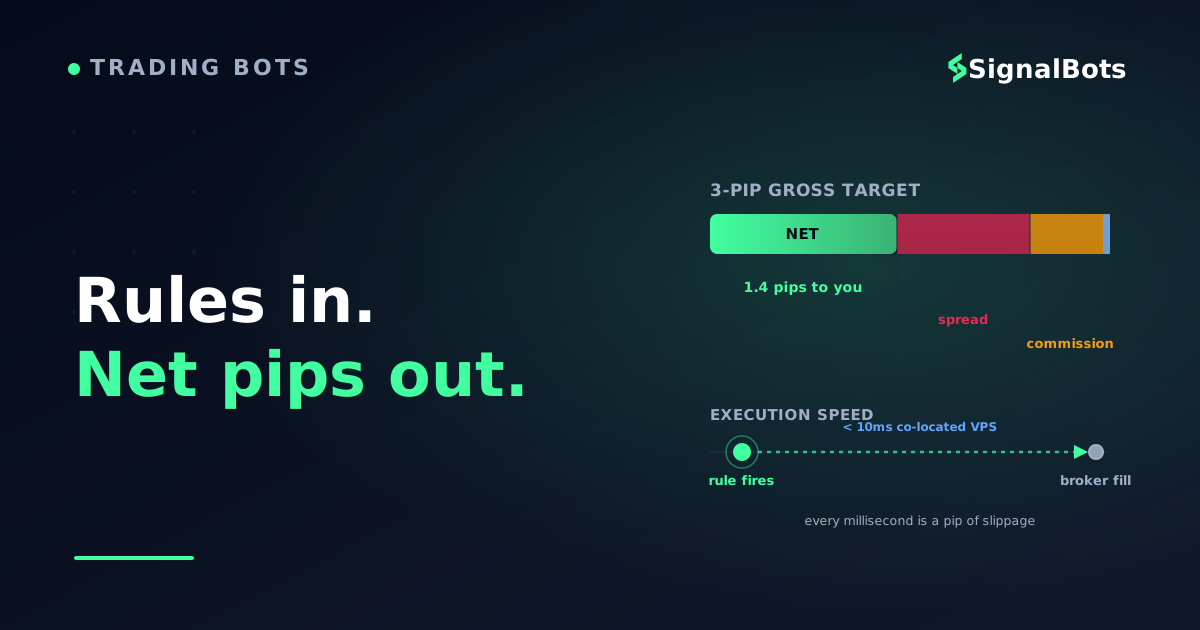
Walk through it concretely. Suppose your edge aims for +3 pips gross. If the spread is 1.0 pip and round-turn commission works out to another ~0.6 pips, you have already spent 1.6 pips before slippage. Your real target — the pips that actually reach your account — is closer to 1.4. Now let the spread widen to 1.8 pips during a news spike your filter didn't catch, and the trade is underwater the instant it opens.
Where a 3-pip scalp actually goes
Net pips to you
Spread
Commission (round-turn)
0All-in cost
Net pips to you1.4 pips
Spread1.0 pips
Commission (round-turn)0.6 pips
Total cost per trade— pips
Illustrative only. On a 3-pip gross target, costs claim more than half before slippage. This is why a scalper's broker and execution choice is the strategy, not a preference.
This is also why latency is not a nice-to-have.Signal latency is the delay between your rule triggering and the order actually reaching the broker's matching engine. On a scalp, price can drift a pip in the time a slow connection takes to send the order — and that drift is slippage, a direct tax on a strategy that only aims for a few pips. The fix is physical: run the EA on a VPS located in the same data center as the broker's server, so the round trip is measured in single-digit milliseconds instead of the tens-of-milliseconds a home connection adds.
Use the calculator below to see how brutal the math is. Set your gross target, spread, and commission, and watch what actually lands in your account — then push the spread up two-tenths of a pip and see the net collapse.
The takeaway is not "scalping is hopeless." It is that automating a scalper forces a cost-first mindset: your net edge is gross target minus everything the round trip costs, and automation only pays off if the after-cost number is reliably positive. A bot that fires perfect entries into a 1.8-pip spread account will lose faster than you did by hand.
Step 4 — the broker and platform your automated scalper needs
Because cost and speed are the strategy, the broker is not a neutral pipe — it is a component of your system. You are not looking for the "best broker" in the abstract; you are looking for the narrow set of conditions an automated scalper requires. Judge candidates on criteria, not on a leaderboard:
Raw-spread / ECN account model. An ECN broker passes through interbank pricing at near-zero spread and charges a transparent commission instead of padding the spread. That is the model a scalper wants, because you can see and control the cost. A market-maker account that hides its markup inside a wider spread is working against a three-pip target.
Automation explicitly permitted. The broker must allow EAs and not restrict scalping in its terms. Some brokers add a minimum hold time or penalize sub-minute trades — poison for a scalper. Confirm EA and scalping permission before you commit.
Fast, honest execution. You want market execution with low rejection and minimal requotes, plus a data center your VPS can sit next to. Ask whether they offer or recommend a co-located VPS.
MT4/MT5 or cTrader support. Your EA has to run somewhere. MT5 with MQL5 is the mainstream choice; cTrader (with cAlgo/C#) is a strong ECN-native alternative. Pick the platform your strategy is written for.
Whichever broker you settle on, verify the exact account type and current scalping policy on its own site before you open an account — the account tier matters as much as the broker, since the same broker's standard account and raw-spread account are two very different cost structures for a scalper.
What to look for
Criterion
Scalper-ready
Fights your edge
Account model
Raw-spread / ECN, transparent commission
Market-maker, markup hidden in spread
EA & scalping policy
EAs allowed, no minimum hold time
Restricts sub-minute trades or scalping
Execution
Market execution, few requotes
Frequent requotes, instant-only fills
Hosting
Co-located VPS available nearby
No VPS option, distant servers
The same two words appear on every scalper's checklist: transparent cost and fast, honest execution. Everything else is negotiable.
Step 5 — risk management for high-frequency, small-target trades
A scalper's risk problem is a volume problem. You are taking many trades a day at a tiny reward-to-risk ratio, which means two things: your win rate has to be high to stay profitable, and a losing streak arrives faster than it would on a slower strategy. Automating the strategy makes both truths more dangerous, because the bot can rattle off ten trades in the time it takes you to notice something is wrong.
That is why an automated scalper needs guardrails a manual trader enforces by feel:
A hard kill switch. Set a daily-loss limit in the EA itself — after N consecutive losses or a fixed dollar drawdown, the bot stops trading for the day, no exceptions. This is the single most important line of code in a scalper.
Fixed-fractional position sizing. Size each trade off a small fixed percentage of equity so a losing streak shrinks your stake instead of compounding the damage. Never let the bot revenge-size after a loss.
A cooldown after a loss. A short pause between trades stops the EA from machine-gunning entries into a market condition that just proved hostile.
One trade at a time (for most scalpers). Concurrency multiplies both your exposure and your cost; unless your strategy is explicitly built for it, cap open trades at one.
The state machine below is what a disciplined scalping EA's day actually looks like — and the transition traders most often forget to code is the one into Halted. Without it, a bad morning becomes a blown account before lunch.
stateDiagram-v2
    [*] --> Idle
    Idle --> Scanning: session opens & spread ok
    Scanning --> InTrade: entry rule fires
    InTrade --> Cooldown: TP or SL hit
    Cooldown --> Scanning: pause elapsed
    Scanning --> Idle: session closes
    InTrade --> Halted: daily loss limit hit
    Scanning --> Halted: daily loss limit hit
    Halted --> Idle: next trading day
    classDef risk fill:#df2c5333,stroke:#df2c53
    classDef go fill:#3bb27333,stroke:#3bb273
    class InTrade go
    class Halted risk
The transition into Halted is the one scalpers forget to code. A kill switch that stops the bot after a daily-loss limit is what keeps one bad hour from ending the account.
None of this removes risk — automation removes emotional mistakes, not market risk, and a backtested edge is a historical result, not a promise about tomorrow. Before you run any of this on real money, read our risk warning and treat the demo-to-live jump as the moment the numbers get real.
Step 6 — prove it before you trust it
The gap between a backtest that looks brilliant and a live account that bleeds is almost always execution: the backtest assumed a spread and fill you will not get. So validate in the order that catches this:
Backtest with realistic costs. Run the EA in MT5's Strategy Tester with modeled spread and commission set to your real account, not the platform default. A scalper that is only profitable at a zero spread is not profitable.
Forward-test on demo, live-market. Let the EA run on a demo account during real sessions for long enough to see real spread widening and slippage. This is where over-tuned scalpers quietly fall apart.
Go live tiny. Start at the smallest position size the broker allows and compare live results against the demo. If live is materially worse, the difference is your true execution cost — and you need to solve it (better broker, closer VPS) before scaling up.
Only after live matches demo do you scale the position size. That sequence is not bureaucracy; it is the only way to separate a real edge from a backtest that flattered you.
FAQ
Can any scalping strategy be automated?
Only if you can state every rule without a judgment call. If your edge depends on "reading the tape" or a feel you can't reduce to a number, a bot can't run it — you'd be automating a gap. The first real test of a strategy is whether you can write its entry, exit, and filter as unambiguous if-then statements. If you can, it's automatable; if you can't, you don't yet have a mechanical edge.
Do I need to know how to code to automate a scalper?
To write your own EA in MQL5, yes — at least enough to translate your rules into the OnTick() structure shown above. But there are two lower-code paths: keep your logic in TradingView Pine Script and route alerts to your broker through a connector, or use a strategy builder that generates the EA from a visual ruleset. The trade-off is flexibility — hand-written code gives you the most control over the execution details that matter most to a scalper.
Why does my automated scalper lose money live but win in backtests?
Almost always cost and speed. Backtests default to an optimistic spread and an instant, perfect fill; live trading hands you a wider real spread, commission, slippage, and a few milliseconds of latency. On a three-pip target those add up to more than your edge. Re-run the backtest with your real account's spread and commission modeled in, then forward-test on demo before trusting any live deployment.
What's the ideal timeframe for an automated forex scalper?
Most automated scalpers work the 1-minute (M1) chart, with some going to tick-level entries and 5-minute (M5) for filtering. The shorter the timeframe, the more your edge depends on execution quality — an M1 bot is far less forgiving of spread and latency than an M5 one. Match the timeframe to how good your broker and hosting actually are, not to how fast you wish you could trade.
Is a VPS really necessary for automated scalping?
For a scalper, effectively yes. A VPS in the same data center as your broker cuts the round trip to single-digit milliseconds, and on a few-pip target those milliseconds are pips of slippage saved. A home connection adds tens of milliseconds and drops out at the worst moments. If you're automating a slower strategy you can skip it, but the tighter your target, the less optional co-located hosting becomes.
You came in with
“a scalping ruleset that only works while you babysit the screen”
and you leave with
a coded scalper whose edge survives real spreads and latency.
Automating a scalper is a cost-and-speed problem before it is a coding problem.
The rules are the easy part — you can write an EA in an afternoon. The strategy is everything that decides whether a few-pip target survives the round trip: a raw-spread account, a co-located VPS, a hard kill switch, and a validation sequence that catches the backtest-to-live gap before it costs you. Get those right and the bot does the one thing you can't: react identically every time, without fear or boredom. Below are the SignalBots surfaces that plug straight into a MetaTrader workflow.
The Forex Desk is the SignalBots editorial team responsible for our currency-market coverage. We research and write the guides, explainers and reference articles on how the majors, minors and crosses actually trade — sessions, spreads, swaps and the macro releases that move price.



Discussions 0
Leave a comment