You know the moment. The backtest curve climbs smooth and steep, the profit factor looks fantastic, and three weeks after you go live the equity curve does the opposite of everything the report promised. The Expert Advisor (EA) didn't break — it was never consistent to begin with. It was consistent on the data you fitted it to, which is not the same thing.
Consistency in a forex EA is not one setting you flip on. It is a stack of decisions — how you validate the edge, how you size risk, what conditions you refuse to trade, and how many independent strategies you run — and each layer covers a weakness the layer below it can't. This page walks the whole stack, in the order that actually protects a live account.
The short answer
A backtest that looks perfect rarely survives contact with a live account.
A robust, well-filtered edge
Survives out-of-sample and forward tests, not just the fit
Risks a fixed fraction of equity, capped by a kill-switch
Trades only the conditions it was actually built for
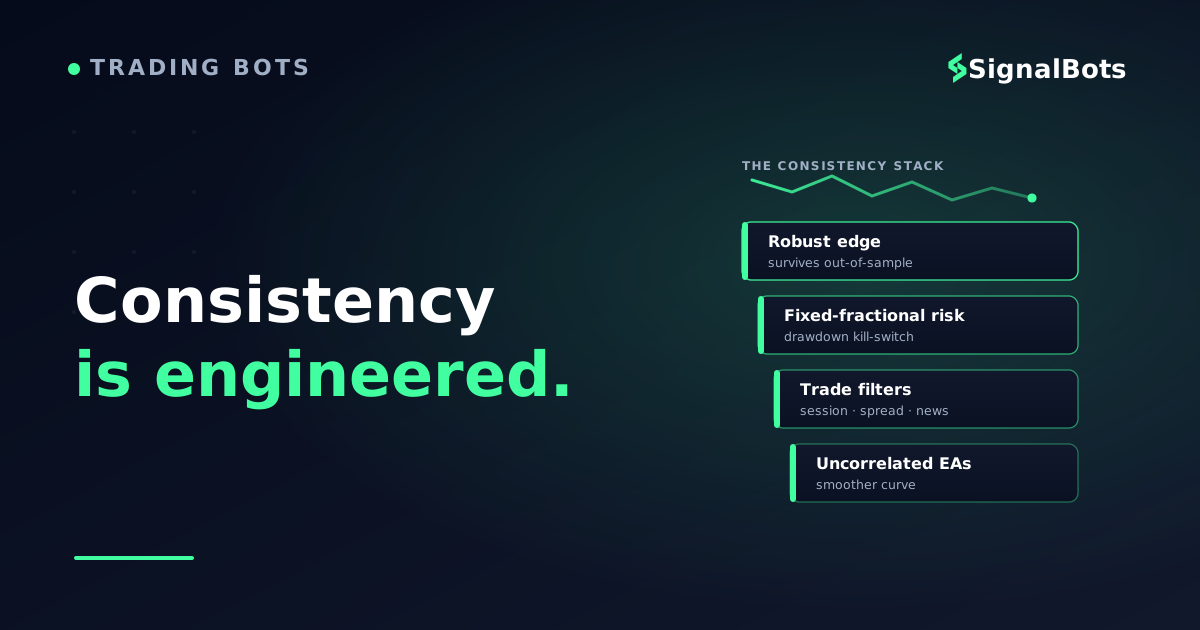
Consistency is engineered across four layers — not found in one perfect setting.
Consistency is built in layers: a validated edge first, then risk control, filters, and diversification.
Key Takeaways
Consistency comes from a robust edge, not a pretty backtest — an EA that survives out-of-sample and forward testing beats one over-optimized to fit the past.
Fix your risk per trade as a fraction of equity and cap drawdown with a hard kill-switch; martingale "recovery" logic is what blows accounts, not what saves them.
Trade filters (session, spread, news, regime) remove the losing conditions your entry logic was never built for — often the single biggest jump in consistency.
Run several uncorrelated EAs instead of one, and size for the worst-case losing streak, not the average.
Table of Contents (24 min read)Contents
Consistency Means the Edge Survives Out-of-Sample
Before risk settings, before filters, one question decides everything: does the strategy have a real edge, or did the optimizer just memorize the past? An EA that looks profitable only because it was tuned to a specific slice of history has no consistency to protect — you're managing the risk of a coin flip.
The trap is overfitting: the more parameters you optimize, the easier it is to bend the curve to fit historical noise instead of a repeatable market behavior. A strategy with fifteen inputs, each dialed to its single best value, is almost always memorizing rather than generalizing. When the market's texture shifts even slightly, the memorized settings have nothing to say.
The defenses are simple to name and non-negotiable to skip:
Split your history. Develop and optimize on one slice (in-sample), then test the frozen settings on a slice the optimizer never saw (an out-of-sample test). If performance falls off a cliff on unseen data, the edge isn't real.
Walk it forward. Rotate the in-sample and out-of-sample windows across the whole history so you're validating that the parameters hold as the market changes, not just on one lucky split.
Forward-test on demo. Run the EA on a live data feed with no capital at risk for a stretch of weeks before funding it — a forward test exposes the gap between historical simulation and current market conditions, including spread, slippage, and fill behavior a backtest smooths over.
The difference that lasts
Over-optimized EA
15+ parameters, each set to its single best historical value
Tested only on the data it was tuned to
Backtest profit factor looks spectacular
Falls apart the moment market texture shifts
Robust EA
Few parameters, values that work across a broad range
Validated out-of-sample and walk-forward, then forward-tested on demo
Backtest looks good, not perfect — and that's the point
Degrades gracefully instead of collapsing when conditions change
A slightly worse-looking backtest that survives unseen data beats a perfect one that only fits the past.
A useful gut check: if a small change to one parameter turns a great result into a terrible one, the strategy is sitting on a knife-edge of curve-fit noise. A robust edge shows a broad plateau of parameter values that all work reasonably — you want to be in the middle of a wide hill, not balanced on a single sharp peak.
Fix Your Risk Per Trade — and Cap the Drawdown
A validated edge still loses if a single bad stretch wipes the account before the edge can play out. This is where most "consistent" EAs quietly fail: not on the entry logic, but on how much they stake.
The consistency-preserving rule is fixed-fractional sizing — risk per trade is always a small, constant fraction of current equity, so losing trades automatically shrink your stake and winning trades grow it. Suppose your position sizing rule risks 1% of equity per trade: on a $10,000 account that's $100, and after a drawdown to $8,000 the same rule risks $80. The account can bleed for a long time without ever facing a fatal bet.
Contrast that with the "multi-level" or martingale logic many EA vendors sell as a recovery feature: after a loss, the EA doubles down at a larger size to "win it all back." It produces a beautiful equity curve — right up until the losing streak that every strategy eventually hits, at which point the exponentially growing positions turn a normal drawdown into a blown account. Be wary of any bot marketed as "risk-free" recovery; a strategy that can't lose has simply hidden where the loss lives.
Try the numbers
Fixed-fractional risk sizer
Account equity ($)
Risk per trade (%)
Stop-loss (pips)
Pip value per lot ($)
Risk per trade
—
Position size (lots)
—
Fixed-fractional sizing means your stake scales down in a drawdown automatically — the opposite of martingale.
On top of per-trade sizing, a consistent EA needs a hard drawdown limit — a threshold at which it stops trading entirely and waits for you. Whether it's a daily loss cap or a max total drawdown ceiling, the kill-switch exists so that a bad day, a broken market regime, or a data-feed glitch can't cascade into a catastrophic loss while you're asleep. The point of the cap isn't to avoid losing; it's to guarantee you survive to trade the edge tomorrow.
And size for the worst case, not the average. Every strategy has a losing streak longer than you expect — if six straight losses at 1% risk is uncomfortable, then a run of ten (which will happen) at 3% risk is account-ending. Position sizing is chosen for the tail, not the mean.
Why the tail matters
An illustrative eight-loss streak: fixed-fractional risk bends, martingale breaks. Every strategy eventually meets that streak.
Filters Remove the Conditions Your Edge Wasn't Built For
Here is the layer most retail EAs skip, and it's often the single biggest jump in consistency: a strong entry signal fired in the wrong conditions is a losing trade. A trade filter is a gatekeeper that blocks the EA from acting when the environment doesn't suit the strategy — not to find more trades, but to refuse the bad ones.
The filters that matter most for a forex EA:
Session filter. Most intraday forex edges only work when liquidity is high. A breakout EA that thrives in the London/New York overlap will chop itself to pieces in the thin, directionless Asian session. Restricting the EA to the hours it was designed for often does more for consistency than any entry tweak.
Spread and slippage filter. If the spread widens past a threshold (rollover, news, illiquid hours), the EA should stand down — a scalping edge measured in a few pips is erased by a spread spike before the trade even starts.
News filter. High-impact economic releases produce gaps and violent whipsaws that no technical entry survives reliably. Pausing around scheduled releases removes a whole class of unpredictable losses.
Regime filter. This is the deep one. A trend-following EA loses steadily in a range; a mean reversion EA gets run over in a strong trend. A regime filter (a longer-timeframe trend gauge, a volatility band) lets the EA sit out the market state it was never built to handle.
When your edge actually works
Forex trading sessions (UTC)24-hour clock · times in UTC
UTC timeline
SydneyAEDTTokyoJSTLondonGMT/BSTNew YorkEST/EDT
21:00–24:0021:0000:00–6:00–6:00
0:00–9:000:00
7:00–16:007:00
12:00–21:0012:00
000306091215182124
Tokyo + London7:00–9:00 UTC · Asian-European handover
London + New York12:00–16:00 UTC · Peak liquidity & volatility
Sydney
Tokyo
London
New York
Overlap (peak liquidity)
A session filter keeps an intraday EA in the high-liquidity London/New York overlap and out of the dead hours.
Think of filters as narrowing the EA to its home turf. The entry logic answers "is there a signal?" The filters answer "is this a moment my signal can be trusted?" A well-filtered mediocre entry beats a brilliant entry that fires in every condition indiscriminately, because consistency is about the losing trades you never take as much as the winning ones you catch.
The gatekeeper stack
Take itProceed with careSkip / stand aside
Every filter is a chance to say no. A consistent EA takes fewer, better trades — not more of them.
Run a Portfolio, Not a Single EA
Even a robust, well-filtered EA has losing periods — stretches where its particular edge is simply out of favor with the market. Riding one EA means your whole account rides that single rhythm, and a flat or drawing-down month feels a lot longer when it's the only thing running.
The fix is diversification across strategies, not just currency pairs. Running a portfolio of uncorrelated EAs — say a trend-follower, a mean-reversion system, and a breakout strategy on different pairs and timeframes — means one EA's drawdown is often offset by another's good stretch. The combined equity curve is smoother than any single component, because the losing periods don't line up.
The critical word is uncorrelated. Three trend-following EAs on EUR/USD, GBP/USD, and AUD/USD are not a portfolio — those pairs move together, so the three EAs will win together and, more dangerously, lose together. Genuine diversification needs strategies that make money in different market conditions, so that when one is in its bad regime, another is in its good one.
Diversification that actually works
Approach
What it feels like live
Single EA, one pair
Every drawdown hits the full account; long flat stretches with nothing offsetting them
One EA, several correlated pairs
Looks diversified, isn't — the pairs move together, so wins and losses stack up at the same time
Several uncorrelated EAs
One system's bad regime is often another's good one; the blended curve is smoother and drawdowns are shallower
Diversify across strategies and market conditions, not just across pairs that move together.
A note on scale: you don't need ten EAs. Two or three genuinely different, individually validated strategies deliver most of the smoothing benefit. Adding more only helps if each new addition is truly uncorrelated with what you already run — otherwise you're just adding cost and complexity for the illusion of diversification.
The Consistency Stack, Start to Finish
Put the four layers together and consistency stops being a mystery. Each layer fails on its own; together they compound:
A robust edge validated out-of-sample and forward-tested, so you're protecting something real rather than a curve-fit ghost.
Fixed-fractional risk with a hard drawdown kill-switch, sized for the worst-case losing streak, so no single stretch can end the account.
Trade filters — session, spread, news, regime — so the EA only acts in the conditions its edge was built for.
A portfolio of uncorrelated EAs, so no single strategy's cold streak dictates your whole equity curve.
Before you commit capital to any EA — one you bought, or one you built from scratch yourself — run it through the same checklist. The strategies that make it to "consistent" all clear these bars; the ones that blow up almost always failed one of them quietly.
The go-live gate
Before you fund a forex EA
0 / 10
Validated on out-of-sample data the optimizer never saw
Walk-forward tested across changing market periods
Forward-tested on a demo account with a live feed
Parameters sit on a broad plateau, not a single sharp peak
Risk per trade is a fixed fraction of equity
A hard drawdown limit / kill-switch is enabled
Sized for the worst-case losing streak, not the average
Session, spread and news filters are active
A regime filter keeps it out of its wrong market state
Run alongside at least one uncorrelated strategy
★
Checklist complete — you’re cleared to proceed.
Every box is a failure mode a consistent EA has already closed. Skip one and you've found where it will break.
All of this assumes clean execution, and that's the layer traders forget: a validated, well-risked EA still underperforms its backtest if signals reach the market late or fills come back at worse prices. Consistent automation needs consistent delivery — the same discipline you apply to the strategy applies to the pipe that carries it to your broker. If you're delivering signals into MT5 or automating execution against a live feed, our MT5 connectors and forex signals are built for exactly that sub-10ms hand-off, so slippage stays a rounding error rather than a hidden drag on the edge you worked to validate.
FAQ
Can any forex EA really be consistent long-term?
Consistency is realistic, but it looks different from the smooth backtest curves vendors advertise. A genuinely consistent EA still has losing weeks and drawdowns — what makes it consistent is that its edge is validated on unseen data, its risk is capped so no streak is fatal, and it only trades the conditions it was built for. "Consistent" means survivable and repeatable, not never loses. Any EA sold as never losing is hiding where the loss lives.
Why did my EA work in backtest but fail live?
Almost always overfitting or execution reality. If the EA was optimized on one slice of history and never validated out-of-sample, the backtest was memorizing the past rather than capturing a repeatable edge — so it had nothing to offer on new data. The other common gap is execution: backtests often assume perfect fills and tight spreads, while live trading adds slippage, spread widening, and latency that quietly erode a thin edge.
Is martingale a good recovery strategy for an EA?
No. Martingale (and "multi-level" recovery logic) produces a smooth-looking equity curve by doubling down after losses, but it converts a normal losing streak — which every strategy eventually hits — into an account-ending event. Fixed-fractional sizing does the opposite: it shrinks your stake in a drawdown, so the account can absorb a long cold stretch and survive to trade the edge again.
How much should an EA risk per trade?
As a fixed fraction of current equity, sized so your worst realistic losing streak is uncomfortable but survivable — commonly a small single-digit fraction of the account. The exact number depends on the strategy's win rate and reward-to-risk profile, but the principle is fixed: risk scales with equity, and you size for the tail (the long losing run that will happen) rather than the average outcome.
Should I run one EA or several?
Several — but only if they're genuinely uncorrelated. Two or three EAs that profit in different market conditions (a trend-follower plus a mean-reversion system, on different pairs and timeframes) smooth the combined equity curve because their losing periods rarely align. Running several correlated EAs (same strategy type, pairs that move together) just concentrates the same bet and gives you the illusion of diversification without the benefit.
Do trade filters reduce profit by taking fewer trades?
They take fewer trades, but usually raise consistency and often net profit too, because the trades they remove are disproportionately losers — signals firing in the wrong session, wide spreads, news chaos, or a market regime the strategy can't handle. A filter isn't there to find more opportunities; it's there to refuse the conditions your edge was never built to survive.
Sources & Further Reading
Want to go deeper? These independent, authoritative sources shaped this guide — each one is worth reading in full:
The Forex Desk is the SignalBots editorial team responsible for our currency-market coverage. We research and write the guides, explainers and reference articles on how the majors, minors and crosses actually trade — sessions, spreads, swaps and the macro releases that move price.



Discussions 0
Leave a comment