Read every signal the same way — direction, entry, stop-loss, take-profit, expiry — then translate it per market before you act.
Gold's wider dollar-based stops mean smaller lots for the same risk budget: rebuild the size from each signal's stop distance, never reuse the last trade's lots.
When forex and gold signals fire together, check risk budget and dollar correlation before comparing reward-to-risk — two anti-dollar trades are one bet.
Timing is part of the signal: gold honors its setups best in the London–New York overlap, and a fresh alert in the wrong session is still the wrong trade.
Table of Contents (35 min read)Contents
One Feed, Two Very Different Markets
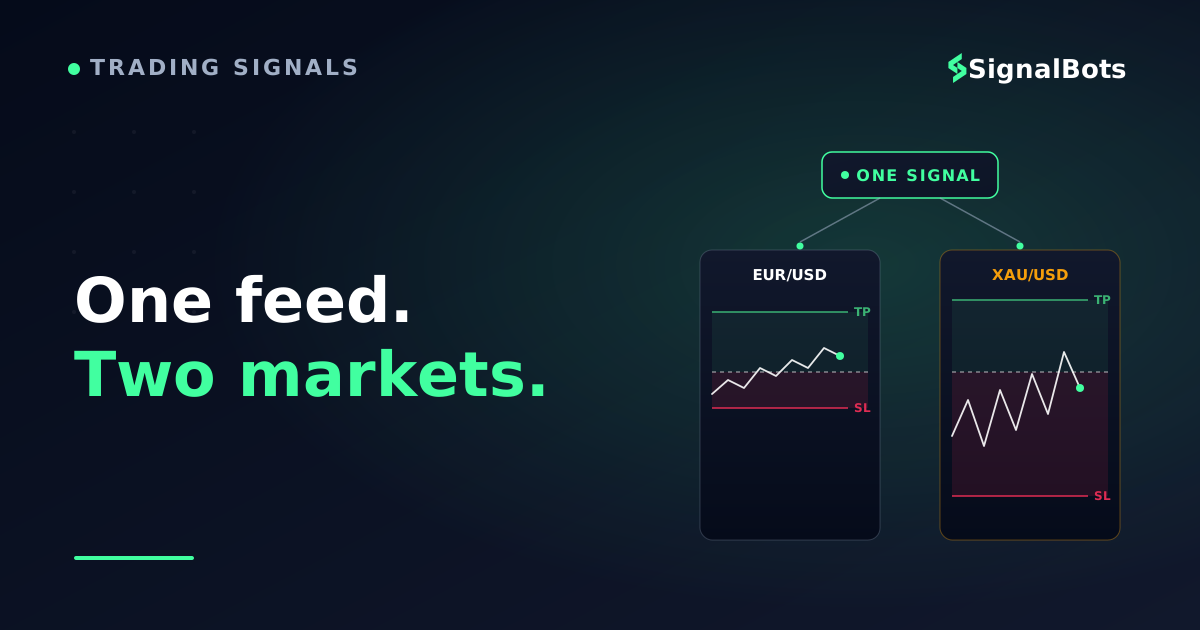
Your signal feed does not care what it is quoting. A buy on EUR/USD and a buy on XAU/USD arrive in the same envelope — direction, entry, stop, target, expiry — same format, same ping, sixty seconds apart. That sameness is exactly where mid-level traders get hurt, because the two instruments behind those identical messages do not move the same, cost the same per lot, or forgive the same mistakes.
If you run a feed that spans both markets — say a live forex signal feed alongside live gold (XAU/USD) signals — you need one routine and two translations. The routine never changes: validate the signal, translate it into a position size, execute with the exits attached, manage it to expiry. The translation layer changes every time the symbol does: what a unit of stop distance costs, how wide that stop needs to be, and which hours the market actually honors the setup.
This guide is that method. It assumes you already have a feed you trust — the question here is not where signals come from, but what you do in the sixty seconds after one arrives, and what changes in those sixty seconds when the symbol reads XAU/USD instead of EUR/USD.
The Part That Never Changes: Reading the Signal
Every professional-grade alert shares the same signal anatomy. Before you touch an order ticket, confirm all five fields are present and coherent:
Signal direction — buy or sell. On gold this reads exactly like a currency pair: buy means you profit if XAU/USD rises.
Entry price — the level the setup was priced from. Every other number in the signal only makes sense relative to this one.
Stop-loss — the level where the idea is wrong and the trade must end. This is the number your position size will be built from.
Take-profit — where the reward gets banked. Together with the stop, it defines the reward-to-risk ratio you are being offered.
Signal expiry — the setup's shelf life. A level-based idea decays as the market moves; expiry tells you when it is no longer valid even if price returns to entry.
With the fields confirmed, the routine is four moves:
Check freshness first. The gap between the provider's timestamp and your screen is signal latency, and on fast instruments it decides whether you are trading the setup or its echo. Compare the current quote to the entry price. A workable rule of thumb: if price has already traveled more than about a third of the stop distance beyond entry, the reward-to-risk you would actually get is no longer the one the signal priced — treat it as a stale signal and let it go. There will be another.
Confirm the geometry. Stop and target should sit behind visible structure, not at arbitrary round distances, and the implied reward-to-risk should be worth the trade. If a signal ever arrives without a stop, that is not a signal — it is a guess.
Translate risk into size. This is the step where forex and gold diverge hard, and it gets its own section below.
Execute with the exits attached, then manage to expiry. Stop-loss and take-profit go on the order ticket itself, never in your head. After that, your only jobs are honoring the expiry and resisting the urge to move the stop.
Fast delivery is what makes step one routinely pass instead of routinely fail — it is why we built our own pipeline around sub-10ms delivery. But whatever feed you use, the freshness check is yours to run: latency you do not measure is risk you did not price.
What Changes: Gold Is Not Just Another Pair
XAU/USD sits in the forex tab of most platforms and quotes like a pair, which quietly invites you to treat it as one more major. It is not. It is a commodity wearing a currency costume, and three differences change how you execute the exact same signal envelope: the dollar math per lot, the stop geometry, and the temperament of the tape.
Start with the dollar math, because it is the difference that costs real money on day one. On a standard EUR/USD lot, one pip of movement is worth about $10. A standard gold contract is 100 ounces, so a $1 move in the gold price is worth about $100 per lot. A gold signal whose stop sits $8 away is therefore risking $800 per standard lot — the kind of number that turns a routine losing trade into an account-shaking one if you sized it like a currency pair.
What actually changes
Execution factor
Forex major (EUR/USD)
Gold (XAU/USD)
Unit you think in
Pips (0.0001)
Dollars per ounce
Value per standard lot
About $10 per pip
About $100 per $1 move
Typical stop geometry
Tens of pips, behind a level
Several dollars, behind structure
Temperament
Session-bound, mean-reverting stretches
Trend bursts, news-sensitive, gap-prone
Spread behavior
Tight and stable in liquid hours
Wider, stretches hard around news
Sizing consequence
Standard lot math
Smaller lots for the same risk
Same signal envelope, different translation: the fields you read are identical, but every execution constant behind them changes with the symbol.
The second difference is stop geometry. A disciplined gold signal does not use a fixed pip count — it places the stop behind the structure that produced the setup, and on gold that structure is measured in dollars. Seen on the chart, the same five fields you just read as text look like this:
A gold signal on the chart
XAU/USD buy signal — where the levels actually sitXAU/USD1H
The stop sits behind the shelf that produced the setup — measured in dollars, not pips. Your position size, never your stop placement, absorbs that extra distance.
Notice what the wide stop is not: it is not extra risk. It is the same risk expressed over a longer distance — provided the next section's translation actually happens. A tight, forex-sized stop on gold feels safer and is usually the opposite: it sits inside the market's ordinary breathing room, where normal fluctuation — not a wrong idea — takes you out before the setup can resolve.
The Translation Layer: One Risk Budget, Two Lot Sizes
Here is the rule that makes one feed safely tradable across both markets: your risk budget is fixed in account currency; only the lot size floats. Decide your risk per trade — a fixed slice of the account — and rebuild the position size from each signal's own stop distance:
Position size = risk budget ÷ (stop distance × value per unit of distance)
Suppose a trader runs a $10,000 account and risks 1% per signal — a $100 budget. Two alerts arrive from the same feed:
XAU/USD buy, $8 stop. $100 ÷ ($8 × $100) = 0.125, rounded down to 0.12 lots.
Same envelope, same budget, same routine — and the gold position is around a third of the forex position by lot count. That shrinkage is not caution; it is the entire mechanism that lets gold's wider stop carry identical risk. The single most common gold-signal mistake is skipping this step and reusing a forex lot size out of habit, which silently triples the bet.
Try your own numbers
Same risk budget, two markets
Pick the instrument, set your risk and the signal's stop distance, and watch the lot size adjust so the dollar loss stays identical in both markets.
Account balance
$
Risk per trade
Instrument
Stop distance
pips / $
Risk budget
—
Position size
—
A $100 budget buys 0.40 lots against a 25-pip EUR/USD stop, but only about 0.12 lots against an $8 gold stop. The lot number shrinks; the risk does not.
Run your own numbers before the next signal arrives, not while it is ticking. For the per-pair versions of this math, the forex position-size calculator and the pip value calculator cover every major and metal.
Timing: When Each Market Honors Its Signals
An entry price is not a trade — an entry price at an hour with real liquidity is. The same level, hit at two different times of day, can produce a tight fill that follows through or a wide fill that drifts sideways until expiry. So the third translation is temporal.
Currency majors have session personalities — yen pairs wake up in Tokyo, EUR and GBP crosses come alive with London — the pair-by-pair version of that clock our guide on trading currency pairs with signals maps in full. Gold is more concentrated. Its decisive moves cluster around London and New York — above all the window where the two overlap and the US data calendar lands. Outside those hours the gold book thins out, spreads stretch, and slippage quietly eats the edge the signal priced at the moment it fired.
Timing the same entry
FX and gold hours on one UTC clock24-hour clock · times in UTC
UTC timeline
SydneyTokyoLondonNew York
21:00–24:0021:0000:00–6:00–6:00
0:00–9:000:00
7:00–16:007:00
12:00–21:0012:00
000306091215182124
London + New York12:00–16:00 UTC · Peak liquidity for gold & majors
Sydney + Tokyo0:00–6:00 UTC · Thin gold book, wider spreads
Sydney
Tokyo
London
New York
Overlap (peak liquidity)
Gold's cleanest signal follow-through clusters in the London–New York overlap. The same XAU/USD entry taken in Asian hours often fills wider and drifts instead of following through.
Automated systems encode this as a trading session filter — the bot simply refuses entries outside its liquid window. Trading manually, you are the filter: an XAU/USD signal landing deep in the Asian session deserves an extra beat of skepticism that the identical EUR/USD signal would not.
And if your alerts arrive through a channel — say a gold signal Telegram channel — read the timestamp against the session, not just against the clock; a signal can be fresh by the minute-hand and still be in the wrong hour for its market. The forex market hours tool shows where you are on that clock right now.
When Both Fire at Once: Choosing Your Setup
One feed covering two markets means one inbox where a EUR/USD signal and an XAU/USD signal will eventually land in the same minute. Taking both by reflex is the wrong default, and the reason is a trap most mid-level traders meet the hard way: correlation. Gold and the euro often trade as expressions of the same idea — the direction of the US dollar. Long gold plus long EUR/USD is frequently not two positions; it is one short-dollar bet at double size, and it will win and lose as one.
So when two signals compete, run the checks in a fixed order — budget, correlation, session, and only then reward-to-risk, the same discipline our guide to managing risk on AI forex signals builds from scratch:
Choosing between setups
Two fresh signals — which one do you take?
Take itProceed with careSkip / stand aside
Budget first, correlation second, session third — only then does reward-to-risk break the tie.
The order matters because each check is cheaper than the one after it. Budget is a number you already know. Correlation is one question: do these both need the dollar to move the same way? Session is a glance at the clock above. Only the final comparison requires judgment — and by then, at most one clean candidate is usually left standing.
Run It as a Checklist
Method survives pressure only when it stops being a decision and becomes a sequence. Everything above compresses into eight ticks — run them in order, every signal, both markets:
The routine, compressed
Before you act on the next forex or gold signal
0 / 8
Signal is fresh — price has not run more than about a third of the stop distance past entry
All five fields are present: direction, entry, stop-loss, take-profit, expiry
Instrument identified: pip math for a currency pair, dollar math for gold
Position size recalculated from this signal's stop distance — not copied from the last trade
Total open risk, including correlated dollar exposure, still fits inside your cap
Session window suits the instrument — no thin-hours gold entries
Stop-loss and take-profit are attached to the order ticket, not kept in your head
You know what invalidates the setup before its expiry
★
Checklist complete — you’re cleared to proceed.
The first four ticks are the constant routine; the middle three are the translation layer that flexes between forex and gold; the last one is what separates managing a trade from watching one.
One Routine, Two Translations
The feed formats a EUR/USD signal and a XAU/USD signal identically because the reading really is identical — five fields, four moves, one risk budget. What must never be identical is the translation: gold's dollar-per-lot math shrinks the position, its structure-based stops widen the distance, and its session profile narrows the hours you should act. Hold the routine constant, swap the translation per symbol, and one feed serves both markets without either market distorting the other.
The method only has something to work on when the signals themselves are complete and fast enough to still be fresh when you read them. Our live signal feeds across every market ship all five fields on every alert — so the sixty seconds this guide trains are the only sixty seconds you need.
FAQ
Should I risk the same percentage on gold signals as on forex signals?
Yes — the fixed percentage is the point of the whole system. Your risk budget per signal stays constant in account currency; what changes between markets is the lot size that budget buys, computed from each signal's own stop distance. If you find yourself lowering the percentage specifically for gold, that is usually a sign the sizing step is being skipped and fear is standing in for math.
Why is a gold stop-loss so much wider than a forex stop?
Because it is placed behind structure, and gold's structure is drawn in dollars. XAU/USD routinely covers more ground in a session, in risk terms, than a major pair does — so the levels that define a setup sit further from entry. A wider stop is not more risk if the position is sized from it; a forex-width stop on gold is usually more risk in practice, because ordinary fluctuation triggers it before the idea gets a chance to be right or wrong.
Can I act on a gold signal during the Asian session?
You can, but you should know what you are paying for the privilege: a thinner book, a wider spread, and follow-through that often waits for London anyway. Unless the provider explicitly designs its gold setups for those hours, treat an Asian-session XAU/USD alert with extra skepticism — or note the levels and revisit the setup when the liquid window opens, if it has not gone stale or expired.
What if price has already passed the entry when I see the signal?
Measure, don't chase. Compare how far price has traveled beyond entry against the signal's stop distance — past roughly a third of it, the reward-to-risk you would actually receive is meaningfully worse than the one the signal priced, and the correct action is to skip. Chasing a moved entry at the original stop and target quietly converts a good setup into a mediocre one. Missing a trade costs nothing; mispricing one does.
Do forex and gold signals expire differently?
The expiry field works the same way in both markets — it marks when the setup's logic stops being valid — but gold's faster tape tends to invalidate levels sooner, so its expiries often run shorter in practice. Either way the rule is identical: the stated expiry is a hard boundary, not a suggestion. A signal that has expired is not a discount; it is a setup whose reasoning no longer exists.
Sources & Further Reading
Want to go deeper? These independent, authoritative sources shaped this guide — each one is worth reading in full:
The Forex Desk is the SignalBots editorial team responsible for our currency-market coverage. We research and write the guides, explainers and reference articles on how the majors, minors and crosses actually trade — sessions, spreads, swaps and the macro releases that move price.



Discussions 0
Leave a comment