By mid-morning, your free signal channel has already posted three alerts: a EUR/USD buy, a GBP/JPY sell, and a USD/CHF buy marked "act fast." You took the first, hesitated on the second, chased the third after price had already moved — and by Friday you honestly can't say whether the channel is good, bad, or whether you'd even know the difference.
That scattered result is common, and it usually isn't the channel's fault. Free daily signals fail most traders for one reason: they arrive as events and get traded as impulses. The fix is not a better channel — it is a routine that turns every alert into the same short, repeatable decision.
This guide builds that routine piece by piece: how to read a signal's anatomy, where to source free daily signals and vet the provider behind them, the five-gate filter that decides take-or-skip, and the guardrails that stop free alerts from becoming overtrading.
The routine at a glance
How a free daily signal becomes a trade
1
Signal lands
The provider posts pair, direction, entry, stop and target to your channel — Telegram, push or a dashboard.
2
Read the anatomy
You decode the five fields and pull up the chart yourself before doing anything else.
3
Check freshness
Compare the current price to the entry and confirm the setup hasn't expired or gone stale.
4
Filter the risk
Reward-to-risk, position size and your daily caps decide whether you trade — not the alert.
5
Execute and log
Place the order with stop and target attached, then journal the outcome — win, loss or skip.
Five repeatable moves separate traders who use signals from traders who chase them.
Key Takeaways
A complete signal states pair, direction, entry, stop-loss and take-profit — treat anything less as a tip, not a trade plan.
Judge a free provider by its own history — full anatomy on every post and losses left on the record — never by advertised win rates.
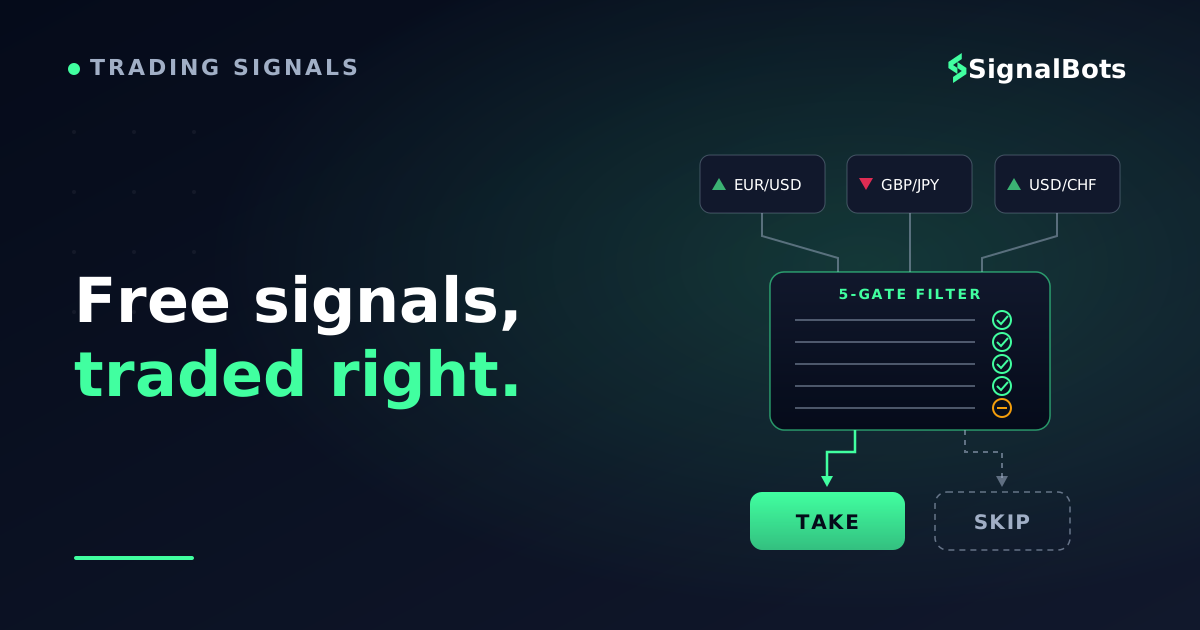
Run every alert through the same five gates: completeness, freshness, reward-to-risk, position size, and your daily caps.
Signal frequency is a marketing metric; your filter — not the channel's output — decides how often you trade.
Table of Contents (33 min read)Contents
What a Daily Forex Signal Actually Contains
Strip away the emojis and formatting, and every usable trading signal answers the same five questions:
Pair — what to trade (EUR/USD, GBP/JPY).
Direction — buy or sell.
Entry — the price or zone where the idea is valid.
Stop-loss — the price where the idea is proven wrong and the trade ends at a controlled cost.
Take-profit — where the reward is banked (some providers stagger two or three targets).
A well-built daily signal adds two more elements: a rationale — one or two lines on why the call exists (a level break, a session pattern, a model's confidence reading) — and a validity window that tells you how long the entry stays actionable. Here is how those fields translate onto a chart:
Signal anatomy
EUR/USD — what a complete buy signal looks like on the chartEUR/USD1H
Illustrative example. Risk is 24 pips, reward is 48 — a 2:1 structure you can verify in seconds once you can place every field on the chart.
The numbers in this example do real work. Entry 1.0842 with a stop at 1.0818 defines a 24-pip risk; the target at 1.0890 offers 48 pips of reward, so the trade carries a 2:1 reward-to-risk ratio. That ratio — not the win rate a channel advertises — is the first number your routine will judge signals by.
The Two Fields Beginners Skip — and Shouldn't
The validity window matters because a signal is built at a moment in time. Providers cap that lifespan with a signal expiry — explicit ("valid until London close") or implied by the timeframe. Suppose EUR/USD has already covered 20 of those 48 pips by the time you open the app: entering now roughly halves your reward while your distance to the stop grows, so the 2:1 trade you were offered no longer exists. Acting on it anyway means trading a stale signal — the same words, materially worse maths.
The rationale line earns its place differently. Reading why a provider called the trade teaches you their method over time, which is how a signal channel becomes a learning tool instead of a dependency. Its absence is also a vetting datapoint: a provider who never explains a call is asking for blind trust — exactly what this guide is here to remove.
Where to Get Free Daily Signals — and How to Vet the Source
Free forex signals reach you through a handful of delivery channels, and the channel shapes how usable the signal is by the time you see it:
Telegram channels — the default home of free signals. A public Telegram signal channel broadcasts instantly and, crucially, keeps a scrollable history you can audit before trusting it.
Provider dashboards — a web page listing live and recent calls with their status; our live forex signals feed works this way, showing each signal's full anatomy as it updates.
Push notifications — a signal notification sent straight to your phone is the fastest route to your attention, which matters when validity windows are short.
Email and forums — the slowest lane. Fine for reviewing a provider's thinking; poor for acting on intraday entries.
Speed is not a luxury here. The freshness gate you'll apply in a moment is far easier to pass when alerts reach you by push or Telegram than when they wait in an inbox.
The Free-Provider Vetting Checklist
Price tells you nothing about quality on its own — free channels range from genuinely good acquisition funnels to outright fabrications, which is why our ranked, vetted shortlist of forex signal groups applies the same checks below across the market's biggest names. Before a channel earns a place in your routine, check six things against its own history:
Full anatomy, every time. Entry, stop and target on every post. A channel that omits stops even occasionally fails the audit.
Losses on the record. Scroll back: losing calls should still be there, marked as losses — not deleted or quietly edited.
Stable cadence. A professional signal frequency looks like a steady rhythm tied to market sessions, not silence for days and then a burst of ten calls when volatility makes headlines.
Honest language. Any promise of "guaranteed profit" or "risk-free" returns is a disqualifying red flag, not marketing enthusiasm.
A consistent session pattern. Good providers publish in predictable windows (say, London morning) — it means a process exists behind the posts.
A rationale on most calls. Per the section above: explanation invites scrutiny, and scrutiny is what you're vetting for.
One more red line: a signal provider never needs your account credentials, and a channel that pressures you to deposit with a specific broker "to receive the signals" is monetizing you, not informing you — the exact playbook our guide to spotting Telegram forex signal scams walks through in full. Walk away from both.
What a Free Tier Really Gives You
Most free channels are the visible edge of a paid service, so expect structural limits — fewer pairs, fewer sessions, sometimes a delay relative to the paid feed; the trade-offs are covered in our glossary's VIP vs free signals breakdown. For this guide's purpose, that's fine: a free tier is entirely sufficient to build the routine below and to find out — at low cost — whether a provider deserves any deeper commitment.
A Daily Routine That Makes Signals Repeatable
The difference between using signals and chasing them is that a routine converts a stream of alerts into a dataset you can judge. Four blocks, all short:
Before the session (10 minutes). Check the economic calendar and mark the news windows you won't trade around. Set two caps in advance — the maximum trades you'll take today and the maximum total risk you'll hold open at once. Then decide when you're actually available: a signal you can't manage is a signal you skip.
When an alert lands (5 minutes). Run the five-gate filter from the next section, in the same order every time. The order is deliberate — the cheap checks come first, so most skips cost seconds.
After each trade (2 minutes). Log it: source, time, pair, the gates it passed, size, outcome. Log the skips too — a stale signal you refused that went on to lose is direct evidence the routine is working.
Weekly (15 minutes). Read the log and compare two tracks: the provider's raw calls versus the subset your filter passed. Judge both only over a meaningful sample size — weeks of entries, not a hot Tuesday. If neither track holds up, drop the channel without regret; it was free, and so is leaving.
The Five-Gate Take-or-Skip Filter
This is the heart of the method — the part that replaces blind following with a decision you control. Every alert, however exciting, walks the same tree:
A new signal just landed — take it or skip it?
Take itProceed with careSkip / stand aside
The cheap gates come first, so most skips cost you seconds — and skipping is always free.
Gates one to three use only what's in the message and on the chart. Gates four and five come from your plan, which is why two traders can act differently on the same signal and both be right.
Sizing: the Gate That Does the Heavy Lifting
The single most protective habit in signal trading is fixing your risk per trade as a small percentage of the account — a common convention is around 1% — and deriving position size from the signal's stop distance every single time. The provider chooses the stop; you choose what that stop is allowed to cost you.
Try your numbers
Position size per signal
Set your account, risk percentage and the signal's stop distance — the result is the size that keeps every alert at the same fixed, survivable risk.
Account balance
$
Risk per signal
Stop distance
pips
Pip value per standard lot
$
Position size
—
Cash at risk
—
Risk if you took 5 today
—
Notice the third readout: at 1% per signal, five unfiltered alerts quietly put 5% of the account on the line in a single day.
Suppose you hold a $1,000 account and risk 1%: the EUR/USD example above (24-pip stop, $10 per pip per standard lot) sizes to roughly 0.04 lots, and a full loss costs $10 — an outcome you can absorb dozens of times while your weekly reviews do their work. Want the mechanics handled for you across account currencies and pairs? Use our free forex position size calculator.
Don't Follow Blindly: False Signals and Overtrading
A false signal is an alert that was valid at issue and failed anyway — the breakout reversed, the level didn't hold. Every provider produces them, free or paid, human or algorithmic, because a signal is a probability statement about an uncertain market, not a prediction. The defense is never "find a channel with no losers" — no such channel exists, and one claiming otherwise is showing you a curated highlight reel. The defense is structural: the stop-loss caps what any one false signal can cost, the sizing rule keeps that cost identical across trades, and the journal reveals whether wins outweigh losses over a real sample. That structural view of risk is also why we publish a full risk warning alongside every signal surface we run.
Overtrading is the free-signal trap specifically: because each alert costs nothing, acting on it feels free too. It isn't — every trade spends real capital and real attention. In practice, overtrading on free alerts looks like three behaviors:
Stacking correlated calls — a EUR/USD long plus a GBP/USD long is closer to one doubled dollar-side bet than to two independent opportunities.
Revenge re-entries — taking a "recovery" signal minutes after a stop-out, before the loss has even been logged, let alone understood.
Session creep — trading hours you're never normally at the screen for, because the phone buzzed.
The guardrails are as unglamorous as they are effective: keep the daily trade cap you set each morning, stop after two consecutive losses and review before re-engaging, and pre-define a weekly loss level — a small, fixed slice of the account — that pauses signal trading until the following week. None of these rules require willpower in the moment; that is the point. You made the decisions before the market started pushing.
Your Next Step
You came into this guide with signals that felt random. The anatomy check, the vetting pass, the daily blocks and the five gates turn that same stream into something closer to a hiring process: the provider applies for your capital, every alert is an interview, and your journal makes the final call.
We started with
“Free signals traded on impulse, with results you couldn't explain”
and arrived at
One repeatable filter that decides which alerts deserve your capital.
The signals are free. The consistency is built.
Nothing in this routine requires a paid tier: the anatomy check, the freshness rule, the five gates and the journal work on any honest free channel. Run the process for a few weeks, let your log — not the channel's marketing — tell you whether the provider earns a place in your day, and let your sizing rule keep every alert survivable while you find out.
Yes — as decision support inside a routine, not as a strategy by themselves. A vetted free channel gives you a daily stream of structured trade ideas, which is genuinely valuable when you filter each one through your own risk rules. The value collapses the moment the signals are followed blindly, because you inherit the provider's losses at whatever size your impulses picked.
How many of a channel's daily signals should I take?
There is no correct number — there is a correct process. The five gates decide, and on many days the honest output is zero trades: entries expire before you're available, the reward-to-risk floor filters out thin setups, or your daily caps fill early. A disciplined filter typically passes a minority of a busy channel's alerts, and that is a feature, not a leak.
What should I do when I miss the entry price?
Treat the signal as expired and let it go. The entry, stop and target were designed as one package; entering late keeps the package's risk while shrinking its reward. Missing a trade costs nothing — there is no meter running — and the next qualified signal restores the same opportunity with clean maths.
Can I automate trades from a free signal channel?
Technically yes — copier tools such as a Telegram-to-MT5 copier can turn channel posts into platform orders automatically. Do it only after several weeks of manual logging have validated both the provider and your filter settings, because automation executes your process exactly as configured — including the freshness and exposure checks, which you must encode as rules since the tool won't hesitate on your behalf.
How long should I test a provider before trusting it?
Long enough for your journal to hold a meaningful sample of logged outcomes — think several weeks of consistent tracking, not a handful of trades. Watch behavior during losing stretches especially: a provider worth keeping posts losses openly, keeps its stops honest, and holds its cadence instead of doubling output to win back attention.
Sources & Further Reading
Want to go deeper? These independent, authoritative sources shaped this guide — each one is worth reading in full:
The Forex Desk is the SignalBots editorial team responsible for our currency-market coverage. We research and write the guides, explainers and reference articles on how the majors, minors and crosses actually trade — sessions, spreads, swaps and the macro releases that move price.



Discussions 0
Leave a comment