Fit judged from each broker's own platform and account docs, not a leaderboard.Match a broker to your engine →
A best-for-automation shortlist starts from what your bot needs to place an order, not what a manual trader clicks.
Key Takeaways
The broker that suits a human day trader can quietly break a bot — the make-or-break criteria are netting-vs-hedging, anti-scalping/minimum-hold rules, and whether it flattens you before close.
Match the broker to your engine first: an MT5 Expert Advisor, a cTrader Automate bot, and a REST/webhook executor each want a different account surface.
Intraday margin buys you more size during the session than you can hold overnight — your bot has to respect the flatten-before-close window or the broker does it for you at market.
This page is the hub: once the day-trading-specific fit is settled, the latency and API deep-dives are separate decisions for their own guides.
Table of Contents (21 min read)Contents
Why a 'best day-trading broker' list fails a bot
You searched for the best day-trading broker, but you already know the twist: you're not the one placing the trades. Your Expert Advisor, your cTrader bot, or your webhook executor is. And the broker that feels great to a human — slick app, one-tap orders, generous leverage — can quietly sabotage an automated intraday strategy in ways you only discover after a live account is already running.
The usual leaderboards rank on things a human notices: chart tools, mobile UX, education, a friendly onboarding flow. A bot doesn't care about any of that. A bot cares about a much smaller, sharper set of questions — and most of them never appear on a mainstream "best broker" page because they only bite when software, not a person, is at the keyboard.
This guide is the day-trading-specific answer for automation. It's the hub for choosing an intraday broker for a bot: the session and margin realities that shape when your bot can trade, the account-model traps that decide whether it can trade at all, and how to line the broker up with the engine you actually run. Two deeper rabbit holes branch off from here and get their own treatment: squeezing out the last milliseconds for a scalping bot where signal latency is the whole game, and picking a broker purely on its FIX/REST API surface. Follow those links when your strategy lives in one of them; this page settles the intraday fit they all sit on top of.
The three things that silently break an intraday bot
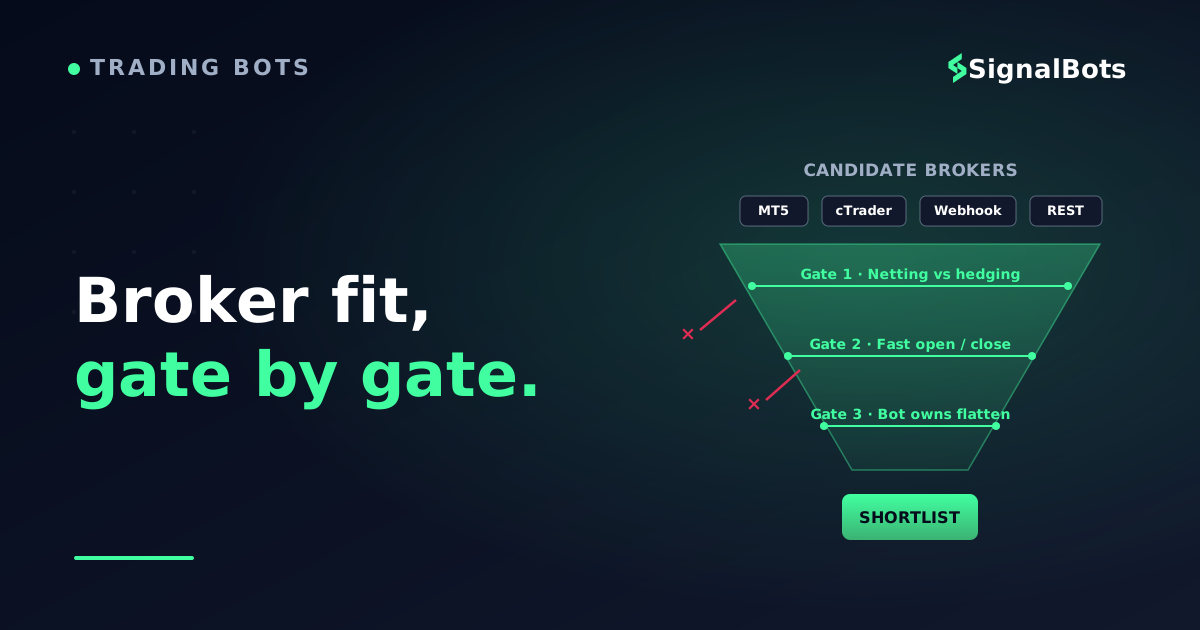
Before any latency or spread comparison matters, three account-level rules decide whether your bot can even execute its plan. Get one of these wrong and the strategy that backtested beautifully throws rejects, opens the wrong position, or gets liquidated at the worst possible second.
Netting vs. hedging. On a hedging vs. netting account, one symbol can hold several independent positions at once; on a netting account, a second order in the same symbol nets against the first. An intraday bot that layers into a position — or runs two sub-strategies on EUR/USD simultaneously — behaves completely differently on the two models. If your logic assumes hedging and the account is netting, your "add" becomes a "partial close" and the trade is now inside-out. Decide which model your engine assumes, then only shortlist brokers that offer it.
Anti-scalping and minimum-hold rules. Some brokers quietly forbid closing a trade within a set number of seconds, or void profits from trades held "too briefly." A human rarely trips this. A bot firing dozens of fast intraday entries trips it constantly — and you find out when a withdrawal is contested, not when the order fills. Any broker you'd hand an intraday bot to must permit fast open-and-close cycles in writing, not just tolerate them.
The flatten-before-close window. Intraday margin is generous because the position isn't meant to survive the session. Many brokers auto-close (or jack up margin on) open intraday positions in the final minutes before the session ends. If your bot doesn't own a trading session filter that flattens before that window, the broker flattens for you — at market, at whatever spread exists in the last illiquid minute.
The pre-flight check
Will this broker actually let my intraday bot run?
Take itProceed with careSkip / stand aside
Three account-level checks, in order. A single 'no' on netting-vs-hedging or anti-scalping is disqualifying before you ever look at spreads.
Run every candidate broker through these three gates before spreads or latency enter the conversation.
Match the broker to your engine, not the other way round
Here's the reframe that makes broker selection tractable: your bot's engine is the fixed constraint, and the broker is chosen to serve it. You don't pick a broker and then hope your automation works — you know how your strategy runs, and you shortlist brokers whose account surface speaks that language natively.
There are three broad engine families for intraday automation, and each wants a different thing from a broker:
An Expert Advisor running in MetaTrader 5 (or MT4) wants a broker that offers that exact platform, permits algo-trading on the account, and — for anything running unattended — a VPS for the EA so it survives a home internet drop.
A cTrader Automate bot (C#) wants a broker that actually offers cTrader, not just MetaTrader — a smaller field, so this one filters your list fast.
A webhook bot driven by a signal feed or a TradingView alert webhook wants a broker (or a bridge) that can receive an order over an API. On the automation-friendly forex/CFD side this is where a broker API deep-dive matters — a separate decision from the day-trading fit we're settling here.
The table below lines up common intraday engines against what to demand from the broker. Read it as "I run this, therefore I need a broker that offers that."
Engine-first shortlisting
Your engine
Non-negotiable from the broker
Nice to have
What breaks it
MT5 / MT4 Expert Advisor
That exact platform + algo-trading enabled
Free/low-cost VPS, hedging account
MT5 forced when your EA is MT4-only
cTrader Automate (C#) bot
Broker actually offers cTrader
Raw-spread / ECN pricing
MetaTrader-only broker — no cTrader
Webhook / API executor
An order API or a supported bridge
Documented REST/FIX endpoints
Closed platform, no programmatic orders
Copy / signal follower
Permits automated order relay to the account
Symbol names matching your signal source
Symbol-mapping mismatch silently drops orders
Start from the engine you already run. The broker's job is to serve it natively — anything in the last column is a hard filter, not a compromise.
A quick word on the account model itself. Whether a broker runs an ECN model or a market-maker book shapes your fills, but that's a broad execution-model question the whole broker-automation cluster shares — we won't re-teach it here. For an intraday bot the practical takeaway is narrow: an ECN/raw-spread account with a broker API or a well-supported platform is the safe default, because your automation gets consistent, programmatic access instead of a discretionary dealer sitting between it and the market.
Session timing is an intraday broker decision
For an intraday strategy, when your bot is allowed to trade is as much a broker choice as how. This is the part that genuinely separates day-trading broker selection from generic broker selection: an overnight or swing bot barely notices session structure, but an intraday bot lives and dies inside it.
Two things depend on it. First, liquidity: spreads tighten and ranges widen during the big session overlaps, so a breakout or momentum bot placed into the dead hours is trading a different, thinner market than it backtested on. Second, the broker's own order duration and intraday-margin behavior are keyed to the session — the generous margin and the forced flatten both live on the session clock.
So before you commit an intraday bot to a broker, know exactly which UTC hours it will trade and confirm the broker's session rules line up with them. The clock below is the map most FX intraday strategies are timed against.
When an intraday FX bot has real liquidity (UTC)24-hour clock · times in UTC
UTC timeline
SydneyAEDTTokyoJSTLondonGMT/BSTNew YorkEST/EDT
21:00–24:0021:0000:00–6:00–6:00
0:00–9:000:00
7:00–16:007:00
12:00–21:0012:00
000306091215182124
Tokyo + London7:00–9:00 UTC · Asian-European handover
London + New York12:00–16:00 UTC · Peak liquidity & volatility
Sydney
Tokyo
London
New York
Overlap (peak liquidity)
The London + New York overlap (12:00-16:00 UTC) is where intraday spreads tighten and ranges widen. Time your bot's session filter to it, and confirm the broker isn't forcing flatten inside the window you actually trade.
The practical rule: give your bot a session filter that keeps it inside the hours where its edge exists, and cross-check that window against the broker's flatten-before-close policy. If the broker's forced-flatten time lands inside your bot's active window, that's a mismatch — either the broker is wrong for this strategy or your bot has to exit earlier than its logic wants.
Intraday margin: more size, on a leash
Intraday margin is the reason day-trading brokers can offer more buying power inside a session than you're allowed to carry overnight. It's a genuine edge for a bot that turns positions over inside the day — but it comes with a string attached, and the string is automated.
The deal is simple: the broker lets your bot control a larger position during the session precisely because it expects the position gone by the close. Hold past the flatten window and one of two things happens — the broker re-margins the position to the (much higher) overnight requirement, or it flattens you outright. Neither is a decision your bot makes; it's a decision the broker makes to your bot.
That changes what "good margin" means for automation. A human day trader reads intraday margin as free leverage. An automated intraday strategy has to read it as leverage with a hard deadline — the extra size is only safe if the bot reliably exits before the broker's window. Size the position for the intraday allowance, but let the flatten time, not the margin number, govern the trade.
The illustrative math is worth internalizing. Suppose a broker gives four times the intraday buying power it allows overnight. Your bot can run a position four times larger during the session — but if a trade is still open when the window hits, that same position is now under-margined by a wide margin overnight, and the broker closes it at whatever price the last thin minute offers. The buying power was real; so was the leash.
Netting-vs-hedging match
Gate 1
Wrong model inverts your entries
Fast open/close allowed
Gate 2
No minimum-hold or anti-scalping clause
Bot owns the flatten time
Gate 3
Exit before the broker forces it
Clear all three gates before spreads, latency or API depth enter the decision.
The named shortlist — and why
With the gates and the engine-match settled, here are real, automation-friendly forex/CFD brokers worth putting on an intraday shortlist. Treat these as concrete candidates to verify against each broker's own current platform and account docs — not a ranking, and not a substitute for running each through the three gates above.
IC Markets — raw-spread ECN accounts that MT4/MT5 EAs are built for, plus native cTrader with its Automate (C#) environment. Hedging accounts and no anti-scalping restriction make it a strong default for fast intraday bots.
Pepperstone — offers MT4, MT5 and cTrader, so it fits whichever of the three engine families you run; raw-spread pricing suits turnover-heavy intraday logic.
FP Markets — raw ECN pricing and an EA-friendly MetaTrader setup; a solid pick when your engine is a MetaTrader Expert Advisor and you want tight raw spreads.
OANDA — the option to reach for when your engine is a webhook or REST-driven executor rather than a platform EA, thanks to its documented programmatic order access.
Notice what's not on this list: binary-options brokers and crypto exchanges. This is a forex/CFD automation shortlist, and a day-trading broker for an FX/CFD bot must be an FX/CFD broker — never a cross-market substitute. If you're automating a different market, that's a different shortlist entirely.
Wherever your bot's orders originate — a MetaTrader EA, a cTrader bot, or a signal feed — the piece that actually carries them to the account is a connector, and if you trade FX specifically, the forex signal pages show the live feed an intraday bot can be wired to. We settle the connector choice at the end of this page.
FAQ
Is the best day-trading broker also the best broker for a bot?
Not automatically. The best broker for a human day trader is judged on UX, education and app quality; the best broker for an automated intraday strategy is judged on account model, anti-scalping policy, platform/API fit and forced-flatten behavior. They can be the same broker, but only after you run it through the automation-specific gates rather than assuming the leaderboard already did.
What's the single most common day-trading broker mistake for automation?
A netting-vs-hedging mismatch. A bot written for a hedging account, run on a netting account, will have its "add to position" order net against the existing trade — quietly inverting the strategy. It backtests fine and breaks live, which makes it the hardest mistake to spot after the fact.
Does intraday margin help or hurt an automated strategy?
Both. It lets your bot control more size during the session, which can improve capital efficiency — but that size comes with a forced deadline. If your bot doesn't reliably exit before the broker's flatten window, the extra leverage turns into a forced liquidation at a bad price. Treat intraday margin as leverage on a leash, governed by your session filter.
Do I need a VPS for an intraday trading bot?
If the bot must run unattended through the session, effectively yes. An Expert Advisor or cTrader bot on your home machine stops the moment your internet or power drops, potentially leaving positions unmanaged. A VPS keeps the engine and its exit logic running independent of your local connection.
Should I pick the broker with the lowest latency for day trading?
Only after the fit questions are settled. Ultra-low latency matters most for scalping-grade strategies that live or die on milliseconds; for most intraday bots, getting the account model, session rules and platform fit right matters far more than shaving the last millisecond. If your strategy does hinge on fills, execution speed is the metric to chase — a real but secondary decision, and its own topic.
Can I automate a day-trading strategy through a webhook instead of an EA?
You came in for
“the best day-trading broker”
and what you actually need is
the one that fits your bot.
Pick the broker your engine can trade through — then wire the automation.
SB
SignalBots MT5 Connector
Once you've chosen an automation-friendly intraday broker, the connector relays your bot's or signal feed's orders into MetaTrader on that account — so the same broker fit works whether you run an EA, a cTrader bot, or a webhook executor.
The Cross-Market Desk is the SignalBots editorial team for topics that span every market — platform connectors, copy trading, partnership and IB programs, and the general mechanics of trading automation. We research and write the guides that apply no matter what you trade.



Discussions 0
Leave a comment